


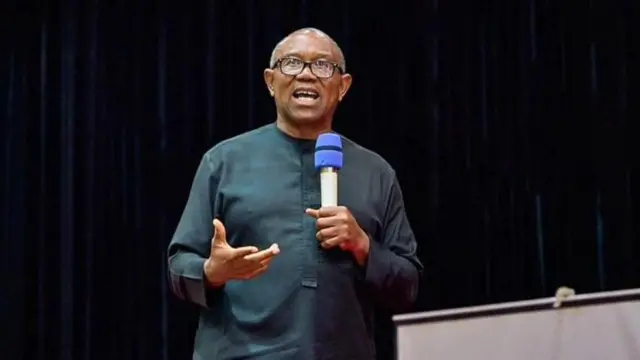
Peter Obi remains one of Nigeria’s most influential public figures because his power is not built on public office. He does not currently control the presidency, a state government, or the National Assembly. Yet, his name still shapes political debate, drives youth participation, and influences how many Nigerians judge leadership.
His influence comes from trust, visibility, discipline, and the movement he inspired during the 2023 presidential election. Obi ran under the Labour Party and came third with 6,101,533 votes, a major result for a candidate outside Nigeria’s two dominant parties, the APC and PDP. That performance proved that a third-force candidate could challenge the old political order and win national attention
New Daily Prime estimates his weighted influence score at 89.0/100, positioning him among Nigeria’s top public figures whose soft power has helped shape the country’s culture, global image and creative economy.
New Daily Prime Key Influence Metrics for Peter Obi
| Indicator | Reason |
|---|---|
| Current Power & Institutional Control | Peter Obi does not currently hold public office, but he remains one of Nigeria’s strongest opposition figures. His views still shape political debate and influence voter behaviour. |
| Reach & Visibility | He is widely discussed across traditional media, social media, public events, and diaspora platforms. His name remains central in national political conversations. |
| Impact & Tangible Results | His 2023 presidential campaign changed Nigeria’s political landscape by proving that a third-force candidate could compete strongly against the two dominant parties. |
| Soft Power & Cultural Influence | The Obidient movement became more than a campaign slogan. It became a political identity for many Nigerians who want accountability and better governance. |
| Relevance to 2026 | As Nigeria moves closer to the 2027 election cycle, Obi remains a major figure in opposition politics and a key voice in debates about leadership and reform. |
| Generational Influence | He has strong appeal among young Nigerians, professionals, students, first-time voters, and citizens seeking a new political direction. |
| National & International Recognition | He is recognised both in Nigeria and abroad as a major political figure, democratic voice, and former presidential candidate.
|
Weighted Influence Scorecard for Peter Obi
| Indicator | Weight | Score | Points |
|---|---|---|---|
| Current Power & Institutional Control | 15% | 6.7/10 | 10 |
| Reach & Visibility | 15% | 10/10 | 15 |
| Impact & Tangible Results | 15% | 8.7/10 | 13 |
| Soft Power & Cultural Influence | 15% | 10/10 | 15 |
| Relevance to 2026 | 15% | 9.3/10 | 14 |
| Generational Influence | 15% | 10/10 | 15 |
| National & International Recognition | 10% | 10/10 | 10 |
| Total Weighted Influence Score | 100% | — | 92/100 |
Formula: Weight × Score = Points.
Why Peter Obi Is So Influential
Peter Obi’s strongest asset is credibility. Many of his supporters see him as a politician who speaks about the issues that affect ordinary Nigerians: jobs, education, security, waste in government, public debt, production, and the cost of governance. His message is not built around noise. It is built around the idea that Nigeria can be managed better.
The rise of the Obidient movement is one of the clearest signs of his influence. What started as support for one candidate became a wider political identity. It attracted students, young professionals, traders, religious groups, digital activists, and Nigerians abroad. The movement also showed that social media could move from online debate to real political action. The 2023 election saw strong youth participation, and many young voters rallied behind Obi and the Obidient movement.
Obi also changed the way Nigerian politicians speak to voters. Before his rise, many campaigns depended heavily on party structure, ethnic loyalty, money politics, and old political networks. Obi pushed a different message: competence, prudence, character, and accountability. Even his critics had to respond to those themes. That is influence.
Read related news:
Peter Obi, Kwankwaso join NDC: 10 things to know about new party
Peter Obi explains exit from ADC, cites ‘toxic’ politics, state interference
Iginla: Only Peter Obi can give Tinubu tough challenge in 2027
His relevance to 2026 is also clear. Nigeria is already moving toward another major election cycle, and any serious conversation about opposition politics includes Peter Obi. Reuters reported in 2026 that Obi was among the key opposition figures involved in moves to challenge President Bola Tinubu’s political advantage before the next election.
However, his influence has limits. He does not currently hold executive power. He cannot directly sign budgets, control security agencies, appoint ministers, or implement national policy. That is why his score for institutional control is lower than his score for visibility, soft power, and generational influence.
But influence is not only about office. It is also about the ability to shape public thinking. On that measure, Peter Obi ranks very high. He has made millions of Nigerians believe that politics can be about ideas, not only party machines. He has also shown that young voters can become a major force when they are organised around a clear message.
Peter Obi’s power is the power of belief. His supporters see him as a symbol of discipline, accountability, and a different kind of leadership. His critics may question his structure, strategy, or ability to win power, but they cannot ignore his impact. That is why a 92/100 Weighted Influence Score is justified. He remains one of the most influential Nigerians because he turned public trust into a national political movement.

