


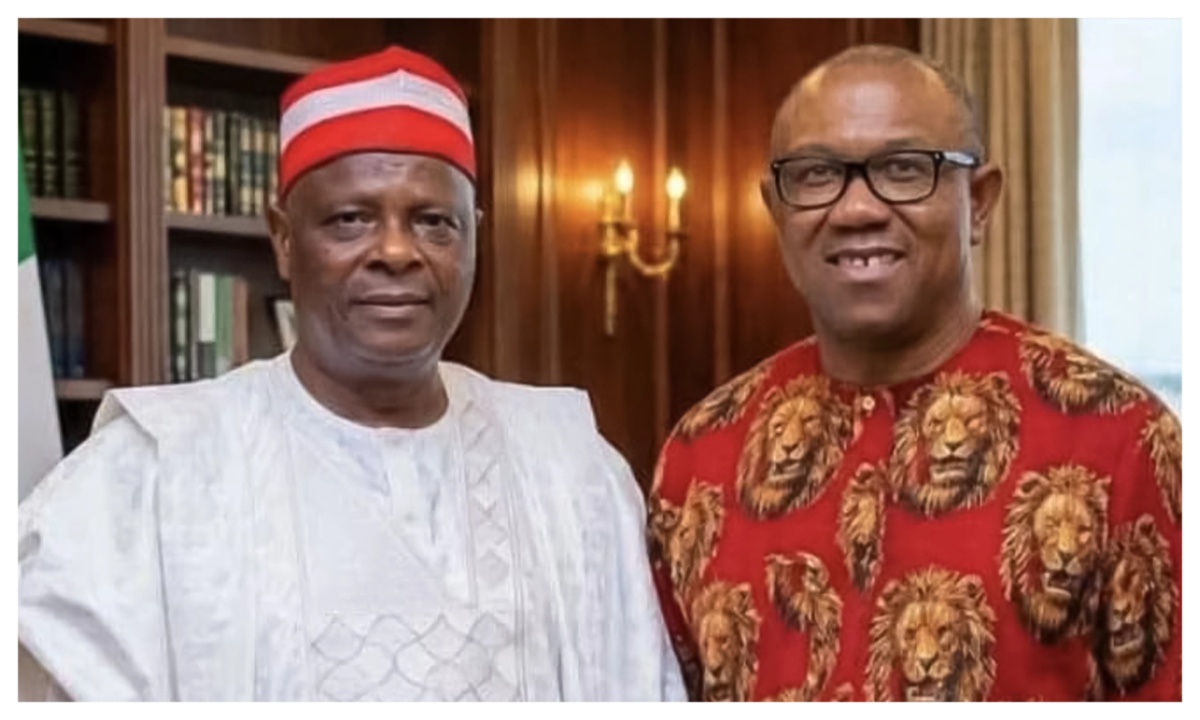
Former Anambra State governor Peter Obi is facing fresh political resistance in parts of northern Nigeria as discussions around his possible 2027 presidential bid continue to gather attention.
Some northern political voices say Obi and his proposed alliance with former Kano State governor Rabiu Kwankwaso may struggle to gain wide support in the region. The concern is tied to the visibility of their party, the Nigeria Democratic Congress, and the level of trust voters are willing to place in the alliance.
According to the Punch, messages criticising the Obi-Kwankwaso ticket have been circulating on some WhatsApp platforms in the North. Some of the materials reportedly described the pair as “haram”, meaning forbidden.
The same report said some angry youths in Ungogo Local Government Area of Kano State burnt campaign posters bearing the faces of Obi and Kwankwaso. The incident has added to signs of early tension around the proposed political partnership.
The pressure also appears to be playing out within party ranks. A member of the Kano State House of Assembly, Muhammad Tomas, who recently left the All Progressives Congress for the NDC, has returned to the APC.
The National Publicity Secretary of the Arewa Consultative Forum, Prof. Tukur Muhammad-Baba, said the NDC had not yet become a strong political brand among ordinary voters in the North.
According to him, the party is still largely unknown across many communities, despite the national attention around some of its leading figures.
Read related news:
Kwankwaso denies protest, warns against political misinformation
Kwankwaso hinted at possible NDC-ADC alliance ahead of 2027 elections
Adeboye: Peter Obi urges youths to reject ethnic, religious division
Muhammad-Baba said Kwankwaso remained a major name in northern politics, but added that his influence outside Kano was uncertain. He also questioned whether the former Kano governor could still command the same level of support he enjoyed during the 2023 presidential election.
He said many voters were now more careful about political promises and alliances because past expectations had not produced better living conditions.
Muhammad-Baba also argued that northern voters were becoming tired of politics built mainly around religion, ethnicity and regional identity. He said many people now want leaders who can provide practical answers to insecurity, poverty, unemployment and poor governance.
The debate around Obi’s image in the North has also resurfaced.
According to the Punch, the President of the Arewa Youth Consultative Council, Zaid Ayuba, claimed that many northerners did not trust Obi because of what he described as his position on the Indigenous People of Biafra.
Ayuba said Obi would need to give a convincing explanation of his views before he could be accepted by a large section of northern voters. He insisted that his position was not based on religion or ethnicity, but on justice and national security concerns.
A political science professor in Sokoto also argued that the NDC’s biggest challenge in the North may be visibility. The academic, who spoke anonymously, said the party had little presence in states such as Kaduna, Jigawa, Benue, Plateau, Katsina, Gombe, Niger, Taraba and Zamfara.
According to the professor, the NDC remains largely unknown to ordinary voters when compared with bigger parties such as the APC, PDP and ADC. However, supporters of the Obi-Kwankwaso alliance have rejected claims that the NDC is being rejected in the North.
In Borno State, the NDC chairman, Haruna Amuda, said the party was gaining members and had structures across all 27 local government areas of the state. He said thousands of people, including members of rival parties, were moving into the NDC.
In Jigawa State, party chieftain Abdulrazak Birnin-Kudu said coordinators had been appointed in all 27 local government areas, with mobilisation also taking place at ward level. He said young people were playing a major role in the party’s growth.
The party’s governorship candidate in Jigawa, Aminu Dutse, said economic hardship and insecurity had created space for new political platforms. He said the NDC now had candidates for all elective positions ahead of 2027, though the party still had to convince voters that it could deliver real change.
The Northern Region Director of the Civil Liberty Organisation, Steve Aluko-Daniel, also dismissed claims that the NDC had no support in the region. He said northern politics was no longer controlled by one dominant bloc and that voters were now free to support candidates of their choice.
According to him, no single political figure has inherited the support base of former President Muhammadu Buhari. He said this had created room for new movements, including the NDC.
Aluko-Daniel also said the North was returning to “talakawa” politics, a form of grassroots politics focused on ordinary people.
The National Co-Chairman of the NDC Coalition Alliance Network, Zakari Garba, said the party was expanding through youth groups, women’s organisations, professionals and grassroots volunteers.
He described the Obi-Kwankwaso partnership as a strong political combination, saying Obi was respected for economic management while Kwankwaso had deep grassroots experience in the North.
Still, critics believe the alliance faces a difficult test. Some northern groups have accused Kwankwaso of abandoning regional political interests by aligning with Obi. The Northern Youth Assembly said the move was a betrayal of what it described as the original ideals of the Kwankwasiyya movement.
The group said northern voters deserved leaders who would place the region’s interests at the centre of political decisions.
Efforts to reach some NDC officials and leaders of the Obidient Movement were not successful at the time of the original report.
For now, the race is still taking shape. The NDC says it is gaining ground, while critics argue that it remains weak and poorly understood in many northern states.
What is clear is that the Obi-Kwankwaso alliance will need more than name recognition to win over sceptical voters. It will have to build trust, strengthen local structures and answer difficult questions before the 2027 election gathers full momentum.

