


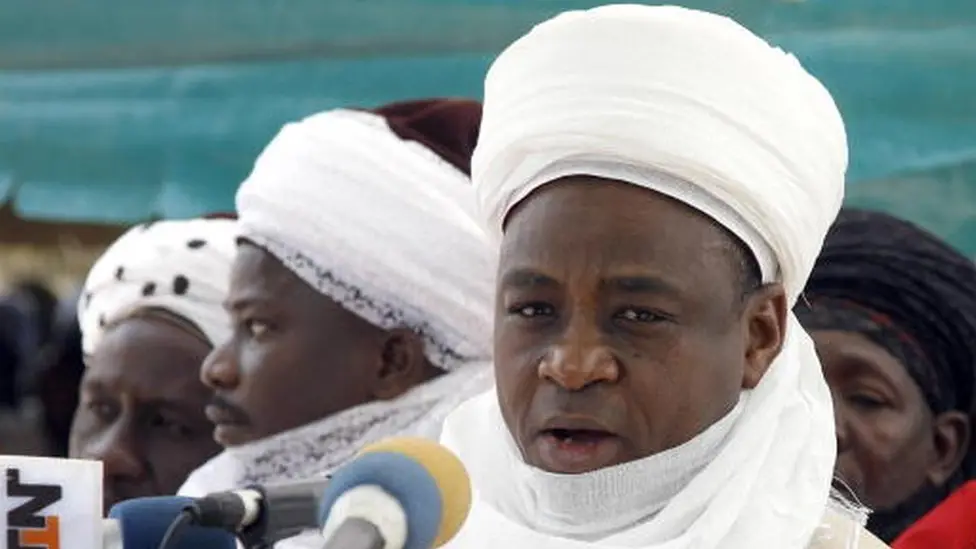
Muhammadu Sa’ad Abubakar III, the Sultan of Sokoto, remains one of Nigeria’s most influential figures because his authority touches faith, tradition, national unity and political access. He is not an elected leader, but his words can shape religious observance, calm public tension and reach the highest levels of government.
New Daily Prime estimates his weighted influence score at 91.0/100, placing him among Nigeria’s top national figures. His score is justified because few Nigerians combine spiritual authority, traditional legitimacy, national access, peacebuilding influence and international recognition at the same level.
New Daily Prime Key Influence Metrics for Sultan of Sokoto
| Indicator | Assessment |
|---|---|
| Current Power & Institutional Control | The Sultan does not hold elected office, but he has strong institutional influence through the Sokoto Sultanate and his role as President-General of the Nigerian Supreme Council for Islamic Affairs. |
| Reach & Visibility | His public statements and religious announcements reach millions of Muslims across Nigeria and receive national media attention. |
| Impact & Tangible Results | His influence is seen in Ramadan and Eid announcements, peace messages, interfaith dialogue, and national conversations on insecurity and unity. |
| Soft Power & Cultural Influence | His strongest influence comes from faith, tradition, history and the moral authority attached to the Sokoto throne. |
| Relevance to 2026 | He remains highly relevant because Nigeria continues to face insecurity, religious tension, economic hardship and political division. |
| Generational Influence | His influence reaches older and younger Muslims through religious guidance, education messages, peace advocacy and national moral leadership. |
| National & International Recognition | He is widely recognised in Nigeria and abroad as one of the leading Muslim and traditional authorities, including recognition in global Muslim influence rankings. |
Weighted Influence Scorecard for Sultan of Sokoto
| Indicator | Weight | Score | Points |
|---|---|---|---|
| Current Power & Institutional Control | 15% | 8.7/10 | 13 |
| Reach & Visibility | 15% | 9.3/10 | 14 |
| Impact & Tangible Results | 15% | 8.7/10 | 13 |
| Soft Power & Cultural Influence | 15% | 10/10 | 15 |
| Relevance to 2026 | 15% | 9.3/10 | 14 |
| Generational Influence | 15% | 8/10 | 12 |
| National & International Recognition | 10% | 10/10 | 10 |
| Total Weighted Influence Score | 100% | — | 91/100 |
The Sultan’s first source of power is his position as Nigeria’s leading Muslim authority. The Nigerian Supreme Council for Islamic Affairs lists him as its President-General, while the council describes itself as the body recognised by federal and state governments for coordinating Islamic affairs in Nigeria. That gives him a practical national role, not just a ceremonial title.
Read related report:
Eid-el-Fitr to hold Friday as moon is not sighted — Sultan
FACT-CHECK: Did Sultan of Sokoto flee after US soldiers arrived in Nigeria?
Olubadan hails Sultan of Sokoto as model of religious tolerance, national unity
His authority is also felt in everyday religious life. In March 2026, the Sultanate Council declared Friday, March 20, 2026, as Eid-el-Fitr after the Shawwal crescent was not sighted. The announcement helped determine the end of Ramadan and the day of celebration for Muslims across Nigeria.
This is one of the clearest examples of his real-world influence. His office helps coordinate moon-sighting reports and gives direction on major Islamic observances, including Ramadan and Eid. For millions of Nigerian Muslims, that role affects worship, family plans, public holidays and national religious unity.
The Sultan’s relevance in 2026 also comes from Nigeria’s security and social challenges. During his Eid-el-Fitr message in Sokoto, he called for stronger measures against insecurity and urged Muslims to continue praying for peace, unity and prosperity in Nigeria.
His reach extends beyond Muslim communities. The Nigeria Inter-Religious Council says the Sultan co-chairs the body with the President of the Christian Association of Nigeria. NIREC was created to promote understanding, peace and religious harmony between Nigeria’s major faiths.
That interfaith role is central to his national value. In a country often strained by religious tension, ethnic division and insecurity, the Sultan can speak across communities. He can sit with Christian leaders, traditional rulers, governors, ministers and community figures without the burden of partisan politics.
His international profile also remains strong. In 2025, he attended a summit at the Oxford Centre for Islamic Studies, where he called for unity and dialogue as tools for peace and social harmony. The event brought together Muslim world leaders and was opened by King Charles III, the centre’s Grand Patron.
His recognition abroad was further strengthened in 2026 when he was reported to have been ranked 17th in the 2026 edition of The Muslim 500: The World’s 500 Most Influential Muslims. The ranking cited his religious leadership, peace advocacy and wider role in global Muslim affairs.
The Sultan’s soft power is rooted in the Sokoto throne itself. The office carries the history of the Sokoto Caliphate and the legacy of Usman Dan Fodio. This gives the Sultan a moral and historical weight that many elected officials do not possess.
His background also strengthens his public image. Before ascending the throne, he served in the Nigerian Army and rose to the rank of Brigadier General. He became the 20th Sultan of Sokoto in 2006 after the death of his elder brother, Sultan Muhammadu Maccido.
His influence has limits. He does not control the presidency, state budgets, security agencies, federal appointments or the National Assembly. His authority is moral, religious and traditional. It can guide public behaviour and national conversation, but it cannot always enforce policy outcomes.
Still, the Sultan of Sokoto stands out because his authority does not depend on elections. His power comes from trust, history, faith and access. Unlike most traditional rulers, his role carries national Islamic weight. Unlike politicians, he can speak to moral issues without contesting for office.
At 91.0/100, the Sultan of Sokoto ranks among Nigeria’s most influential personalities because he remains a bridge between religion and state, tradition and modern life, northern authority and national unity. His influence is not the power of command; it is the power of moral weight.

