


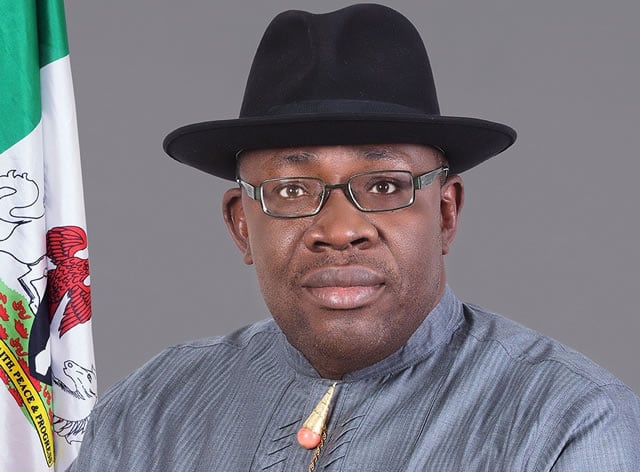
Former Bayelsa State Governor Seriake Dickson has voiced strong concerns over the current state of the Peoples Democratic Party (PDP), arguing that the party has drifted so far from its founding principles that it no longer resembles the platform he once knew.
Speaking during an appearance on Politics Today on Channels Television, Dickson rejected suggestions that he and others are abandoning the PDP. Instead, he maintained that the party itself has moved away from its original identity.
“Where we are now, it is not fair to say that I and others who are leaving now have left the PDP. It will be more appropriate to say that the PDP left me. PDP left us,” he said.
Read related news:
Successive govt failed to tackle terrorism decisively — Dickson
Ex-Bayelsa gov Dickson dumps PDP for NDC
“A Party That Has Lost Its Way”
Dickson described the situation as troubling, noting that a party once trusted by millions of Nigerians has, in his view, lost its structure, direction, and cohesion.
According to him, the PDP that existed in the early 2000s—when it dominated Nigeria’s political landscape—has effectively disappeared.
“It is very sad that before our very eyes our trusted and loved platform evaporated. That is different from leaving,” he added.
His remarks reflect a broader concern among party stakeholders about internal divisions and weakening unity within the PDP.
The former governor traced his political journey, explaining that he joined the PDP after leaving the Alliance for Democracy, where he served as National Legal Adviser.
Over the years, Dickson became a prominent figure within the PDP, contributing to its growth and national reach during its most influential period.
However, he argued that the current structure of the party no longer reflects the values that once made it appealing.
“The PDP as I knew it… has since been killed and buried,” he said, stressing that what remains cannot be compared to the party that once commanded nationwide support.
PDP’s Legacy of Power
Reflecting on the party’s history, Dickson pointed to its record of producing three consecutive Nigerian presidents, a feat that once established it as the country’s dominant political force.
He referenced the administration of Olusegun Obasanjo, who governed for eight years and played a key role in stabilising Nigeria’s democracy after military rule.
He also mentioned Umaru Musa Yar’Adua, whose tenure was cut short by his death, and Goodluck Jonathan, who completed Yar’Adua’s term and later won the 2011 presidential election.
“That was the PDP that was attractive,” Dickson said, highlighting what he sees as a sharp contrast between the party’s past strength and its current state.
Dickson’s comments come at a time when the PDP is facing internal challenges, including leadership disputes and shifting political alliances.
His remarks add to ongoing debates about the party’s future direction and its ability to remain competitive in Nigeria’s evolving political landscape.
With key elections on the horizon, questions remain about whether the PDP can rebuild its structure, restore internal unity, and reconnect with voters.
For now, Dickson’s position is clear: rather than leaving the party, he believes the party has left behind the principles that once defined it.

