


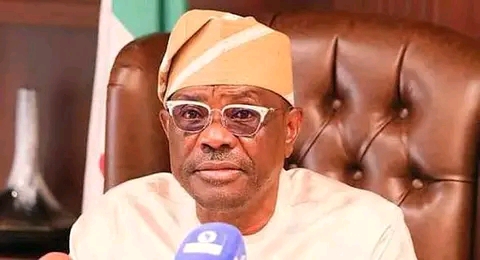
Federal Capital Territory Minister, Nyesom Wike, on Tuesday openly linked the wave of ongoing infrastructure projects across Abuja to the ruling All Progressives Congress’ electoral calculations ahead of the 2027 general elections, declaring that President Bola Tinubu would record improved political fortunes in the territory because residents were already “feeling the impact of governance.”
Wike made the remarks after inspecting several projects lined up for inauguration as part of activities marking Tinubu’s second anniversary in office.
Although FCT ministers traditionally showcase projects during administration anniversaries, Wike’s comments introduced a sharper political undertone, framing roads, judicial facilities, and satellite town interventions not only as governance efforts but as assets capable of reshaping voting behaviour in a territory historically difficult for the APC.
The minister argued that infrastructure delivery was beginning to alter public perception of the Tinubu administration, particularly in rural communities and satellite towns often overshadowed by development in Abuja’s city centre.
READ RELATED STORY
Eid-el-Kabir: FCT police deploy bomb disposal teams, tighten security
Wike urges FCT residents to support Tinubu, promises streetlights for communities
ADC FCT chapter backs David Mark leadership, calls for party unity
Wike said, “What reason would people have not to vote for Mr President now? How many governments before now have been able to impact satellite towns the way this administration is?”
He added that residents were more interested in practical governance than political rhetoric. He noted that ordinary Nigerians want roads, electricity, improved living conditions, and visible public investment.
The former Rivers State governor also pointed to recent Area Council election outcomes as evidence that support for the APC is expanding within the FCT.
For years, the opposition dominated presidential voting patterns in Abuja, with complaints regularly centred on uneven development between the capital city and surrounding settlements. Wike appeared to acknowledge that political reality indirectly by repeatedly emphasising interventions outside elite districts.
He cited the A2-Pai Road in Kwali as one of the administration’s symbolic projects, noting that it marked the first time a sitting president visited the area to inaugurate infrastructure.
Beyond roads, the minister inspected the rehabilitation of the Court of Appeal complex in Dakibiyu, judges’ quarters in Katampe, internal roads, and the relocation site for traders displaced from the Apo Mechanic Village.
According to him, work on the Dakibiyu court complex had reached about 70 per cent completion, while finishing touches were ongoing at several residential facilities being developed for judicial officers
Wike also disclosed that no fewer than 20 projects would be commissioned during the anniversary celebrations, though he suggested the number could rise as additional projects approached completion.
He said the ongoing interventions extended to Bwari, Karu, Gwagwalada, Gaduwa, Kabusa, and other districts where road construction, bridges, walkways, streetlights, and water infrastructure were at different stages of completion.
At the Apo relocation site, the minister stated that roads and streetlights had already been completed, while security and water facilities would commence shortly.
Wike further challenged opposition figures and coalition groups seeking power ahead of 2027 to physically inspect projects executed within the FCT rather than rely on political criticism from afar.
He said, “I wonder where the opposition or coalition members are. They should come and see what is happening in the FCT.”
His remarks come at a time political alignments are already gathering momentum nationally, with parties repositioning ahead of another election cycle despite the 2027 polls still being nearly two years away.
While the minister projected confidence that infrastructure delivery would strengthen APC’s standing in Abuja, critics of successive governments have often argued that public projects are frequently deployed as electoral instruments during politically sensitive periods.
Still, Wike maintained that the current administration’s development drive was inclusive and designed to improve living conditions across both urban districts and neglected rural communities within the Federal Capital Territory.

