



Britain and four major Western allies have warned Israel against launching a large-scale ground offensive in Lebanon, cautioning that such a move could trigger devastating humanitarian consequences and risk widening the conflict across the Middle East.
In a joint statement issued alongside Canada, France, Germany and Italy, the countries urged Israel to pursue an immediate de-escalation with Lebanese representatives and called for an end to attacks targeting civilians.
The warning followed Israel’s announcement that its forces had begun what the Israel Defense Forces (IDF) described as a “limited and targeted” ground manoeuvre inside Lebanon aimed at destroying the military infrastructure of Hezbollah, the Iran-backed militant group.
Western leaders fear that any expansion of the operation could escalate into a prolonged regional conflict.
Read related news:
Britain could mobilise 65‑year‑old reservists within next 12 months to fight in Ukraine
Starmer says Britain not involved in US strike on Venezuela
Britain’s longest railway bridge completed for HS2 project
Iranian troops destroy UK air defences, attack British Soldiers
“A significant Israeli ground offensive would have devastating humanitarian consequences and could lead to a protracted conflict. It must be averted,” the joint statement said.
The five nations also warned that the humanitarian situation in Lebanon had already reached alarming levels, citing ongoing mass displacement and rising civilian suffering.
“The humanitarian situation in Lebanon, including ongoing mass displacement, is already deeply alarming,” the statement added.
Lebanon was drawn into the wider Middle East conflict on March 2 when Hezbollah launched attacks on Israel following the killing of Iran’s Supreme Leader, Ayatollah Ali Khamenei. Since then, exchanges of cross-border fire between Hezbollah and Israeli forces have intensified, raising fears that the conflict could spread further across the region.
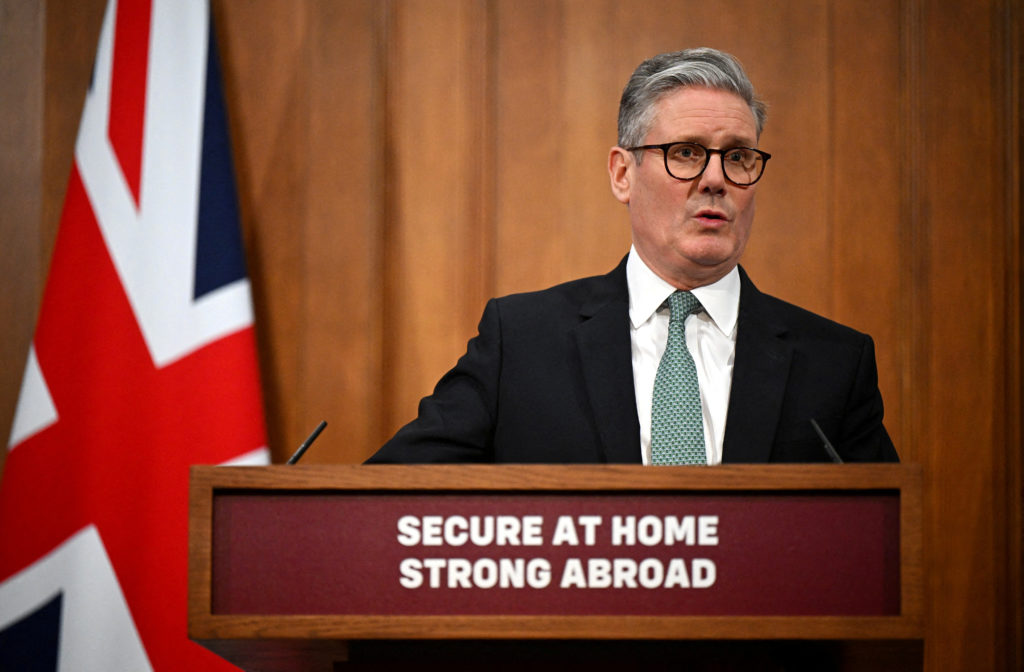
Amid the growing tensions, British Prime Minister Sir Keir Starmer defended his government’s decision not to join the United States-led offensive against Iran.
In a video posted on social media, Starmer said that deploying British troops to war was the most serious responsibility faced by any prime minister and must only be done after careful consideration of the national interest.
“I have been attacked by some for my decision not to join the offensive against Iran,” Starmer said. “But at every stage I have stood by my principles that our decisions should be based on a calm, level-headed assessment of the British national interest.”
He added that British service personnel deserved a “thought-through plan” and a clear legal basis before being sent into conflict.
Meanwhile, the European Union signalled that it has little appetite for expanding its military role in the region.
Kaja Kallas, the EU’s foreign policy chief and vice president of the European Commission, said there was no support among member states for broadening the mandate of the bloc’s existing naval mission in the Middle East.
“There was in our discussions a clear wish to strengthen this operation, but for the time being there was no appetite to change the mandate,” Kallas said.
The EU naval mission, known as Operation Aspides, was launched in February 2024 to protect commercial shipping from attacks by Yemen’s Houthi rebels in the Red Sea.
European foreign ministers have also discussed whether the mission could be extended to protect vessels navigating the Strait of Hormuz, a strategic oil route that carries roughly a fifth of the world’s crude supply.
However, Kallas stressed that diplomacy remains Europe’s preferred approach.
“We are working for diplomatic solutions regarding the Strait of Hormuz,” she said, adding: “This is not Europe’s war.”
Analysts warn that the escalating tensions involving Israel, Hezbollah and Iran could significantly increase the risk of a broader regional confrontation, with potential consequences for global security and energy markets.

