



The All Progressives Congress (APC) senatorial primaries for the 2027 general elections produced more than just a list of winners. Across several states, influential senators, former governors and long-standing party figures lost their return tickets amid fierce internal battles, shifting alliances, accusations of manipulation and growing resistance against entrenched political structures.
Read more breaking stories from our latest nigeria news
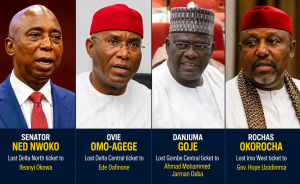
Among the biggest upsets was the defeat of Senator Ned Nwoko in Delta North, where former Delta State governor, Ifeanyi Okowa, secured a sweeping victory in the direct primary election.
Official results released by the party showed that Okowa polled 113,309 votes against Nwoko’s 2,612 votes, while another aspirant, Mariam Ali, received 40 votes.
Although party leaders did not officially state reasons for the outcome, the margin of defeat reflected Okowa’s enduring grassroots structure and influence in Delta North after years as governor. Nwoko, despite his growing visibility in the Senate and recent defection to the APC, appeared unable to match the political network built by Okowa across the district.
In Delta Central, another political heavyweight, former Deputy Senate President Ovie Omo-Agege, lost to incumbent Senator Ede Dafinone in what became one of the most surprising contests in the South-South.
Results announced by the APC National Assembly Primary Committee showed Dafinone secured 116,252 votes against Omo-Agege’s 3,643 votes.
The outcome suggested a sharp decline in Omo-Agege’s control of the district after losing the 2023 governorship election in Delta State. Dafinone’s camp also benefited from strong support among local party stakeholders who rallied behind the incumbent senator during the exercise.
Omo-Agege rejected the results and insisted he won the primary, further exposing deep cracks within the Delta APC.
In Gombe Central, former governor and serving senator, Danjuma Goje, suffered a crushing defeat after losing to former Deputy Commissioner of Police, Ahmad Mohammed Jarman Deba.
Deba polled 21,793 votes, while Goje secured 2,620 votes.
The result marked a major political shift in Gombe, where Goje had dominated the senatorial district since leaving office as governor in 2011.
His defeat is linked to growing agitation for generational change within the district, as younger political blocs pushed for a fresh candidate ahead of the 2027 elections. Deba’s emergence was also widely celebrated by supporters who described it as “a new political direction” for Gombe Central.
Former Imo State governor, Rochas Okorocha, also suffered a humiliating defeat in Imo West after losing to incumbent Governor Hope Uzodimma.
Official results showed Uzodimma polled 230,464 votes, while Okorocha secured only 1,098 votes.
The outcome reflected the prolonged political rivalry between both men, which has shaped APC politics in Imo State since Uzodimma succeeded Okorocha as governor. Uzodimma’s control of the party structure in the state, combined with the advantages of incumbency, gave him overwhelming dominance during the primary.
In Edo South, Senator Neda Imasuen lost to former House of Representatives member Omoregie Ogbeide-Ihama in a controversial exercise later trailed by conflicting claims and protests.
Results announced at the collation centre showed Ogbeide-Ihama polled 27,154 votes, while Imasuen received 13,580 votes. Former governorship aspirant Osagie Ize-Iyamu scored 6,785 votes.
Imasuen blamed his defeat on alleged manipulation and intimidation by party leaders. According to him, some ward leaders openly informed him before the primary that the party had already adopted a preferred aspirant, making consultations unnecessary.
After the exercise, he said: “There is nothing satisfactory about this sham election they conducted today.”
The senator also claimed that only loyalists of a preferred aspirant were allowed to participate freely during the voting process.
In Kogi East, Senator Jibrin Isah, popularly known as Echocho, lost his return ticket to Dr Erico Ameh after a bitter contest that immediately triggered accusations against Governor Ahmed Ododo’s political camp.
Isah alleged that election materials were hijacked and his supporters were frustrated during the primary. While vowing to challenge the governor politically, he declared: “The battle line has been drawn.”
His defeat highlighted Governor Ododo’s growing influence in Kogi APC politics and the apparent weakening of older political blocs in the state.
In Ogun East, former governor and incumbent Senator Gbenga Daniel lost momentum in the contest after his supporters withdrew from the primary over what they described as security concerns and an unfavourable atmosphere for a fair contest.
Governor Dapo Abiodun eventually emerged dominant in the district as the exercise tilted heavily in favour of the governor’s political structure.
Although Daniel did not publicly reject the process, the withdrawal of his supporters underscored Abiodun’s growing influence within Ogun APC and the difficulty older political blocs now face in challenging sitting governors who control party machinery at the state level.
Plateau State also witnessed internal discontent after former Plateau North aspirant Gyang Yaya Zi San was initially listed among aspirants barred from the race during the APC screening exercise before later being removed from the updated disqualification list released by the party.
The confusion surrounding the screening process triggered complaints among some party members and further reflected tensions over transparency and internal consultations within the Plateau APC ahead of the primaries.
Although Plateau did not record a high-profile upset comparable to Delta or Imo, the controversy surrounding screening and candidate clearance exposed lingering cracks within the party structure in the state.
Incumbent Senator representing Plateau Central Senatorial District, Diket Plang, also lost his bid for a return ticket after being defeated in the APC senatorial primaries held on Monday.
Businessman David Bitrus Barji emerged winner of the contest, defeating Plang and other aspirants by a wide margin. Returning Officer Saddat Garga announced that Barji polled 57,727 votes to clinch the party’s ticket.
According to the results, Senator Diket Plang came a distant second with 1,822 votes, while Usman Ephraim Gar, a serving state commissioner, secured 1,322 votes.
Beyond electoral losses, some influential figures failed to participate entirely after being screened out by the party.
In Rivers State, former deputy governor and serving senator Ipalibo Banigo, businessman Tein Jack-Rich, former Rivers Head of Service Tammy Danagogo, former Rivers commissioner Ojukaye Flag-Amachree and Kebbi South senator Garba Maidoki were among those disqualified.
Although the APC did not provide detailed reasons for each disqualification, Rivers recorded one of the highest numbers of aspirants barred from the exercise, reflecting the deepening power struggle within the party in the state.
Banigo openly criticised the screening process, arguing that the party failed to provide a level playing ground for women in politics.
At least 44 aspirants across the country were disqualified during the APC screening exercise. The party’s National Publicity Secretary, Felix Morka, said the screening followed established procedures and internal guidelines.
Across many states, the primaries were also marred by protests, allegations of imposition, consensus arrangements and claims of intimidation, exposing continued internal tensions ahead of the 2027 elections.
Despite the controversies, APC leaders insisted the exercises were largely peaceful and transparent and maintained that the primaries reflected the party’s internal democratic process as preparations intensify for the next general election.

