


Families from ethnic minority communities have been forced to leave their homes after several nights of racist and anti-immigrant violence across Belfast and other parts of Northern Ireland.
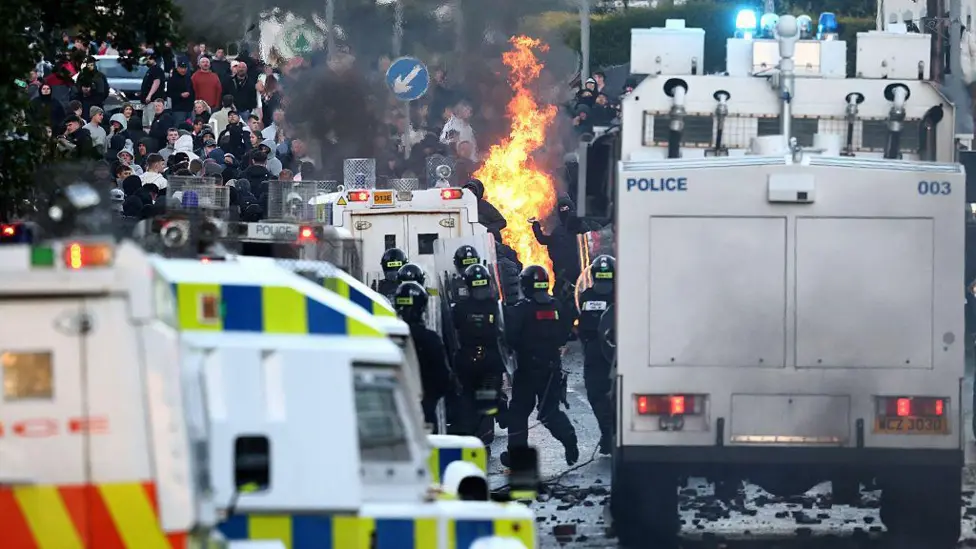
Masked groups attacked houses, businesses and vehicles, while rioters threw masonry, fireworks and flares at police. Cars and buildings were set on fire, roads were blocked and public transport services were disrupted.
The disorder began after a knife attack in north Belfast on the evening of Monday, June 8. A graphic video of the incident was recorded by a passer-by and quickly spread across social media.
Stephen Ogilvie, 44, suffered serious injuries and was taken to hospital. A 30-year-old Sudanese man, Hadi Alodid, was arrested at the scene and later charged with attempted murder and other offences.
The allegations against him have not been proved, and the criminal case remains before the courts.
The suspect alone is accused of the knife attack. His nationality does not connect other Sudanese people, refugees or immigrants to the alleged offence.
Within hours of the footage appearing online, posts began circulating with times and locations for anti-immigration protests. Some posts focused heavily on the suspect’s background, while others gave instructions for roadblocks and urged businesses to close.

Read related news:
Security breach near white house as Afghan immigrant shoots two guards
Charities face rising threats amid anti-immigrant tensions
Farage unveils radical plan for mass deportations of immigrant, ECHR exit
The first major demonstrations took place on Tuesday. Some gatherings remained peaceful, but violence broke out elsewhere as hundreds of people, including masked men, moved through parts of Belfast.
Homes believed to be occupied by immigrants were damaged or set on fire. Cars, buses and bins were burned, while businesses linked to minority communities were also targeted.
The violence continued into Wednesday in Belfast, Glengormley, Portadown and other areas. Protests or disturbances were also reported in places including Coleraine and Derry.
In Glengormley, police said officers came under sustained attack from people throwing masonry and flares. A bin lorry, a car and a vacant building were set on fire, while a hijacked van was pushed towards police lines.
Officers used water cannon and plastic bullets during the most serious disorder. Reinforcements were brought in from Great Britain to support the Police Service of Northern Ireland.
At least 12 police officers were injured during the unrest. Police initially reported 16 arrests, with the total later rising as officers continued to identify suspects. Some people have since been charged, while further arrests are expected as investigators review CCTV, mobile-phone recordings and social-media material.
By Thursday night, police reported a calmer situation, although protests continued in several locations and the wider security operation remained in place.
Families left afraid to return home
The attacks have created fear among immigrants, refugees and other ethnic minority residents.
Some families were taken from their homes after buildings were attacked or threatened. Community workers said people had become afraid to go to work, visit shops or allow their children outside.
Residents reported masked groups stopping people in the street, following workers and recording vehicle registration numbers. A nurse was reportedly chased by masked men while travelling through the city.
For some Sudanese residents, the disorder recalled the violence they had fled before coming to Northern Ireland. Others said they were considering leaving Belfast because they no longer felt protected.
Community volunteers responded by cooking meals, delivering food and offering temporary shelter to people who were frightened to leave their homes.
Local organisations said the attacks were carried out by a small minority and did not represent the wider Belfast community. Residents from different backgrounds also offered support to displaced families.
Claire Hanna, leader of the Social Democratic and Labour Party, described the violence as a “race-based pogrom”.
Speaking in Parliament, she said children had been lifted from their beds as homes burned and that masked men had moved through streets threatening people because of their skin colour or the sound of their voices.
Northern Ireland Secretary Hilary Benn condemned the disorder as “racist thuggery”. First Minister Michelle O’Neill and Deputy First Minister Emma Little-Pengelly also called for the violence to stop.
Prime Minister Keir Starmer said there would be no tolerance for such scenes and warned that those responsible would face the full force of the law.
Officials praised communities that provided shelter and support to displaced residents. However, campaigners have called for stronger protection, emergency accommodation and financial help for families and businesses affected by the attacks.
Questions over the police response
The disorder has also raised questions about how quickly police were able to protect homes and businesses.
In some locations, small groups of officers appeared unable to intervene immediately because they were heavily outnumbered. Police later deployed additional units, water cannon and other public-order resources.
The PSNI said officers had been working day and night to identify those involved. It appealed for videos, photographs and information from members of the public.
The use of plastic bullets is subject to independent review. Human-rights groups have raised concern about their use, particularly where children may be present during disorder.
Police said lawful protest would be facilitated but warned that attacks on homes, businesses, minority communities or officers would be treated as criminal activity.
Social media helped violence spread
Social media played a central role from the beginning of the crisis.
The knife-attack video spread rapidly across Facebook, TikTok and X. It was followed by speculation about the suspect’s immigration status and calls for protests.
Some posts listed roads that organisers wanted blocked. Others gave protest times and locations. More alarming material included a list of residential addresses believed to be connected to immigrants.
Police said the people living at the named properties had been left distressed and warned that sharing their addresses had placed lives at risk.
Far-right activist Stephen Yaxley-Lennon, who uses the name Tommy Robinson, promoted protest information online. X owner Elon Musk shared one of his posts, increasing its reach.
Ofcom, the UK communications regulator, said some of the disorder appeared to have been encouraged online. It warned social-media companies that their platforms must not be used to stir racial hatred, provoke violence or support other criminal activity.
The regulator contacted online service providers and reminded them of their duties under the Online Safety Act. It has also called for platforms to introduce crisis-response systems capable of slowing the spread of illegal content during periods of violence.
The central question is no longer only who posted the original video, but how quickly platforms responded when it was followed by threats, address lists and calls for confrontation.
Economic anger redirected at minorities
Much of the serious disorder took place in working-class unionist areas of Belfast.
Northern Ireland’s history has long been shaped by conflict between mainly Protestant unionists, who support remaining in the United Kingdom, and mainly Catholic nationalists, who favour Irish unity.
The 1998 Good Friday Agreement helped end decades of violence known as the Troubles. However, unemployment, poverty, poor housing and weak public services remain serious problems in some communities.
Brexit has also increased feelings of political and economic uncertainty among some unionists.
Observers warn that these concerns are being redirected towards immigrants who have little or no control over housing shortages, wages, public services or government policy.
Similar unrest has occurred elsewhere in the UK, where violent crimes involving minority suspects have been used by far-right networks to promote wider hostility towards migrants.
Northern Ireland also experienced serious racist disorder in Ballymena and other towns in 2025.
Political leaders have said immigration policy can be debated peacefully, but attacking people because of their race, nationality or language is not protest.
The family of the knife-attack victim also appealed for calm and rejected violence against immigrants.
The unrest began with an alleged crime involving two individuals. It then became collective punishment against families and workers who had no connection to the attack.
For those driven from their homes, the crisis is not an abstract debate about immigration. It is a question of whether they can safely return to their streets, reopen their businesses and trust the authorities to protect them from further attacks.

