


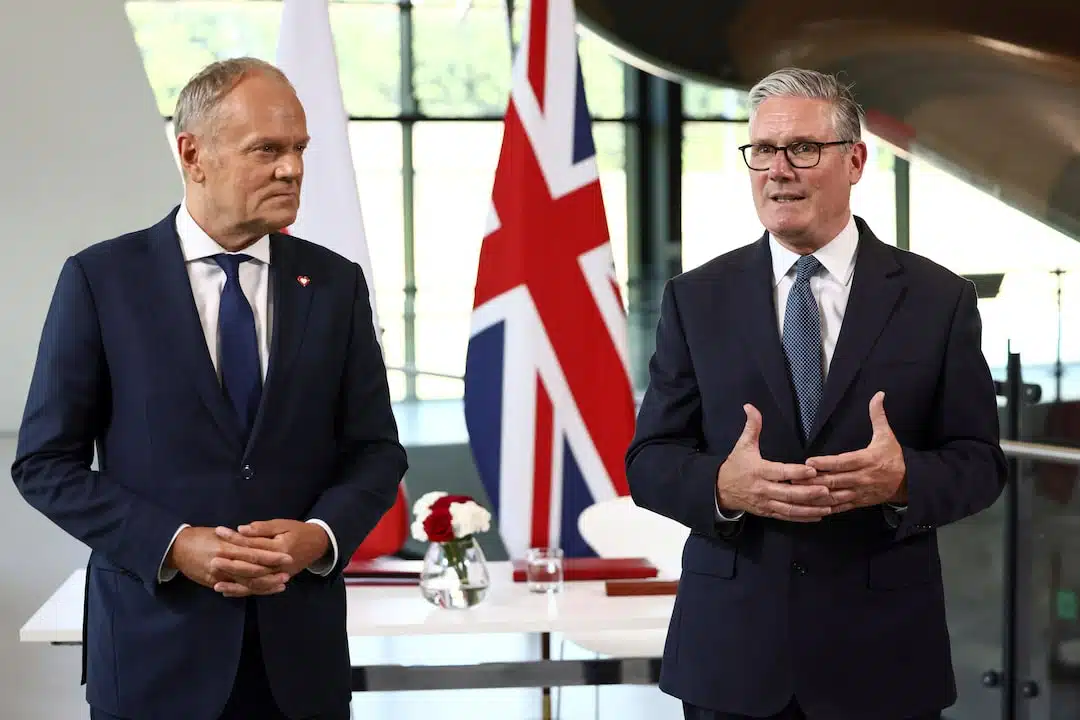
Keir Starmer has revealed that Russian aggression remains the biggest challenge facing the UK and Poland as both countries signed a new defence and security agreement.
Starmer held talks with Polish Prime Minister Donald Tusk at RAF Northolt in west London to formalise the agreement.
The UK Prime Minister said the pact comprises creating defence jobs, boosting cyber defence, securing borders more effectively, and breaking up organised crime groups, describing the agreement as a “generational uplift” in the relationship with Poland.
Giving his reason for the agreement, Starmer said: “There’s no greater challenge for either of our countries than the challenge of Russian aggression, and we see that not just in Ukraine itself, but beyond Ukraine, impacting our own countries,” Starmer said.
“So that’s the context in which we sign what is actually a generational uplift in the relationship on security and defence between our two countries,” he added.
Speaking through an interpreter, Tusk noted that the UK and Poland’s “shared values”, including the rule of law and human rights, formed the “foundation of the agreement”, adding that “they are important for us and for our nations.”
Read related report:
UK Prime Minister faces pressure to quit as party searches for alternative
Blair says Labour needs clear plan before any move against Keir Starmer
Russia hits Ukraine with massive overnight strike
The treaty aims to deepen cooperation between the UK and Poland in security and defence, while also preparing both countries for wider challenges across Europe.
It describes Russia as the “most significant long-term threat” to Euro-Atlantic security and calls for stronger efforts to counter its “malign actions.”
The agreement also reaffirms the UK and Poland’s “ironclad commitment” to NATO and identifies migrant smuggling as a shared challenge requiring joint solutions.
However, the defence adviser at The D Group and senior associate fellow at the RUSI think tank, Ed Arnold, criticised the efficacy of the deal and its difference from past agreements.
“I’m a bit confused why we’ve decided to add an additional treaty to that relationship already,” he said, mentioning existing agreements between the two countries in 2018 and 2023.
Arnold stated: “The main parts of it are actually less on defence and security that are new, but more actually about migration and related security issues.”
In his view, he added: “I see a bit of a risk within the document itself of broadening the relationship with Poland, but there’s nothing in there that is this sort of generational change or however the PM described it.”
Read more on The New Daily Prime

