


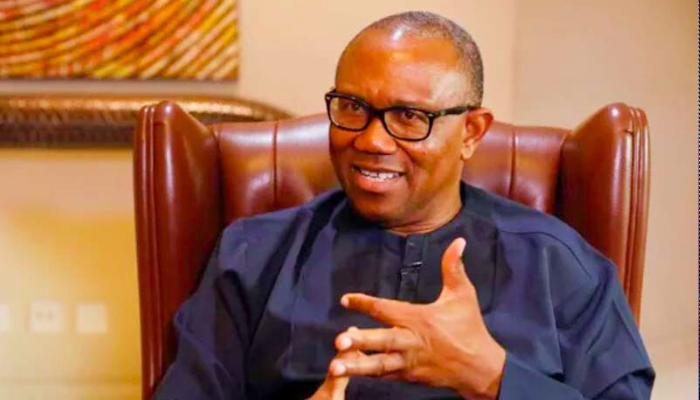
Former presidential candidate of the Labour Party, Peter Obi, has raised concerns over massive revenue leakages in Nigeria, citing findings by the World Bank.
In a statement on Saturday, Obi described it as “deeply troubling” that about N34 trillion — representing roughly 41 percent of federation revenue — did not reach the Federation Account within three years.
“This sum exceeds the combined N34 trillion earmarked for capital projects in the 2024 and 2025 Appropriation Bills… This is not a mere oversight; it points to institutionalised corruption on a massive scale,” he said.
According to data referenced from the World Bank’s Nigeria Development Update, federation revenue rose from N17.08 trillion in 2023 to N29.45 trillion in 2024 and N37.44 trillion in 2025, totalling N83.97 trillion.
However, deductions also surged — from N6.22 trillion in 2023 to N13.38 trillion in 2024 and N14.93 trillion in 2025 — amounting to N34.53 trillion before distribution to federal, state, and local governments.
The World Bank warned that such deductions are “quietly eroding” funds available for governance, as allocations to agencies are made at source, reducing fiscal space for development.
Obi said the situation reflects a troubling paradox in public finance.
“We are trapped in a lethal paradox: earning more as a nation, yet having less to invest in healthcare, education, and infrastructure,” he said.
Linking the trend to development outcomes, he added that the leakages help explain why countries with fewer resources outperform Nigeria in key sectors.
“With such a broken system, how can we fix power, strengthen our schools, build resilient healthcare, or develop critical infrastructure? Nigeria has no business being poor,” Obi stated.
He also drew parallels with the 1994 Okigbo Panel Report, which uncovered $12.4 billion in unaccounted oil revenue, warning that a more severe situation may now be unfolding with little public reaction.
Obi called for urgent reforms, urging transparent and disciplined leadership to curb leakages and redirect resources toward national development.
“We must stop these leakages through disciplined, transparent leadership driven by character… With our collective resolve to change this corruption-infested system, a New Nigeria is possible,” he said.
