


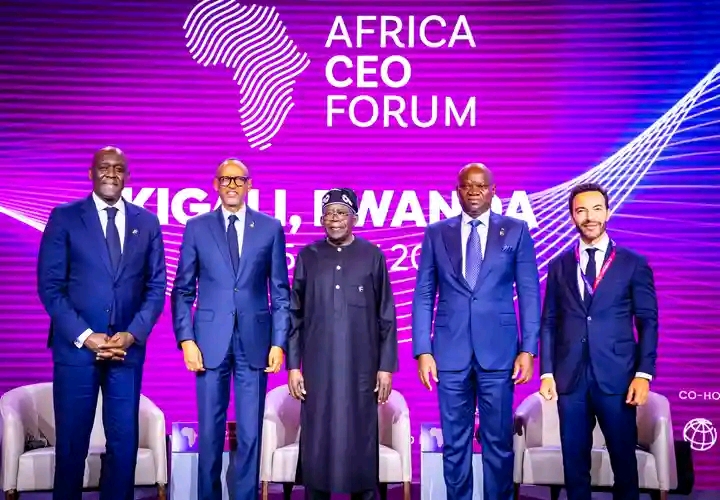
President Bola Tinubu’s recent defence of fuel subsidy removal at the Africa CEO Forum in Kigali, Rwanda, has reignited national debate over Nigeria’s rising debt profile and the long-term economic direction of his administration.
Speaking before investors and African business leaders on the 14th and 15th of May, 2026, Tinubu justified the removal of petrol subsidy by arguing that Nigeria could no longer continue “eating the future” of unborn generations, a statement that has since triggered fresh conversations around public borrowing, fiscal discipline, and the real impact of economic reforms on ordinary Nigerians.
While the President framed subsidy removal as a necessary step towards protecting future generations, many Nigerians are now asking why the country continues to accumulate significant debt barely three years after the policy was introduced.
The debate is gradually shifting from whether subsidy removal was necessary to whether the hardship accompanying the policy is producing visible national value.
Since Tinubu announced the end of fuel subsidy in May 2023, Nigerians have faced steep increases in petrol prices, transportation costs, electricity tariffs, and food inflation. Businesses across several sectors have also struggled with higher operational costs amidst foreign exchange instability and declining consumer purchasing power.
Government officials have consistently defended the policy, insisting that subsidy payments had become fiscally unsustainable and largely benefited smugglers and entrenched interests rather than ordinary citizens.
In Kigali, Tinubu again presented the policy as an intergenerational economic decision, arguing that continued subsidy spending would have amounted to mortgaging Nigeria’s future.
However, public concern appears to be widening beyond the subsidy itself. Many citizens are now curious to know whether the sacrifices demanded by current reforms are translating into measurable economic restructuring capable of improving long-term national productivity and living standards.
Nigeria’s debt burden remains one of the central issues driving that concern. Despite the subsidy removal, the Federal Government has continued to pursue both domestic and external loans during rising fiscal pressures, debt servicing obligations, and economic instability.
READ RELATED STORY:
Atiku slams Tinubu’s security approach as ex-lawmaker dies in kidnappers’ custody
Ayodele raises alarm over Tinubu’s 2027 run
Yilwatda backs Tinubu’s Northern Economic agenda, warns against political interference
APC: Faleke picks forms for Tinubu’s 2027 run
APC receives Tinubu’s nomination forms as Shettima leads high-level delegation
That development has created what many Nigerians considered a difficult contradiction. If subsidy payments represented borrowing against the future, some citizens argue, then continued debt accumulation after subsidy removal raises questions about the broader fiscal direction of the government.
Economic experts have long maintained that borrowing itself is not necessarily harmful if tied to productive investments capable of expanding national output. That is, governments around the world routinely borrow reasonably to finance infrastructure, transportation systems, industrial projects, education, healthcare, and energy development.
But the central issue now is whether current borrowing is producing assets that are strong enough to justify the hardship citizens are enduring.
Questions are increasingly being raised about whether the loans being accumulated are improving electricity supply, reducing transportation costs, modernising healthcare facilities, strengthening public schools, or creating conditions capable of stimulating industrial growth and employment.
Sadly, the economic pressure, to a large number of households, has become severe. Inflation continues to affect food prices and household spending, while wage growth has struggled to keep pace with rising living costs. Small businesses also continue to battle unstable electricity supply, currency volatility, and high operating expenses.
Against that background, Tinubu’s Kigali remarks have resonated beyond the investor conference where they were delivered. Although the President was addressing economic reforms and long-term fiscal sustainability, many Nigerians interpreted the comments as a broader justification for ongoing economic sacrifice.
That interpretation has intensified demands for greater transparency, fiscal accountability, and visible evidence that reforms are producing sustainable national gains.
Public concern has also extended to issues of government spending and cost of governance. Even among supporters of subsidy removal, questions still persist over whether political leaders and public institutions are demonstrating the same level of austerity being demanded from citizens.
Economic reforms, realistically, often depend heavily on public trust and confidence. Citizens are generally more willing to endure temporary hardship when they can clearly see evidence of responsible spending, reduced waste, and long-term developmental planning.
Tinubu’s administration has repeatedly defended its economic policies as necessary corrections to years of structural distortions within the Nigerian economy. Government officials have pointed to increased state allocations, investor engagement, and infrastructure plans as evidence that reforms are beginning to reposition the economy.
But for many Nigerians, macroeconomic explanations alone are no longer enough. Citizens increasingly want visible and measurable outcomes: they want stable electricity, lower food prices, functioning public schools and hospitals, improved security among others.
Most importantly, they want clear proof that present hardship is laying the foundation for a more stable economic future. That expectation may eventually become one of the defining tests of Tinubu’s economic reforms.
Historically, major economic reforms in several countries have often involved periods of social hardship before long-term stability emerged. But economists note that such reforms usually succeed when governments maintain fiscal discipline and ensure that citizens can visibly see the benefits of sacrifice over time.
What often generates public frustration, however, is prolonged hardship without corresponding institutional improvement. That is why the conversation triggered by Tinubu’s Kigali remarks now extends beyond economics into broader questions of governance, accountability, and public trust.
For many Nigerians, the issue is no longer simply whether subsidy should have been removed. The larger question is whether the post-subsidy era is genuinely producing the economic transformation citizens were promised.
And as the debate continues, one concern stands at the centre: If Nigerians are being asked to sacrifice today for the sake of future generations, many now want to know exactly how that future is being built.

