


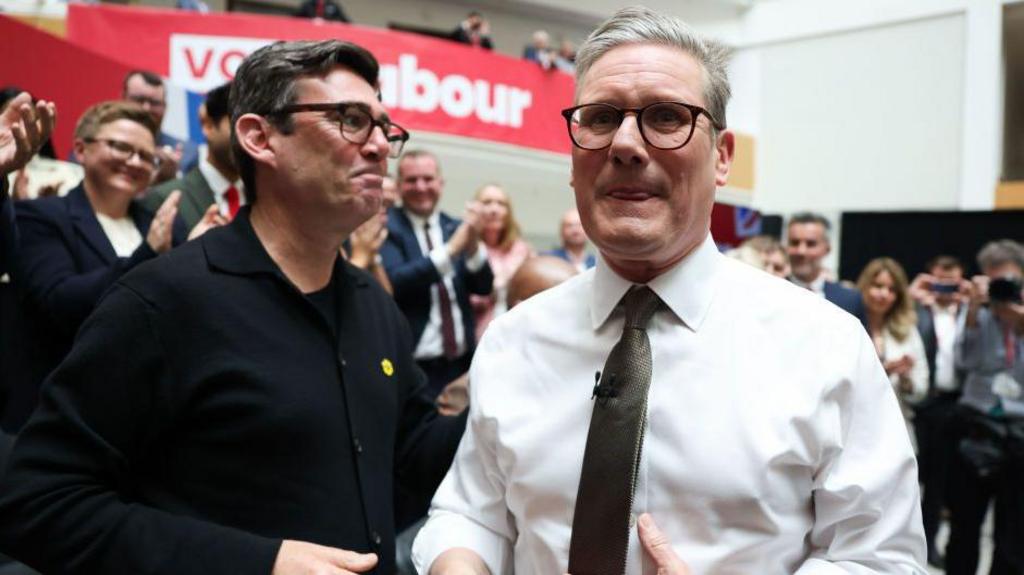
British Prime Minister Keir Starmer has rejected calls for an immediate Labour Party leadership contest, saying the party should concentrate on winning important elections instead of fighting among itself.
Starmer spoke to British journalists while attending the G7 summit in France, as pressure continued to grow over his future as Labour leader and prime minister.
The political tension comes ahead of the Makerfield parliamentary byelection, where Greater Manchester Mayor Andy Burnham is expected to win and return to the House of Commons.
Burnham’s possible return to Parliament has increased speculation about a challenge to Starmer’s leadership. He is widely seen as one of the Labour figures with enough support among party members and lawmakers to become a serious contender for the top job.
However, Starmer said Labour’s immediate priority should be helping Burnham win the Makerfield contest.
He said he had encouraged party members and campaign workers to travel to the constituency and help Labour bring out its supporters on election day.
Should Burnham win the parliamentary seat, he would automatically leave his position as Greater Manchester mayor. This would create another major election to choose his successor.
Read related news:
Starmer vows more police in Jewish areas after Manchester synagogue attack
Starmer seals Poland defence pact as Russian threat Grows
Streeting backs Burnham in makerfield by-election
The mayoral byelection could take place on Thursday, July 30. Bev Craig, the leader of Manchester City Council, has been mentioned as a possible Labour candidate.
Labour comfortably retained the Greater Manchester mayoralty when Burnham contested the last election two years ago. However, much of that success was linked to Burnham’s personal popularity across north-west England.
Any new Labour candidate may face a tougher contest, especially after Reform UK defeated Labour in several areas during the May local elections.

Starmer argued that the party must remain united to defend the mayoral position.
He said Labour would be entering one of the largest byelection campaigns it had ever fought because of the number of voters across Greater Manchester.
“I don’t think there should be a challenge,” Starmer said, adding that recent British political history had shown that repeated leadership battles could damage a government.
Despite his appeal for unity, the prime minister made it clear that he would not resign or avoid a contest.
“If there is a challenge, then I intend to fight,” he said. “I’m not going to walk away from that.”
Streeting warns of leadership contest
Starmer’s comments followed a warning from former health secretary Wes Streeting, who has indicated that he could launch a leadership challenge as early as next week.
Streeting wants the prime minister to announce a timetable for leaving office after the Makerfield result.
During an interview with Sky News presenter Cathy Newman, Streeting said Labour could not continue with uncertainty surrounding its leadership.
When asked what would happen if Starmer refused to set a departure date, he said the party would “inevitably” end up holding a contest.
Newman then asked whether Starmer should expect a challenge next week. Streeting replied: “Yeah.”
He gave a similar answer during a separate BBC Newsnight interview. Although he refused to say whether formal action would begin on Monday or Tuesday, he said the situation could not be allowed to continue for much longer.
Streeting also claimed that he had secured the support of 81 Labour lawmakers, the number he would need to begin a formal challenge under the party’s leadership rules.
Under Labour’s system, a challenger needs nominations from 20 per cent of the party’s members of Parliament before a leadership election can take place.
Starmer promises Burnham a major role
In an apparent effort to ease the growing crisis, Starmer said he wanted Burnham to have a “big role” in the government if he wins the Makerfield byelection.
The prime minister said he planned to speak with Burnham after the weekend.
Starmer described the Greater Manchester mayor as a major asset to Labour and the country. He also recalled working with Burnham when he entered national politics in 2015.
“He’s been a fantastic mayor in Manchester,” Starmer said. “If he comes back into Parliament, I hope he wins in the byelection, he’ll be a fantastic asset for our party and for the country.”
A cabinet position would give Burnham a senior place in Starmer’s administration. However, it may not end speculation about the Labour leadership.
Burnham has already presented himself as a politician who wants to change the direction of the party. His supporters believe a victory in Makerfield would give him the parliamentary platform needed to seek the Labour leadership.
Unlike Burnham, Streeting is already a member of Parliament and could begin a challenge without waiting for the byelection result.
Starmer must now manage threats from both men while trying to show that his government remains focused on running the country.
The Makerfield vote could therefore have consequences far beyond the constituency. A Burnham victory may open the way for a Greater Manchester mayoral election and could also trigger a wider struggle over who leads Labour and governs the United Kingdom.
For Starmer, the message from France was firm: Labour should avoid a leadership contest and concentrate on the elections ahead. But should his opponents move against him, he says he is ready to fight for his position.

