


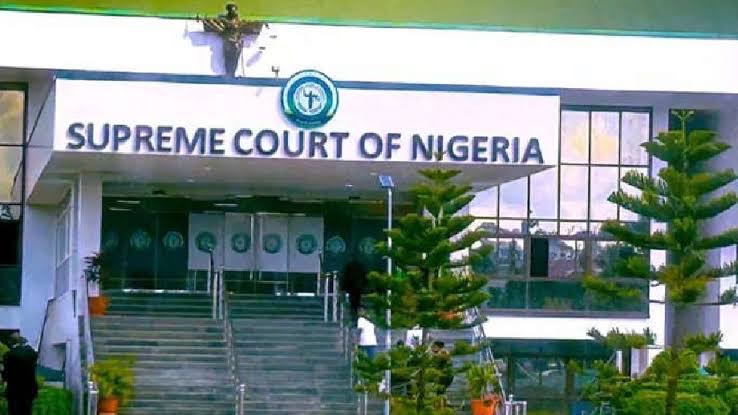
Nigeria’s apex court, the Supreme Court of Nigeria, has nullified the Peoples Democratic Party convention held in Ibadan, a decision that deepens the crisis within the Peoples Democratic Party and raises fresh questions ahead of the 2027 elections.
The court dismissed an appeal filed by a faction ed by Taminu Turaki, ruling that the convention held in November 2025 went against an earlier order of the Federal High Court.
Justice Stephen Adah, who read the lead judgment, held that the party acted in defiance of a valid court order issued by Justice James Omotosho, which had barred the exercise.
READ RELATED NEWS UPDATES
Supreme Court vacates status quo order against Mark-led ADC
Supreme court voids PDP Ibadan convention: What next for Turaki?
Supreme court set to rule on ADC, PDP crisis
Supreme Court adjourns Kano Emirate dispute to 2027
Supreme Court fixes April 22 for PDP crisis appeal hearing
The court, in addition, criticised the Turaki-led group for seeking relief from another court of equal standing instead of filing an appeal. It described the move as an abuse of court process and dismissed the case for lack of merit.
The court declared, “The conduct of the national convention… is null and void.”
It added that any party that ignores a court order does so at its own risk.
What the ruling means
First, the judgment effectively cancels all decisions taken at the Ibadan convention, including leadership outcomes linked to that exercise.
Second, it weakens the position of the Turaki-led faction, which had asked the court to uphold the convention and overturn an earlier ruling by the Court of Appeal of Nigeria.
Third, it strengthens the opposing camp within the PDP, which argued that the convention was illegal because it violated a subsisting court order obtained by Sule Lamido.
Lamido had earlier secured an injunction stopping the convention until he was allowed to contest for the position of national chairman.
Why the case matters
The ruling goes beyond party politics. The court made it clear that political parties must obey court orders, emphasising that they are key institutions in Nigeria’s democracy.
It also settles a key legal question. The court agreed with lower courts that the matter was not purely an internal party affair, since it involved disobedience to a valid order.
However, two justices gave a minority opinion. They argued that party leadership issues should remain internal and not be handled by courts. They still agreed that court orders must be obeyed.
What happens next?
The decision is likely to deepen divisions within the PDP, which has already witnessed rival conventions, suspensions, and counter-suspensions.
In March, another faction backed by Nyesom Wike held a separate convention in Abuja and produced new party leaders.
With the Ibadan convention now voided, attention may shift to which faction holds legal and political control of the party structure.
This ruling, thus, could shape the PDP’s readiness for the 2027 elections, especially as internal unity remains uncertain.
For now, the court has drawn a firm line. Political ambition, it ruled, cannot override the rule of law.
For More Details, Visit New Daily Prime

