


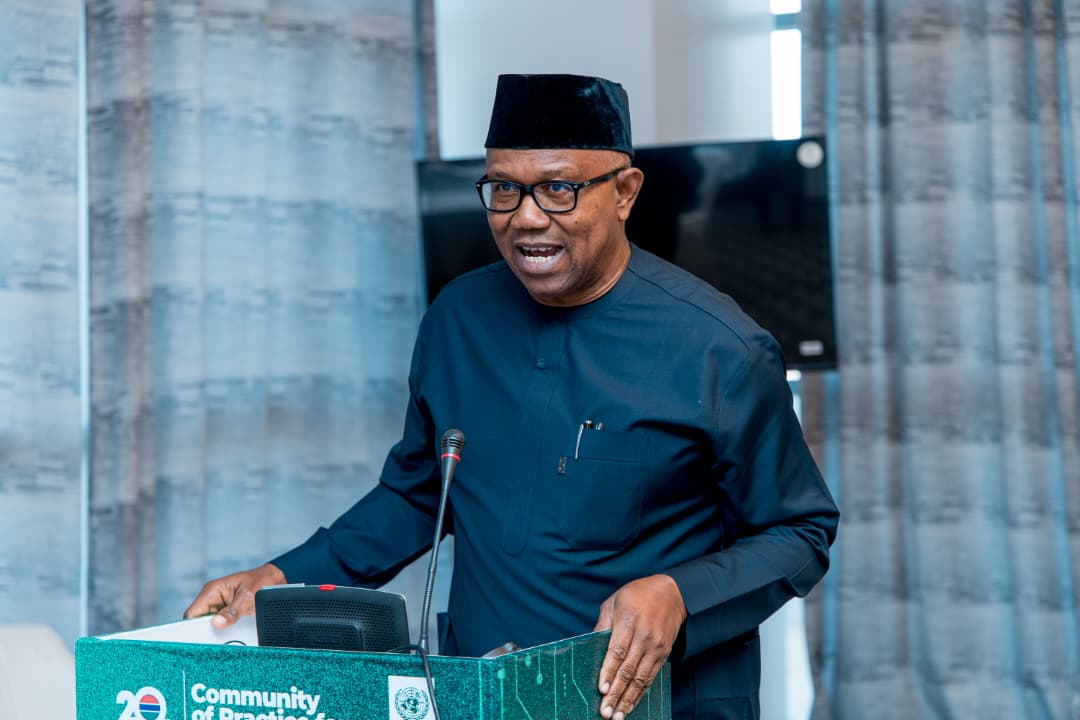
Presidential candidate of the Nigeria Democratic Congress (NDC), Peter Obi, has pledged to increase Nigeria’s electricity generation and distribution capacity to 10,000 megawatts within four years if elected into office.
Peter Obi made the commitment on Saturday shortly after emerging as the presidential candidate of the party ahead of next year’s general elections. Addressing party supporters and members, the former governor outlined his vision for tackling Nigeria’s long-standing electricity challenges, describing reliable power supply as a critical requirement for economic growth and national development.
According to Peter Obi, his administration would prioritise reforms and investments in the power sector to ensure that Nigerians have access to stable and affordable electricity. He stressed that his government would not spend its tenure offering excuses for poor performance but would instead focus on delivering measurable results.
“This is something we have carefully studied. Give us four years and we will fix Nigeria’s electricity issue. We’ll raise Nigeria’s power supply to 10,000MW,” Peter Obi said.
The presidential hopeful expressed concern over the current state of Nigeria’s power sector, noting that the country’s electricity generation remains far below what is required to meet the needs of its rapidly growing population.
“It is completely unacceptable that a country of over 200 million people generates and distributes only about 4,000 megawatts of electricity while millions of Nigerians still lack access to reliable power,” he stated.
Peter Obi compared Nigeria’s electricity output with that of other African nations, arguing that the country has significantly underperformed despite its vast human and natural resources.
“Countries like South Africa and Egypt, despite having significantly smaller populations, each generate and distribute over 40,000 megawatts. Nigeria is not even producing one-tenth of what those countries generate, and that must change,” he added.
Electricity supply has remained one of the most pressing challenges facing Nigeria for decades, with businesses and households frequently relying on costly alternative energy sources such as generators. Industry experts have repeatedly identified inadequate power infrastructure as a major obstacle to industrialisation, job creation and economic competitiveness.
Peter Obi promise is expected to become a key part of his campaign agenda as political parties intensify preparations for the forthcoming general elections. Analysts say voters will be closely watching how candidates intend to address the country’s persistent energy crisis, which continues to affect productivity, investment and the overall quality of life for millions of Nigerians.
With the election season gathering momentum, Obi’s pledge signals a renewed focus on power sector reform, an issue many Nigerians consider central to the nation’s economic future.
