


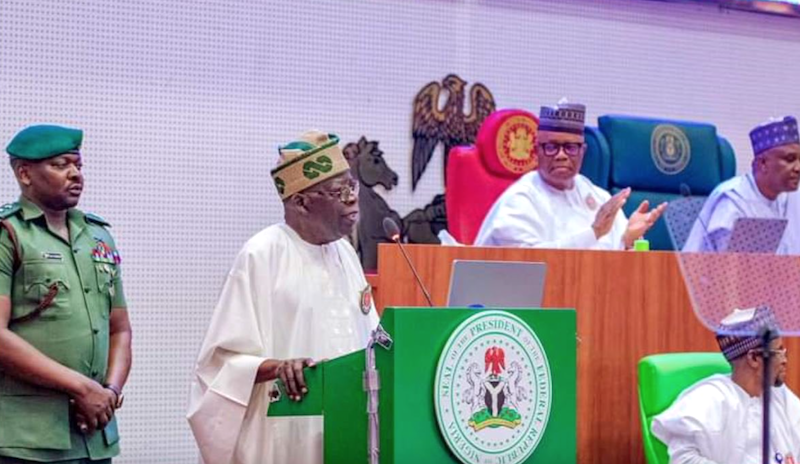
President Bola Ahmed Tinubu has requested the approval of a N9.09 trillion increase to Nigeria’s 2026 budget, citing the need for greater fiscal transparency and effective implementation of priority national programmes.
The request was formally conveyed in a letter read on the Senate floor by Godswill Akpabio during Tuesday’s plenary. Tinubu explained that the adjustment would allow the government to fully account for existing debt obligations while aligning fiscal planning with current economic realities.
Despite the President’s proposal, the National Assembly approved a higher total budget of N68.32 trillion—an increase from the initial N58.18 trillion submitted in December 2025. The approved figure exceeds the President’s revised projection by roughly N1 trillion, reflecting additional legislative adjustments.
According to lawmakers, the upward revision is aimed at addressing legacy liabilities, funding critical infrastructure, strengthening the judiciary, improving healthcare services and supporting preparations for the 2027 general elections.
Chairman of the Senate Committee on Appropriations, Solomon Adeola, stated that the increase was necessary to regularise outstanding commitments from previous fiscal years and ensure macroeconomic stability. A significant portion of the adjustment includes the rollover of N7.71 trillion in capital projects from the 2025 budget, many of which were stalled due to revenue shortfalls.
The expanded budget allocates N32.287 trillion to capital projects, N15.809 trillion to debt servicing, N15.427 trillion to recurrent expenditure and N4.799 trillion to statutory transfers.
Key infrastructure investments include federal equity contributions to rail projects across Lagos, Kano, Kaduna and Ogun States, alongside feasibility studies for new transport corridors and upgrades to existing rail networks. In the health sector, approximately N482.76 billion has been earmarked for priority interventions under international agreements.
The judiciary also received increased funding, with allocations of N98.5 billion for the Court of Appeal and N36.7 billion for the Supreme Court, alongside additional provisions to support the appointment of judges ahead of the 2027 elections.
To finance the budget, lawmakers proposed a mix of revenue enhancements and borrowing. This includes raising the oil benchmark price by $10 per barrel, projected to generate over N2.5 trillion in additional revenue, as well as increased tax contributions from telecommunications firms such as MTN Nigeria and Airtel Nigeria.
However, external borrowing is expected to rise by N6.163 trillion to cover the deficit, which stands at N23.85 trillion, representing 4.28 per cent of GDP.
Lawmakers also approved an extension of the 2025 capital budget implementation to June 30, 2026, citing delays in fund releases and bureaucratic bottlenecks. They called for stronger collaboration between the executive and legislature to ensure timely project execution.
With both chambers of the National Assembly passing the appropriation bill, it is expected to be transmitted to the President for assent in the coming days.

