



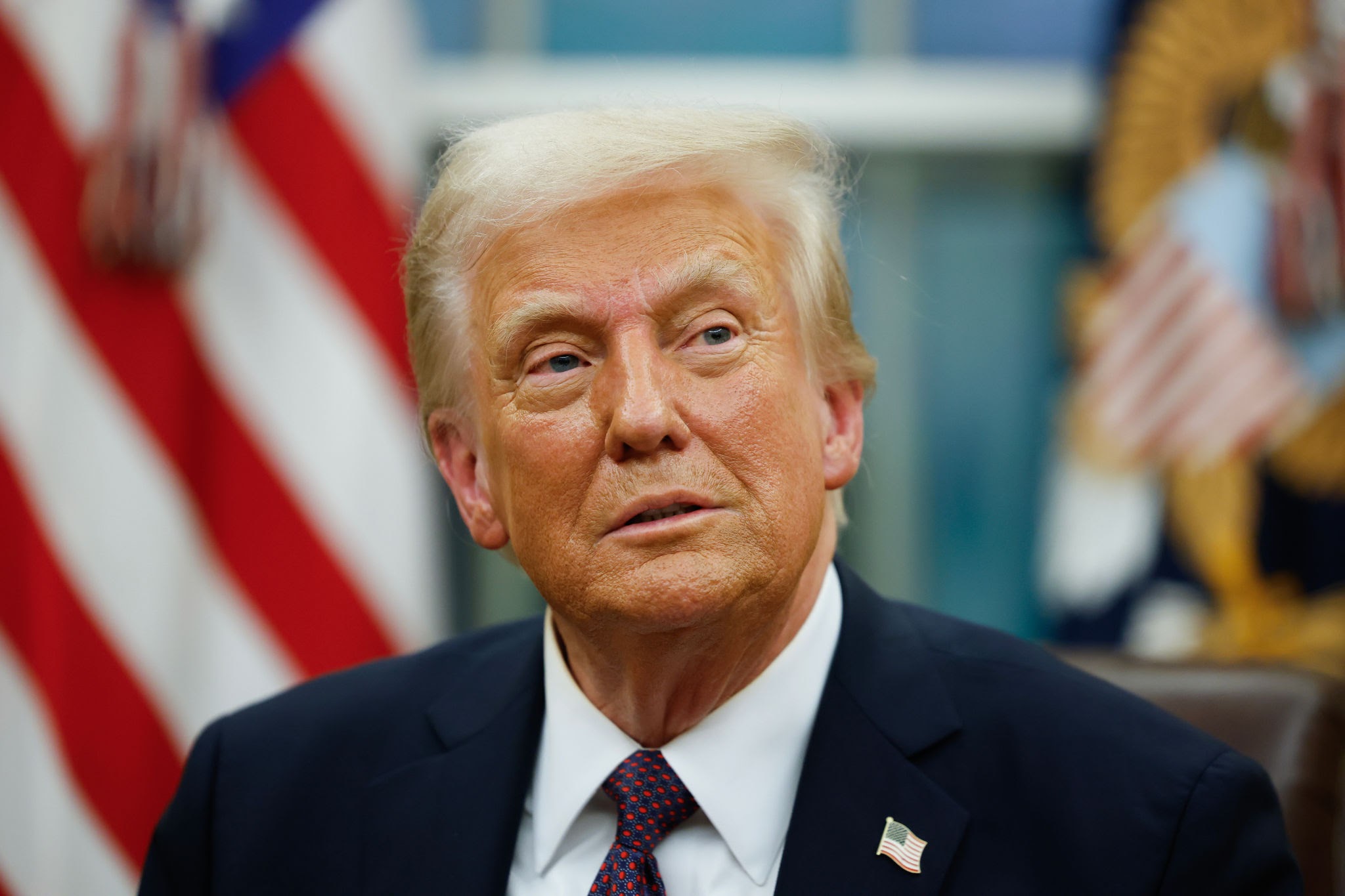
Donald Trump on Tuesday sought to quell a growing backlash in Congress and among his own supporters over the US decision to attack Iran, rejecting claims that he had been manoeuvred into military action by Israel.
Facing criticism from both Democrats and factions of his Maga base, the president denied suggestions that Israel had already decided to strike Iran and that Washington was merely dragged along. Speaking to reporters, Trump insisted the decision was his alone.
“No. I might have forced their hand,” he said. “We were having negotiations with these lunatics, and it was my opinion that they were going to attack first. If we didn’t do it, they were going to attack. I felt strongly about that.”
The controversy was intensified by remarks from the US secretary of state, Marco Rubio, who told lawmakers that the strikes were intended to pre-empt Iranian retaliation against US interests following Israeli attacks that Washington expected.
“We knew that there was going to be an Israeli action,” Rubio said on Monday. “We knew that would precipitate an attack against American forces, and we knew that if we didn’t act first, we would suffer higher casualties.”
Those comments angered Senate Democrats and unsettled parts of Trump’s political base, fuelling suspicions that Israel’s priorities, rather than America’s, had driven the decision to go to war.
Democrats seized on Rubio’s explanation as Congress prepared to debate war powers resolutions in both chambers this week. The measures are designed to reassert the constitutional requirement that Congress authorise military action.
“We have to have a debate in the United States Senate on an authorisation of military force,” said Chris Murphy after a classified briefing by Rubio and senior defence officials. While conceding the resolution was likely to fail, Murphy described the conflict as “deeply unpopular, immoral and illegal”.
Concerns were compounded by what Democrats described as a lack of clarity over the administration’s objectives. Chuck Schumer warned that without a clear plan the US risked being drawn into an endless conflict marked by mission creep.
Republicans, by contrast, largely rallied behind Trump. Senator Markwayne Mullin argued that Iran’s leadership had been responsible for decades of violence against Americans and said the threat could no longer be ignored.
Public unease over Israel’s role in the decision could further reshape US attitudes towards its closest Middle Eastern ally. Support for Israel has already fallen sharply in opinion polls following the prolonged war in Gaza.
Trump’s own explanations for the strikes have shifted in recent days. He initially said the aim was to defend Americans from imminent threats posed by Iran, but has also sent mixed signals about whether US ground troops could be deployed, a move that would likely inflame domestic opposition.
Some of the president’s most prominent online supporters openly criticised Rubio’s remarks. Mike Cernovich called them a “record scratch moment”, while Matt Walsh said they suggested the US was at war because Israel had “forced our hand”.
Steve Bannon, Trump’s former adviser, questioned the lack of coordination. “If we knew Israel would strike and Iran would retaliate, where was the strategy?” he asked.
The perception that the conflict primarily serves Israeli interests has been reinforced by statements from Israel’s prime minister, Benjamin Netanyahu, who has repeatedly pressed Washington to take action against Tehran.
“This coalition allows us to do what I have yearned to do for 40 years,” Netanyahu said on Sunday. “To strike the terror regime.”
As Iran retaliated, killing four US service members, conservative commentator Megyn Kelly questioned the purpose of the war.
“No one should have to die for a foreign country,” she said. “This feels very much like Israel’s war and that may explain why President Trump is struggling to explain why we are in it.”

