


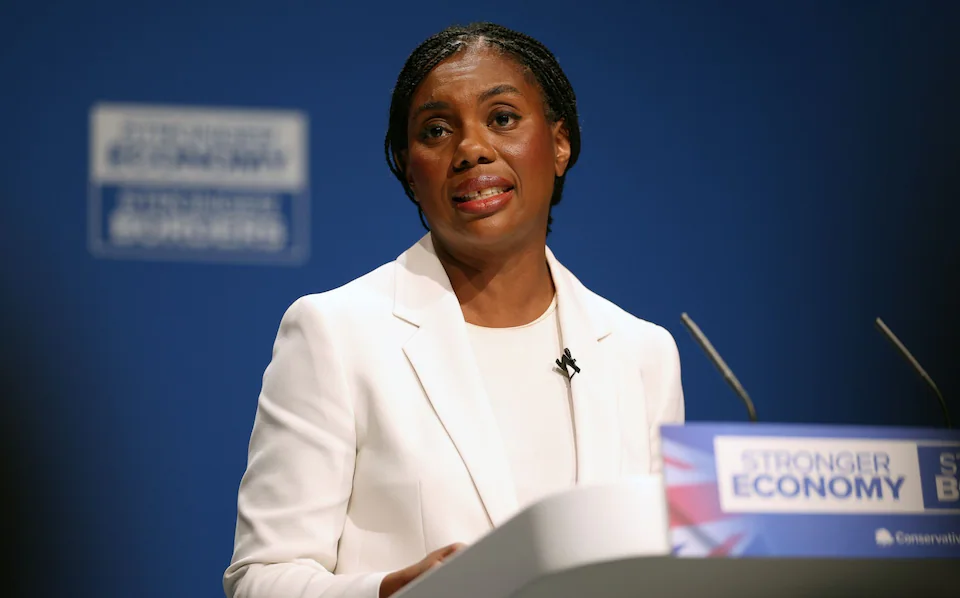
Kemi Badenoch has emerged as the most popular political party leader in the United Kingdom, according to a new opinion poll, marking a significant shift in public perception as her national profile continues to grow.
Read more breaking stories from our latest nigeria news
The survey, conducted by More in Common and reported by the Daily Mail, found that Badenoch recorded a net approval rating of minus nine. While still negative, the figure represents a sharp improvement from minus 32 recorded before her party conference in October last year.
The Conservative leader ranked ahead of key political rivals, including Nigel Farage, who polled minus 16, and Ed Davey, who scored minus 11. The poll placed Prime Minister Keir Starmer at the bottom of the rankings with a minus 42 approval rating, reflecting broader dissatisfaction among voters.
The findings suggest that Badenoch’s visibility and political positioning in recent months have contributed to her rising popularity. Analysts point to her outspoken interventions on key national issues, including her criticism of government policies and high-profile political controversies, as factors strengthening her public image.
Luke Tryl, UK director of More in Common, said Badenoch’s growing recognition has been a defining feature of her recent rise.
Read related news:
Kemi Badenoch expected to unveil plan to exit ECHR
Badenoch, Starmer clash over Ukraine and defence
Badenoch tells wavering Tory MPs to leave amid Reform defections
“Whereas last summer we’d run whole focus groups where no one would know who Kemi was, she is often now brought up spontaneously,” he told The Sunday Times. “Even some of those who would never vote Conservative say they admire her conviction and straightforwardness.”
Despite the improvement in her personal ratings, the poll indicates that the Conservative Party has yet to see a corresponding increase in overall support. While Badenoch performs strongly on measures such as transparency and perceived concern for the public, she still trails Farage on attributes such as strength and leadership.
Badenoch’s rise is particularly notable given her background. Born in London to Nigerian parents, she spent part of her early life in Nigeria before returning to the UK as a teenager. She later became the first Black leader of the Conservative Party, a milestone that has drawn both domestic and international attention.
However, Badenoch has recently clarified her stance on her Nigerian heritage, stating that she no longer identifies with the country as part of her personal identity.
Read more breaking stories from our latest nigeria news
Speaking on the Rosebud podcast hosted by Gyles Brandreth, she said she had not renewed her Nigerian passport since the early 2000s.
“I don’t identify with it anymore; most of my life has been in the UK, and I’ve just never felt the need to,” she said.
While acknowledging her roots, Badenoch emphasised that her sense of belonging lies firmly in Britain.
“I know the country very well, I have a lot of family there, and I’m very interested in what happens there,” she said. “But home is where my family is now.”
She also revealed that her return to the UK at age 16 was influenced by her parents’ concerns about her future in Nigeria.
“My parents thought there was no future for me there,” she said, reflecting on a decision that ultimately shaped her political journey.
As Badenoch consolidates her position within British politics, the latest poll underscores a growing recognition among voters. However, with the Conservative Party still lagging in broader support, the challenge remains whether her personal popularity can translate into electoral gains.
For now, the figures point to a leader gaining traction — even as her party struggles to keep pace.

