


By Tobi Lawal
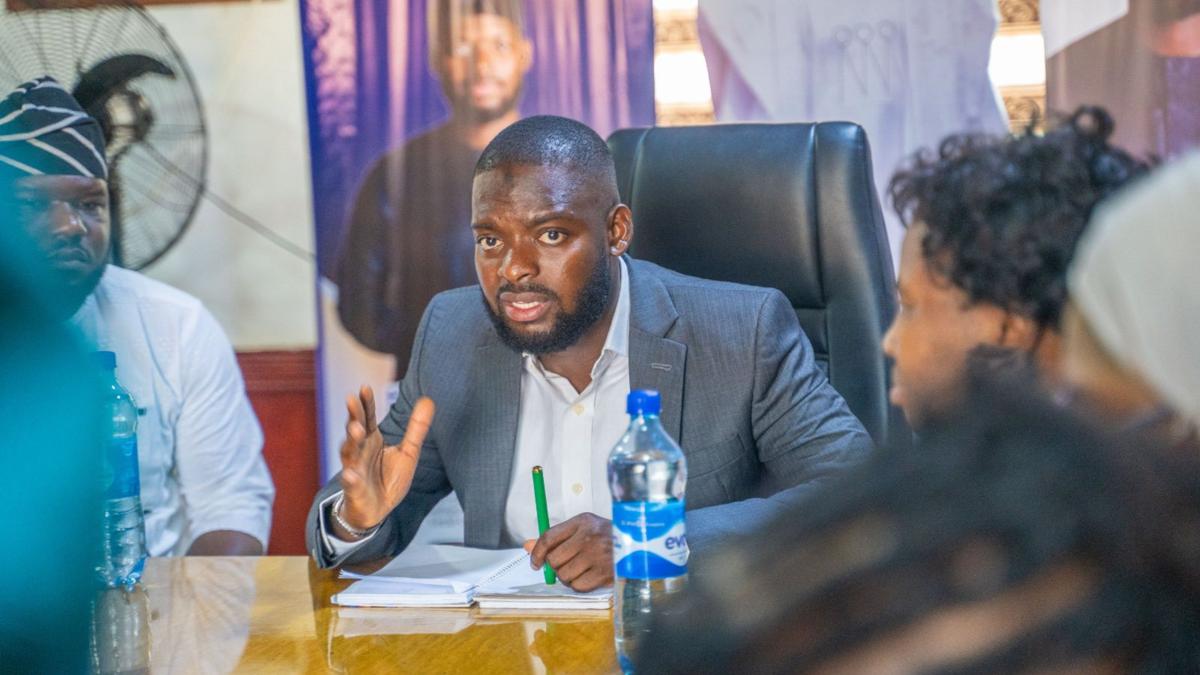
In this interview with The NEW DAILY PRIME, Tobi Lawal, speaks to Chairman of Agege Local Government, Abdul-ganiyu Vinod Obasa about his administration’s efforts at improving environmental sanitation, upgrading infrastructure, strengthening security, and expanding social interventions aimed at improving the quality of life of residents and reducing poverty in the community.
For more updates on party developments, follow the latest APC news in Nigeria.
How would you describe your experience so far as Executive Chairman of Agege Local Government?
It’s been a great experience. Coming from the private sector, there’s a way the public sector is being looked at. Since coming here, it’s been a very great experience. We have one of the most brilliant and most hard-working, diligent sets of people I’ve met here in the local government setup. We’re all working together as a team to make sure we move the community forward. We’re very much trying to make sure that all of the various sectors are tackled and we’re able to make a difference across each of the centres that are within our purview here at the local government. Making a presence and making our residents know that things can be done differently. We can approach things differently and we can let them feel that the local government is here for a reason. We’re here to bring the process of government to the grassroots. We’re here to make life easier.
Read related news:
Sanwo-Olu swears in Abdul-Ganiyu Obasa as Agege LG Chairman
Omo-Agege announces mass defections from PDP to APC in Delta state
Lagos Assembly crisis: PDP mocks APC as Obasa returns as Speaker
Since assuming office as Chairman, how has your administration improved the locality and met the needs of your constituents?
When I was coming in, one of my mindsets was to improve the overall quality of life of our residents here at the local government. This is a place I’ve lived in for 30 years of my life. One of the first things was the environment. It was about refuse being on the median and on the road. Our streets were dirty and we could change the face. People have this negative narrative about Agege. We were scared and we needed to change that. There’s a lot we’ve done within that short period of time. If you go to Alfa-nla/Capitol Road, the median used to be full of dirt. Now we have grass and trees and plants right in that median. It looks beautiful now. If you go to Oba Ogunji, on the right and left side, there used to be a place where it was just mechanical and they would drop dirt. Now it’s green, the walls are painted all the way from Pen-Cinema all the way to the end of Oba Ogunji. You can even bend your way into this road that leads you to the council. These are things we are doing.
The development reflects broader trends in APC political updates across Nigeria.
We are now sweeping our inner streets. We’ve employed sweepers to sweep our inner streets. So, on a day-to-day basis in our local government, you see that the inner streets, from around 7 a.m. are swept. We didn’t have that before. Now we have those measures coming. We’ve been able to procure our own compactors as a local government. We are not saying we want to go into the business of waste management, but rather our major roads that lead us in and out of our council should be clean. When people visit us, they should see it sparkling clean. If you go around this community, major roads in and out, you see that there’s nothing like having refuse on one side of the road like you see in other places.
It was a system where we have a lot of people who are disadvantaged, poor, who are vulnerable. We have to look for ways to see how we can give back to that community. This will improve their human capacity and human development as well. There are certain levels of services as well that council should provide, such as healthcare, education, and improvements of human capacity. Those are things that are very important for me coming into this space.
You have outlined your administration’s efforts in addressing environmental and sanitation issues. Given that drainage and flooding remain significant challenges, what measures are being implemented to address these concerns?
We are solving drainage issues, which are also environmental issues as well. There are five major areas that didn’t have drainage. These are places where we now have construction present and they are now providing drainage to those places. We have our own drainage team that goes around when the place is filled up and needs to be cleared out and desilted. We just bought a tipper as well that will help us move the dirt from the drainage. We put it in the tipper and it takes it down to the dump site. So all of those logistics and the process of trying to get it done, we have to make sure we own those processes as well, so we are able to have control around it. It’s not that we have to wait for one person to come and do this for us. Then all of these people either charge us too much or make it difficult for us to be able to achieve what we want to achieve on time.
There is a prevailing perception that Agege contains shanties and hideouts that pose security risks, particularly around areas such as Pen Cinema and the Agege Train Station. What measures is your administration implementing to address this concern?
We recognise the issues around security. To this end, we have sustained and improved the capacity of our own local security outfit, Agege Crime Fighters; we call them paramole. They go around the community and have their beats where they are stationed. They’re able to gather intelligence and provide this information to law enforcement agencies. We have our peace and security meetings on a monthly basis. We have installed about 600 streetlights. All of the major roads in and out of this community have streetlights. All of our new streets that we constructed all have streetlights. So, these are things we are very intentional about in making sure that we are lighting up this community. There’s light and we’re safer. Before the end of the month, we’ll also have CCTV in strategic areas. About 25 will be installed in certain high-risk strategic areas within this community, so we’re able to actually see what’s going on within our community and be able to act.
Across the corridor that you mentioned, at the train station, all of those places, we have the Agege Crime Fighters stationed there. They solve the problem of street urchins harassing people who come and use the train station. They make sure people are safe, people coming in and going out, making sure they are safe. Under the Pen Cinema bridge as well, where people actually complain about threats, we have been able to station both policemen from the Pen Cinema Police Station and the Agege Crime Fighters. They work hand-in-hand to secure commuters.
Regarding the Agege Crime Fighters, are they armed, and what measures are in place to ensure accountability and full respect for human rights in the discharge of their duties?
We have no issues of abuse within this community, courtesy of the Agege Crime Fighters. Because they are from this community, there are no issues of abuse. There is no unnecessary use of force; none of that. They are not meant to use force on anyone, they are not meant to use arms, and they are not meant to do any of that.
What they’re meant to do is just to make sure that they gather enough intelligence. Where they need to be, they come in numbers and round up people and tell them to stop unnecessary chaos. They are backed up by the police as well at any point in time when they actually carry out a complaint.
Infrastructure renewal is a priority for most local government administrations. What has your administration achieved in this regard?
In seven months, we’ve done 12 roads. We’ve done Ajakaiye, Elitana, Adegbola, Imam Ojoku and Alowonle. We’ve done a lot of roads that connect inner streets that make life easier for people. A lot of these roads are roads that we’ve done. If you follow those streets that lead you all the way to the Lagos–Abeokuta Expressway from Aluminium Village, that road itself had a reason. It was to connect the aluminium traders to the express road, so basically they’re able to come in and out and their business improves. This year, by the end of the month, we have seven roads as well that we are going to start. The most affected area in terms of road network and drainage in our community is Ward D area, which is in Morkaz. So about seven roads that are very important within this community as well we will further do this year. And we are not just stopping there.
How about education, what have you done?
In terms of education, we renovated 17 school blocks across the local government. So, if you go to Keke Nursery and Primary School and Salvation Army School and Ifeoluwa Nursery and Primary School, you will see our impact there. We are putting ICT rooms in our schools. We are in five school compounds for renovation, picking a room there to use as an ICT room and a room to use as a library. We are creating a library and building reading habits. If it’s just an hour a week, they need to read, because reading naturally improves speaking, writing, and many core skills a child needs. We are also doing recreational centres. We’ve done two seven-a-side pitches now, one at Keke Nursery and Primary School and the other at Dopemu Nursery and Primary School.
You have outlined several projects undertaken by your administration. How do you ensure their sustainability and durability, particularly in light of maintenance culture and quality standards?
That starts from the place of quality control from the beginning. The process of doing it has to be well done. That determines the longevity of the project. That process cannot be negotiated; it must not be toyed with. We must ensure that the appropriate quality of work is done. Secondly, across our projects, we have told the CDAs and CDCs that they need to take ownership. It’s theirs. They live there. They own it. They should take charge of it and not let anyone destroy it. It belongs to them, and they should make the best of it.
The engineering departments within the local government have a monthly budget for maintenance across the local government. We have a group where, if a school loses something, for example, a door handle breaks, they report it, and the engineer goes there immediately to fix it. The issue we’ve in this part of the world is that when something small gets damaged, we leave it for years and the whole facility deteriorates. Then we spend a huge amount repairing it. But if we fix things little by little, we avoid large costs and keep our infrastructure in good condition.
Development is often viewed as a subjective concept. How does your administration engage residents in decision-making, project implementation, and feedback processes?
The things that we do involve getting feedback from our residents. Before the year ends, when preparing the budget for the following year, around October or November, we hold a Budget Consultative Forum. Every resident, business owner, SME, church, mosque, imam, estate group, everyone, gathers and shares their needs. They suggest roads, markets, and other priorities, and those inputs form the basis of our budget. We don’t just decide projects arbitrarily; they come from this consultative process. During the year, we may also carry out urgent projects as needed. Importantly, many of the roads we prioritised were directly requested by residents.
You are widely regarded as a youth-focused leader. What key initiatives has your administration implemented to empower young people?
We are big on youth inclusion and empowerment. We’ve upgraded our skill acquisition centres, for fashion design, beauty, and more. We are working with a hair brand to set up a salon in the council building. There are facilities for hairdressing, makeup, nails, and more. There is also a leather hub, a music studio, and a podcast studio for creatives. We’ve trained about 100 youths in filmmaking and cinematography. The best 25 will go on to join the academy.
Public-Private Partnerships (PPPs) have become pivotal to sustainable development. How is your administration leveraging this framework?
We are engaging companies within our local government, such as Guinness and others, to explore PPP opportunities. Some brands are supporting our skill centres. Sterling Bank is supporting school libraries. Jubaili Bros has proposed street lighting projects. We are also planning beautification projects, such as a garden on Akilo Road, in partnership with private organisations. While resources are limited, we are actively leveraging partnerships to deliver projects.
Following your recent global recognition and election as Vice President of Young Elected Local Officials (YELO) Africa, what benefits does this bring to Nigeria, Lagos State, and Agege in particular?
One of the goals of the Young Elected Local Officials Network is to encourage more young people to participate in governance. Across Nigeria and Africa, we aim to increase youth representation in leadership. I have always championed this, and I will continue to do so. I am also leveraging this network to bring opportunities and expertise to Agege. I plan to host YELO officials in Lagos next year to strengthen regional collaboration and attract development opportunities to our community.

