



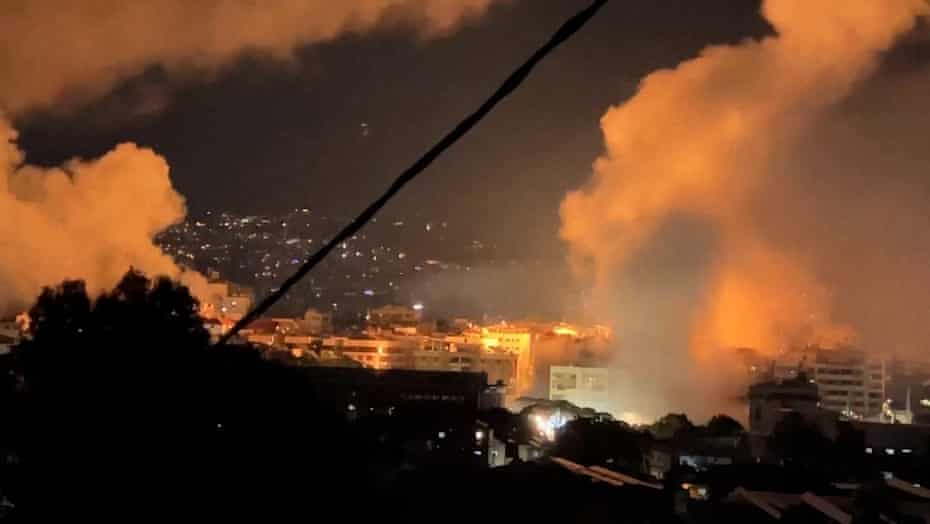
Israel carried out intense airstrikes on Hezbollah-controlled southern suburbs of Beirut in the early hours of Monday, after the Iran-backed group launched missiles and drones towards Israel.
The attacks followed Hezbollah’s claim that it was retaliating for the killing of Iran’s supreme leader, Ali Khamenei, in the escalating US-Israeli war with Iran.
Residents of Beirut were woken at around 3am by a series of explosions. About a dozen strikes hit three locations in the southern suburbs. Bombardments continued into the morning, with another strike reported close to noon, by which time the area had been largely abandoned.
The blasts shattered windows across the capital and were heard miles away. Israeli warplanes were also reported over large parts of southern Lebanon, where buildings collapsed in villages near Tyre.
Lebanon’s health ministry said at least 31 people were killed and 149 injured in what it described as a preliminary toll.
Lebanon has become the latest country drawn into the widening regional conflict, now in its third day. Iran continued attacks on Gulf Arab states, with a drone striking an Aramco oil refinery in Saudi Arabia on Monday morning.
Overnight, a drone also hit a British military base in Cyprus, marking the first time Iranian strikes have affected an EU state.
Ali Larijani, a senior Iranian official, said Iran did not want to attack countries in the region but would continue to do so as long as they hosted US military bases used to launch attacks against Iran.
The US president, Donald Trump, who announced the war as an operation aimed at regime change in Iran, issued conflicting messages on diplomacy. He told The Atlantic on Sunday that he was “ready to talk”, but later said in a video posted on Truth Social that fighting would continue until all objectives were achieved.
He vowed to “avenge” US troops killed so far.
Larijani later said on X: “We will not negotiate with the United States.”
Hezbollah said it had launched a barrage of missiles and drones at the Mishmar al-Karmel missile defence facility near Haifa shortly after midnight. The group said the attack was in retaliation for Khamenei’s killing and in defence of Lebanon.
Israel responded within hours, striking what it described as Hezbollah targets across southern Lebanon, the Bekaa Valley and the Beirut suburb of Dahieh. The Israeli military said several senior Hezbollah officers were killed in the Dahieh strikes.
“Hezbollah opened a campaign against Israel overnight and is fully responsible for any escalation,” said Israel’s military chief, Lt Gen Eyal Zamir. “Any enemy that threatens our security will pay a heavy price.”
Israel issued evacuation orders for 55 towns and villages across Lebanon, warning residents to move at least one kilometre away from areas near Hezbollah facilities. The military also announced the deployment of 100,000 reservists, many along the Lebanese border.
An Israeli military spokesperson said troops had not entered Lebanese territory but were prepared to do so if necessary. The stated aim was to degrade Hezbollah’s capabilities.
Thousands of civilians fled Dahieh on foot and by car. Petrol stations in Tyre were surrounded by long queues as residents headed north. Roads into central Beirut were gridlocked, with vehicles navigating rubble from earlier strikes.
Videos from the area showed buildings in flames and destroyed cars beneath collapsed structures. Witnesses reported seeing rockets fired from southern Lebanon towards Israel during the evacuations.
Memories of the 13-month war between Israel and Hezbollah that ended in 2024 resurfaced quickly. During that conflict, nearly 4,000 people were killed and around one million displaced, with large areas of southern Lebanon left uninhabitable.
By Monday morning, dozens of schools in Beirut had opened to shelter displaced families. Others gathered in Martyr’s Square in the city centre, uncertain of where to go next.
Lebanon’s government condemned the decision to attack Israel without state approval. The prime minister, Nawaf Salam, said he would “not allow the country to be dragged into new adventures”.
“The rocket fire from southern Lebanon is an irresponsible and suspicious act that jeopardises Lebanon’s security and safety,” he said on X, adding that it provided Israel with justification to continue its attacks.
For weeks, Lebanese officials had sought to prevent Hezbollah from joining the war with Iran. Israel had warned that any attack from Lebanon would provoke a wide-ranging response against the entire country.

