


by Ayomide Balogun
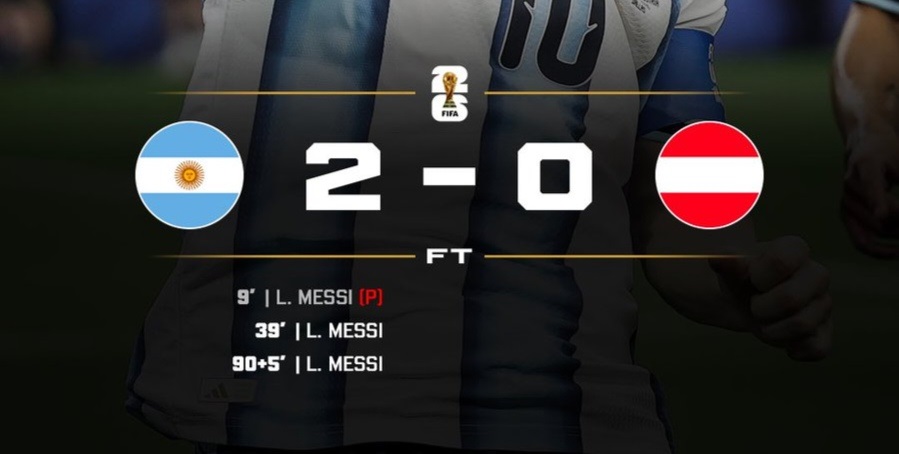
In a match filled with drama, tension, and ultimate brilliance, defending champions Argentina secured a professional 2-0 victory over Austria in their second Group J fixture of the 2026 FIFA World Cup at AT&T Stadium (Dallas Stadium) in Arlington, Texas, on Monday, June 22.
The result not only sent Argentina through to the Round of 32 with a game to spare but also witnessed Lionel Messi etch his name further into football immortality by becoming the outright all-time leading goalscorer in World Cup history.
The game began with high stakes and early drama. Austria, coached by Ralf Rangnick, executed their aggressive high pressing game plan effectively from the kickoff. They disrupted Argentina’s build up and created discomfort in the opening stages. In the 8th minute, Argentina were awarded a penalty, offering Messi the chance to break Miroslav Klose’s record with his 17th World Cup goal. However, the 38-year-old captain unusually fired his spot-kick wide, keeping the score level and the record intact for a few more minutes.
Despite the miss, Argentina gradually asserted control through superior technical quality and composure. The breakthrough arrived in the 38th minute. A well worked team move involving Facundo Medina’s overlapping run and cutback found Messi in a dangerous central position. The captain swept a clinical first time finish into the bottom corner with his left foot, breaking Klose’s long standing record of 16 goals and sending the Argentine dominated crowd into ecstasy. It was a moment of pure class that highlighted Messi’s enduring ability to deliver on the biggest stage.
Austria refused to capitulate and maintained their intense press after halftime, creating occasional half chances through Marcel Sabitzer’s tireless running and set-piece deliveries. David Alaba organized the defense stoutly, while Konrad Laimer and Christoph Baumgartner tried to spark counters.
However, Argentina’s defensive structure, led by the experienced pairing of Cristian Romero and Lisandro Martínez, remained largely unbreached. Emiliano Martínez in goal had a relatively quiet afternoon, dealing comfortably with Austria’s long range efforts. As the match entered its closing stages, Austria pushed forward in search of an equalizer, leaving spaces at the back.
In the 90+5th minute, deep into stoppage time, Messi delivered the knockout blow. Capitalizing on a loose ball in the box following sustained Argentine pressure, he pounced to score his second of the night and 18th World Cup goal overall. The strike not only sealed the 2-0 win but also extended several personal records, including most World Cup wins by a player.
Scaloni’s side showed excellent game management. After absorbing Austria’s early pressure and missing the penalty, they transitioned smoothly into controlled possession (around 60%) and exploited spaces created by Rangnick’s high line. Quick vertical passes and intelligent movement from Julián Álvarez and the midfield duo of Enzo Fernández and Alexis Mac Allister were key to unlocking the Austrian defense.
Messi was, unsurprisingly, the standout performer and Man of the Match. Beyond his two goals, his vision, dribbling, and leadership inspired the team. Álvarez provided constant movement and pressing intensity, while the backline maintained discipline for a second successive clean sheet in the tournament.
For Austria, the performance was respectable. Sabitzer covered immense ground and embodied their fighting spirit. Alaba was solid but overworked, and the team showed they could compete organizationally against top sides. However, they lacked the clinical finishing to punish Argentina’s occasional lapses. Rangnick’s pressing philosophy created problems but ultimately exposed vulnerabilities on the transition.
The victory takes Argentina to six points from two matches, with a strong goal difference. They top Group J and have already qualified for the knockout stages, allowing Scaloni to rotate players in the final group game. Austria sit on three points and remain in the hunt for progression but face a tougher path ahead.
This result reinforces Argentina’s credentials as strong contenders for back-to-back titles. Their blend of defensive solidity, midfield control, and attacking brilliance personified by an ageless Messi continues to impress. Austria can take heart from their organization and effort against the champions but must improve their attacking output to advance further.
