


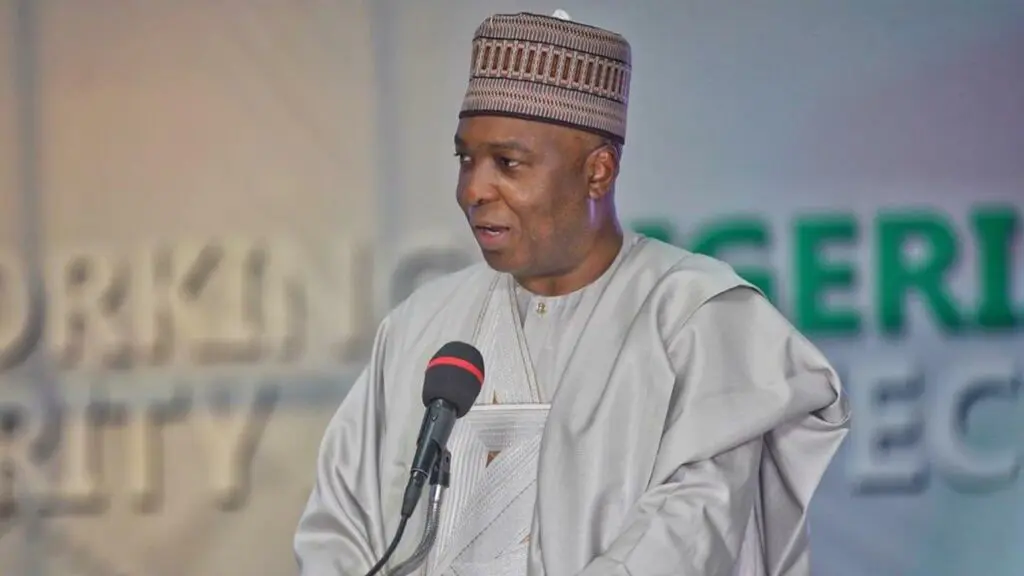
Former Senate President Bukola Saraki has stressed the importance of an independent legislature in sustaining democratic governance, declaring that any parliament unable to challenge the executive arm of government has failed in its constitutional responsibilities.
Saraki made the remarks on Friday during the June 12, 2026 edition of The Platform, a public policy forum broadcast on Channels Television as part of activities marking Nigeria’s Democracy Day celebration.
Speaking on the role of democratic institutions in nation-building, the former Senate President argued that the legislature must serve as a critical check on executive power rather than merely functioning as a rubber stamp for government policies and proposals.
Drawing from his experience as Senate President between 2015 and 2019, Saraki said one of the most important lessons he learned was that a truly effective parliament must possess the courage and independence to scrutinise government actions and reject proposals that do not serve the national interest.
“So, what I learned in those four years in the National Assembly as Senate President is that a legislature that cannot say no is not a legislature at all,” he said.
“A legislature which simply receives, accepts proposals, approves them without scrutiny, and goes home, has not fulfilled its constitutional mandate.”
According to Saraki, the National Assembly occupies a unique position within Nigeria’s democratic framework, providing a platform where diverse interests and opinions can be debated peacefully despite the country’s ethnic, religious and political differences.
He described parliament as an institution that helps preserve national unity by creating a forum where disagreements can be resolved through dialogue and democratic processes rather than conflict.
“The parliament provides an arena where a divided country can argue without breaking, regardless of where one comes from,” he stated.
Saraki also emphasised that legislative independence should not be mistaken for hostility towards the government of the day. Rather, he argued that an autonomous parliament strengthens governance by ensuring accountability, transparency and adherence to democratic principles.
“The independence of the National Assembly is not rebellion against the government of the day,” he said.
The former Senate President noted that robust oversight by lawmakers ultimately enhances the credibility and legitimacy of government decisions. He warned that unchecked executive authority could weaken public trust in democratic institutions and undermine confidence in governance.
“We’re talking about how those institutions can do what they are meant to do in providing the mandate, because if the National Assembly is independent, it’s a very great thing that makes the government legitimate,” he explained.
“A mandate that is never tested is a mandate that no one can trust.”
Saraki’s comments come amid ongoing national conversations about the strength of Nigeria’s democratic institutions and the relationship between the executive and legislative arms of government.
Political analysts have long argued that one of the hallmarks of a mature democracy is the ability of the legislature to exercise effective oversight without fear or undue influence. Such oversight includes scrutinising government spending, reviewing executive appointments, debating legislation and holding public officials accountable.
The former Senate President’s remarks also resonate with broader calls for institutional reforms aimed at strengthening democratic governance and ensuring that constitutional checks and balances function effectively.
As Nigeria commemorates another Democracy Day, Saraki’s intervention serves as a reminder of the central role independent institutions play in safeguarding democratic values and protecting the interests of citizens.
His message underscores a fundamental principle of democratic governance: that the strength of a democracy lies not only in elections but also in the ability of its institutions to operate independently, hold power accountable and uphold the rule of law.

