


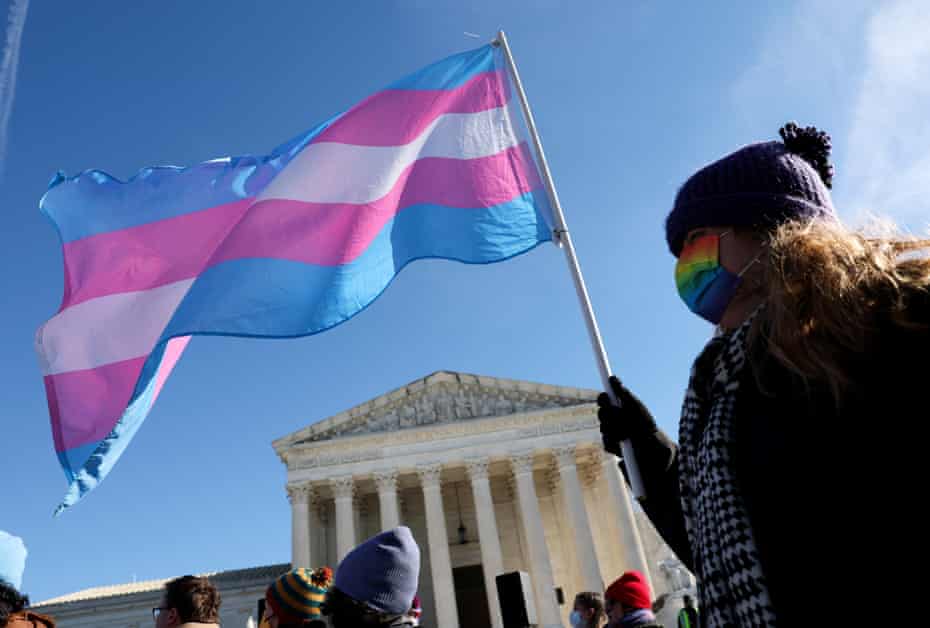
Oral arguments have begun at the US Supreme Court over state laws that bar transgender girls from competing on girls’ school sports teams, in a case with wide implications for civil rights protections.
The hearing combines two legal challenges brought by transgender students against Republican-backed laws in Idaho and West Virginia. A ruling against the students could weaken legal safeguards for trans youth and LGBTQ+ people more broadly.
The court first heard arguments in Little v Hecox, which concerns Idaho’s 2020 law, the first in the country to impose a blanket ban on trans women and girls participating in female sports teams.
The case was brought by Lindsay Hecox, a transgender college student who had hoped to compete in track. Although Hecox has since asked for the case to be dismissed, saying she no longer competes in college sports and wishes to avoid further harassment, the supreme court is proceeding with the hearing.
Representing Idaho, solicitor general Alan Hurst argued that the law is based on sex rather than gender identity. He told the court that sex is central to sporting competition and is linked to physical attributes such as muscle mass, bone density, and heart and lung capacity.
The second case, West Virginia v BPJ, involves Becky Pepper-Jackson, a 15-year-old transgender girl who challenged a 2021 state law that barred her from participating in school track events.
A federal court initially blocked the West Virginia ban, allowing Pepper-Jackson to compete, but the state appealed the decision to the supreme court.
Across the US, 27 states have enacted laws restricting transgender students’ access to school sports. Most of the measures focus on trans girls, although some apply to all transgender youth.
Supporters of the bans argue they are necessary to ensure fairness and safety in girls’ and women’s sports. Trans rights advocates counter that the laws are discriminatory and harmful, and say there is no credible evidence that inclusive sports policies have caused harm to cisgender athletes.
The laws affect a very small number of students. In several states, lawmakers have struggled to identify any transgender girls competing in school sports. The president of the National Collegiate Athletic Association has previously told Congress he was aware of fewer than 10 transgender athletes competing at college level nationwide.
Lawyers representing the students, including the American Civil Liberties Union, argue that the bans violate the constitution’s equal protection clause. In the West Virginia case, they also contend the law breaches Title IX, which prohibits sex discrimination in education.
The states are being supported by the Alliance Defending Freedom, a Christian legal organisation that has been involved in a number of high-profile cases opposing LGBTQ+ rights and abortion access.
A central question for the court is whether the laws should be subject to “heightened scrutiny”, a standard that requires the government to provide strong justification for discriminatory policies. Civil rights groups warn that a refusal to apply this standard could make anti-trans laws easier to uphold.
If the court rules that transgender people are not protected under Title IX, the decision could pave the way for further restrictions, including limits on bathroom access and the use of chosen names and pronouns in schools.
In a statement last week, Pepper-Jackson said she participates in sports to make friends, have fun and challenge herself. She said the law passed in her state singled her out as the only transgender student athlete and denied her the same opportunities as her peers.

