


President Donald Trump has warned that Canada could face sweeping 100% tariffs on its exports to the United States if it proceeds with a new trade agreement with China, sharply escalating tensions between the two neighbours.
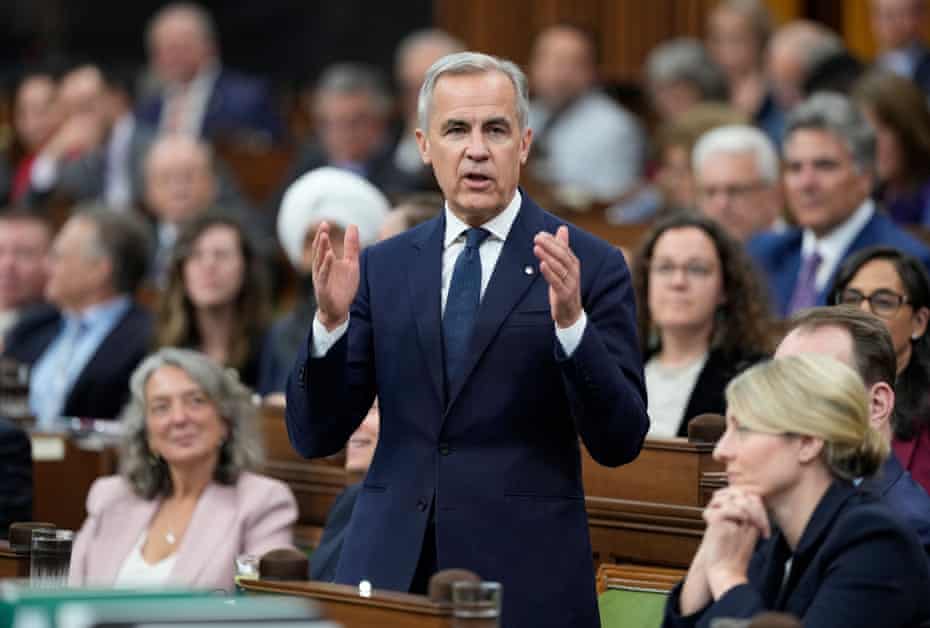
In a social media post on Saturday, Trump said Canada would pay a heavy price if it allowed Chinese goods to enter the U.S. through its territory. He accused Prime Minister Mark Carney of attempting to turn Canada into a “drop-off port” for Chinese products, warning that such a move would not be tolerated by Washington.
The threat came despite Trump previously praising the deal, saying it was something Carney “should be doing” and describing it as a positive step. Canada’s agreement with China, announced earlier this month, would lower tariffs on Chinese electric vehicles in exchange for Beijing easing retaliatory duties on Canadian agricultural exports.
Read related news from New Daily Prime:
Trump files $5bn lawsuit against JPMorgan Chase
Trump files $5bn lawsuit against JPMorgan Chase
Carney’s office did not immediately comment on Trump’s latest remarks.
The dispute unfolds against a backdrop of worsening relations between Trump and Carney, compounded by the former president’s controversial push to acquire Greenland, a move that has unsettled allies and strained the NATO partnership.
Speaking earlier this week at the World Economic Forum in Davos, Trump claimed that “Canada lives because of the United States.” Carney responded by saying his country could demonstrate that nations do not need to bend toward autocratic pressures to survive in a changing global order.
Trump later withdrew an invitation for Carney to join a proposed “Board of Peace,” which he says is intended to help resolve global conflicts. He has also renewed provocative rhetoric about Canada’s sovereignty, again suggesting it could be absorbed into the United States as a 51st state. This week, Trump shared an altered image online depicting Canada, Greenland, Venezuela and Cuba as part of U.S. territory.
In his Saturday post, Trump referred to Canada’s leader as “Governor Carney,” a nickname he previously used for former prime minister Justin Trudeau, underscoring the deterioration in bilateral relations. He also claimed that China would “eat Canada alive,” accusing Beijing of threatening Canada’s economy, social fabric and way of life.
Carney, meanwhile, has framed the China deal as a pragmatic recalibration of Canadian foreign policy. He has argued that global conditions have changed and that Canada must act strategically rather than wait for certainty from Washington. He has also said Canada’s relationship with China, while marked by disagreements over issues such as human rights, has become more predictable than its ties with the U.S. under Trump.
Despite Trump’s threats, Canada remains partially shielded from the harshest U.S. tariffs under the Canada–U.S.–Mexico Agreement, which is due for review this year. Canada is the top export destination for 36 U.S. states, with billions of dollars in goods and services crossing the border daily. It is also the largest foreign supplier of steel, aluminum and uranium to the United States, as well as a key source of critical minerals important to U.S. national security.
As Washington weighs its next move, Canada’s decision to deepen economic engagement with China signals a willingness to diversify trade partnerships at a time of growing uncertainty in North American trade relations.

