


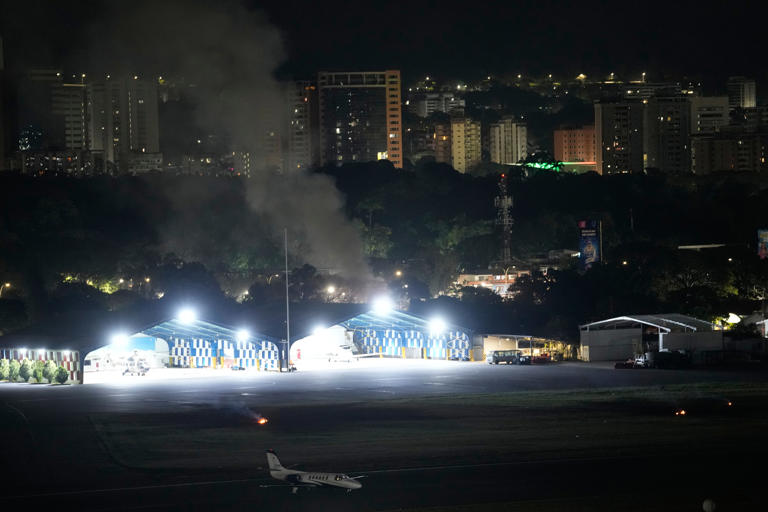
United States has launched military strikes inside Venezuela, sharply escalating tensions between Washington and Caracas after months of warnings by U.S. President Donald Trump against the government of Venezuelan leader Nicolas Maduro.
According to a report by Reuters, explosions were heard across Venezuela’s capital, Caracas, late Friday, as a U.S. official confirmed that American forces had carried out operations on Venezuelan soil. Venezuelan authorities said additional attacks were recorded in the states of Miranda, Aragua and La Guaira, signalling a broadening of the military action beyond the capital.
In response, President Maduro declared a national emergency and ordered the immediate mobilisation of the country’s defence forces. In a strongly worded statement, the Venezuelan government accused President Trump of launching the attacks in an attempt to seize Venezuela’s vast oil and mineral resources. Officials insisted that the United States “will not succeed” in taking control of the country’s natural wealth.
The Pentagon declined to provide details of the strikes, referring all inquiries to the White House, which also refused to comment.
Months of Pressure and Military Buildup
The strikes follow a prolonged campaign of pressure by the Trump administration against the Maduro government. Over recent months, the United States has significantly increased its military presence in the region, deploying an aircraft carrier, warships and advanced fighter jets to the Caribbean. Washington says the buildup is part of efforts to combat drug trafficking, though Caracas has described it as a direct threat to its sovereignty.
President Trump has repeatedly accused Venezuela of fuelling the flow of illegal drugs into the United States. His administration has expanded economic sanctions, imposed a blockade on Venezuelan oil exports, and seized sanctioned oil tankers off the country’s coast. Since early September, U.S. forces have also carried out repeated attacks on vessels in the Caribbean Sea and eastern Pacific Ocean that American officials allege were involved in drug trafficking.
As of Friday, Venezuelan officials said at least 35 boats had been struck, with a reported death toll of no fewer than 115 people. Several governments and human rights groups have condemned the operations as extrajudicial killings, accusations Washington rejects. The Maduro government has consistently denied any involvement in drug trafficking.
Read related story from New Daily Prime: US-Venezuela tensions rise as China, Russia intervene
Last week, President Trump acknowledged that U.S. forces had struck a land-based site in Venezuela where boats were allegedly being loaded with drugs. The admission marked the first known U.S. land operations in Venezuela since the campaign began. Trump did not clarify whether the CIA was involved, though multiple media outlets reported that the agency carried out a drone strike on a docking area believed to be used by drug cartels.
In its latest statement, the Venezuelan government said Maduro had ordered “all national defence plans to be implemented” and formally declared a “state of external disturbance.”
Diplomatic Efforts Undermined
The escalation comes at a time of fragile diplomatic signals. Only days earlier, Venezuela had indicated it was open to negotiating an agreement with the United States to combat drug trafficking. However, in a pre-recorded interview aired on Thursday, Maduro accused Washington of seeking regime change and access to Venezuela’s oil reserves through what he described as a months-long campaign of military intimidation that began with a large U.S. deployment to the Caribbean in August.
Maduro has been charged with narco-terrorism in the United States, allegations his government dismisses as politically motivated.
With U.S. military assets positioned nearby and Venezuelan forces now on high alert, analysts warn that the risk of further confrontation is growing. The strikes represent one of the most serious escalations between the two countries in years, raising fears of wider instability across the Caribbean and northern South America.
As international reactions continue to unfold, attention is focused on whether Washington will expand its military operations—or whether diplomacy can still halt a slide toward a deeper and more dangerous conflict.
For details, visit www.newdailyprime.news

