


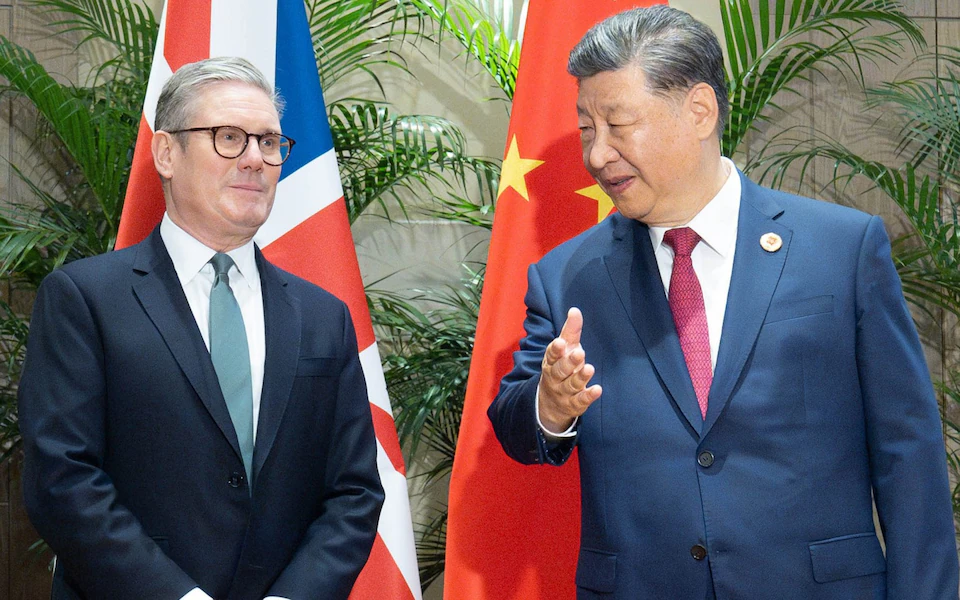
Britain’s Prime Minister, Keir Starmer, has arrived in Beijing on a high-stakes diplomatic visit aimed at resetting relations with China, while insisting the United Kingdom will not be forced to choose between Beijing and its long-standing alliance with the United States.
The visit, the first by a British prime minister in eight years, marks a defining moment in the Labour government’s foreign policy and comes at a time of heightened geopolitical tension between China and Western powers. Speaking ahead of the trip, Sir Keir said Britain would pursue a “pragmatic” relationship with China, focused on economic cooperation, while maintaining firm security and defence ties with Washington.
Read related news from New Daily Prime:
Starmer rejects Trump pressure on Greenland
Starmer condemns Trump’s Afghanistan troops remarks
Despite MI5, MI6 capabilities, China hacked downing street phones for years
That message has been closely scrutinised on both sides of the Atlantic. The United States remains the UK’s most important strategic ally, particularly in defence, intelligence sharing and global security. At the same time, China is one of the world’s largest economies and a key trading partner, making engagement difficult to avoid despite persistent concerns over human rights, cyber security and national security risks.
Sir Keir’s programme in Beijing includes talks with senior Chinese officials and is expected to feature a meeting with President Xi Jinping. Discussions are set to centre on trade, investment and economic stability, with British officials keen to reopen diplomatic and commercial channels that have been largely frozen in recent years. A delegation of UK business leaders is accompanying the Prime Minister, underlining the government’s push to boost exports and attract investment amid weak domestic growth.
Downing Street says the visit is part of a broader effort to stabilise relations with major global powers, arguing that disengagement carries its own risks. China’s role in global supply chains, climate policy and financial markets makes dialogue, officials say, a strategic necessity rather than a choice.
However, the trip has sparked criticism at home. Opponents warn that closer engagement with Beijing could undermine Britain’s commitment to democratic values and strain relations with key allies, particularly the United States. Security concerns also loom large, following recent allegations of cyber activity linked to Chinese state actors and warnings from intelligence agencies about espionage and influence operations.
Sir Keir has acknowledged those concerns, stressing that engagement does not mean concession. He has said issues such as national security, human rights and the rule of law will be raised directly with Chinese counterparts, and that the UK will continue to take what he described as a “clear-eyed” approach to Beijing.
The Beijing visit also comes against the backdrop of a changing relationship between London and Washington. Relations between the UK and the US are entering a closely watched phase as President Donald Trump and Sir Keir seek to define their working relationship amid shifting global alliances and domestic political pressures.
Since returning to the White House, Mr Trump has emphasised transactional diplomacy, placing national interest, trade balances and defence commitments at the heart of US foreign policy. For Sir Keir, who took office promising stability and renewed international engagement, managing ties with Washington has become one of the most delicate challenges of his early premiership.
Publicly, both leaders have struck a respectful tone. Sir Keir has repeatedly highlighted the importance of the UK’s “special relationship” with the US, while Mr Trump has described Britain as a key ally, signalling that cooperation must deliver tangible benefits for American interests.
Privately, differences in political style and priorities remain. Mr Trump’s hardline positions on trade, defence spending and global institutions contrast with Sir Keir’s more multilateral approach. UK officials say the Prime Minister is seeking to anchor relations around shared security goals, including NATO commitments, counter-terrorism cooperation and support for Ukraine, while avoiding public clashes that could unsettle markets or diplomacy.
Trade is expected to be an early test. Mr Trump has revived calls for tougher bilateral trade terms, while Sir Keir has signalled openness to closer economic cooperation, provided British regulatory standards and labour protections are preserved.
Analysts say the China trip and the evolving relationship with Washington together illustrate the central challenge facing the Starmer government: balancing economic necessity with strategic caution. Internationally, the visit is seen as a test of Britain’s ability to pursue an independent diplomatic course without weakening its alliance with the United States.
Whether that balance can be sustained remains uncertain. For now, Sir Keir’s Beijing visit underlines his ambition to reassert Britain as an active diplomatic player,engaging with rivals as well as allies — in an increasingly fragmented and competitive world.
For more details, visit www.newdailyprime.news

