


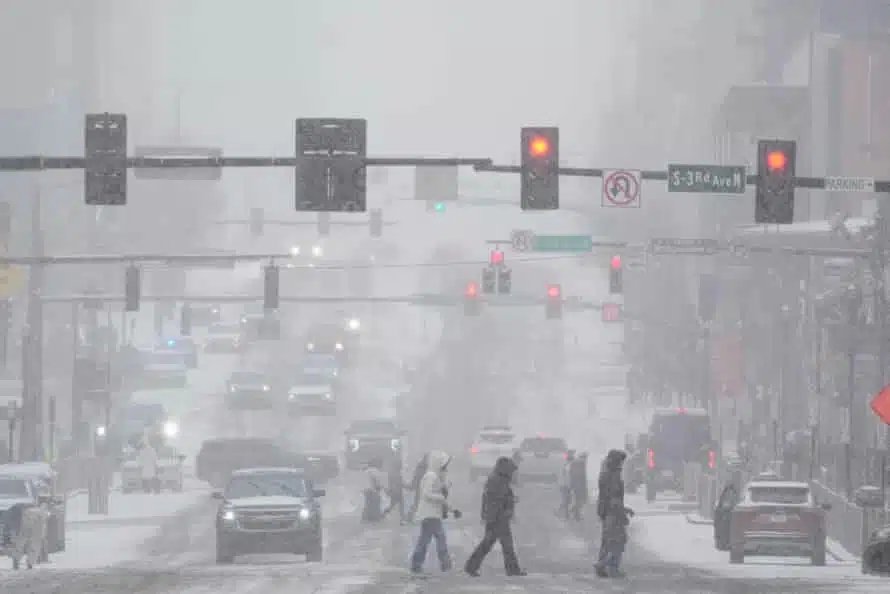
At least seven people have died after a powerful winter storm swept across large parts of the United States, bringing heavy snow and ice from the Gulf Coast to the north-east, knocking out power to more than one million people in the south and forcing widespread travel disruption.
Louisiana’s department of health confirmed two storm-related deaths in Caddo Parish. The agency said two men, whose ages were not released, died from hypothermia.
In New York City, mayor Zohran Mamdani said at least five people were found dead outdoors on Saturday, before snowfall began.
“While we do not yet know their causes of death, there is no more powerful reminder of the dangers of extreme cold and how vulnerable many of our neighbours are, especially homeless New Yorkers,” Mamdani said.
He added that the city is facing a longer stretch of colder temperatures than it has experienced in the past eight years.
The National Weather Service warned that the storm could dump up to 18 inches of snow across New England, alongside half an inch of freezing rain in parts of the mid-Atlantic and the Ohio and Tennessee valleys.
Heavy rain is also forecast for the lower Mississippi Valley, with parts of the Tennessee Valley affected on Monday. After the storm passes, bitter cold and dangerous wind chills are expected from the southern plains to the north-east.
Describing the weather system as “historic”, Donald Trump on Saturday approved federal emergency disaster declarations for South Carolina, Virginia, Tennessee, Georgia, North Carolina, Maryland, Arkansas, Kentucky, Louisiana, Mississippi, Indiana and West Virginia.
“We will continue to monitor and stay in touch with all states in the path of this storm,” Trump wrote on Truth Social. “Stay safe and stay warm.”
According to the Department of Homeland Security, 17 states and Washington DC have declared weather emergencies. Speaking at a news conference, DHS secretary Kristi Noem urged residents to take precautions.
“It’s going to be very, very cold,” she said. “We’d encourage everybody to stock up on fuel and food. We will get through this together.”
Power outages continued to rise on Sunday morning. By 6.30am ET, more than 900,000 customers were without electricity, according to PowerOutage.us.
Tennessee accounted for nearly 335,000 outages, followed by Mississippi with more than 178,000, Louisiana with over 145,000, and Texas with around 93,000.
The Department of Energy issued emergency orders allowing grid operators in Texas and the mid-Atlantic to deploy backup power and run certain resources regardless of regulatory limits, in a bid to prevent large-scale blackouts.
The National Weather Service warned that the storm’s duration and geographic reach were unusual, with heavy ice expected across the south-east that could cause “crippling to locally catastrophic” damage.
Forecasters also predicted record low temperatures and dangerous wind chills spreading into the Great Plains by Monday.
Air travel has been heavily disrupted. More than 10,500 flights were cancelled on Sunday, according to FlightAware, making it the largest cancellation event since the pandemic, according to aviation analytics firm Cirium.
A further 1,800 cancellations have already been reported for Monday. More than 4,000 flights were cancelled on Saturday.
Snow and ice have caused hazardous conditions in several states. Up to eight inches of snow mixed with sleet was reported around Little Rock, Arkansas, while nearly three-quarters of an inch of ice accumulated near Hall Summit, Louisiana. Some areas of New Mexico recorded more than a foot of snow.
Major airlines warned passengers to expect further delays. Delta Air Lines cancelled additional flights in Atlanta and along the east coast, including Boston and New York, and said it was redeploying staff to support de-icing operations at southern airports.
JetBlue cancelled around 1,000 flights through Monday, while United Airlines said it had cut services in areas facing the worst conditions.
Electricity providers also stepped up preparations. Dominion Energy, which supplies parts of Virginia including major data centre hubs, said the storm could be one of the largest winter events ever to affect the company if ice forecasts prove accurate.

