


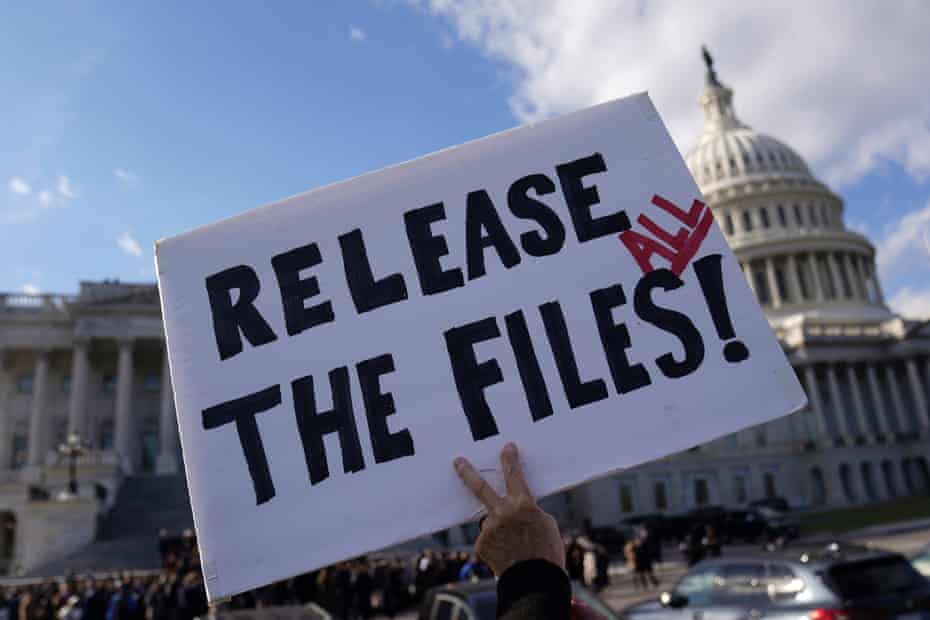
The US justice department said on Wednesday that it has uncovered more than a million additional documents linked to the Jeffrey Epstein case, warning that reviewing them for release could take several more weeks.
In a post on X, the department said federal prosecutors in Manhattan and the FBI had handed over the records in compliance with the Epstein Files Transparency Act, existing laws and court orders.
The department said lawyers were working “around the clock” to review the material and apply legally required redactions to protect victims. It said the documents would be released as soon as possible, but the sheer volume meant the process would take longer.
The statement followed reports earlier on Wednesday that hundreds of thousands of extra records had been identified. A review process involving about 200 analysts is under way and expected to take at least another week.
Axios, citing unnamed justice department officials, reported that around 750,000 records have already been reviewed and disclosed, with roughly 700,000 still to be examined. Officials said many of the remaining files were likely duplicates, meaning the final number could be far smaller.
“This will end soon,” one official told Axios. “The conspiracy theories won’t.”
On Friday, the day the first batch of files was released, the deputy attorney general, Todd Blanche, said several hundred thousand documents were expected to be made public. He said the material included photographs and other records linked to investigations into Epstein.
The initial release prompted anger from victims’ groups and threats of legal action, after the disclosure fell short of what the law required by the 19 December deadline.
Pressure has since mounted on the justice department to complete the process. Lawmakers Ro Khanna, a Democrat from California, and Thomas Massie, a Republican from Kentucky, have threatened contempt hearings against the US attorney general, Pam Bondi, over the missed deadline.
CNN reported that the justice department’s office in Florida had asked career prosecutors to volunteer over the coming days to help redact the remaining files.
In an internal email cited by CNN, senior staff acknowledged the difficult timing. “We are aware the timing could not be worse,” the email said, noting the overlap with the holiday period.
On Tuesday, in the third release of files since Friday, the justice department published about 30,000 records from investigations into Epstein and his associate Ghislaine Maxwell.
That release included more references to Donald Trump than earlier batches. Among them was a 2020 email, apparently from a federal prosecutor in New York, claiming Trump had travelled on Epstein’s private jet more times than previously reported, including one flight where the only listed passengers were Epstein, Trump and a “then-20-year-old”.
The latest batch also contained false material, including a fake letter supposedly sent by Epstein to the convicted sex offender and former gymnastics coach Larry Nassar, and a fabricated video purporting to show Epstein’s death in his jail cell.
Blanche said the presence of such material reflected the nature of large-scale document production. “We produce documents, and sometimes this can result in releasing fake or false documents because they are in our possession and the law requires their release,” he said.
He stressed that the Nassar letter and the video were fake, adding that rumours and sensational claims online should not be confused with verified facts.
The releases have also shed some light on the FBI’s efforts to identify potential co-conspirators.
One email from an FBI employee in New York listed 10 possible co-conspirators after Epstein’s arrest in July 2019. Only three names were unredacted: Maxwell; Jean-Luc Brunel, the model agent who later died by suicide after being charged with rape and sexual assault in France; and the billionaire Leslie Wexner.
Wexner, 88, has repeatedly denied any involvement in Epstein’s crimes and is not known to be under investigation. His representatives said prosecutors had previously stated he was neither a target nor a co-conspirator, and that he had cooperated fully with investigators.
The partial disclosure of names has triggered a political response.
The Senate Democratic leader, Chuck Schumer, called for greater transparency. He said the justice department must explain who was involved, how they were linked to Epstein and why they were not prosecuted.
“Protecting possible co-conspirators is not the transparency the American people and Congress are demanding,” he said.

