


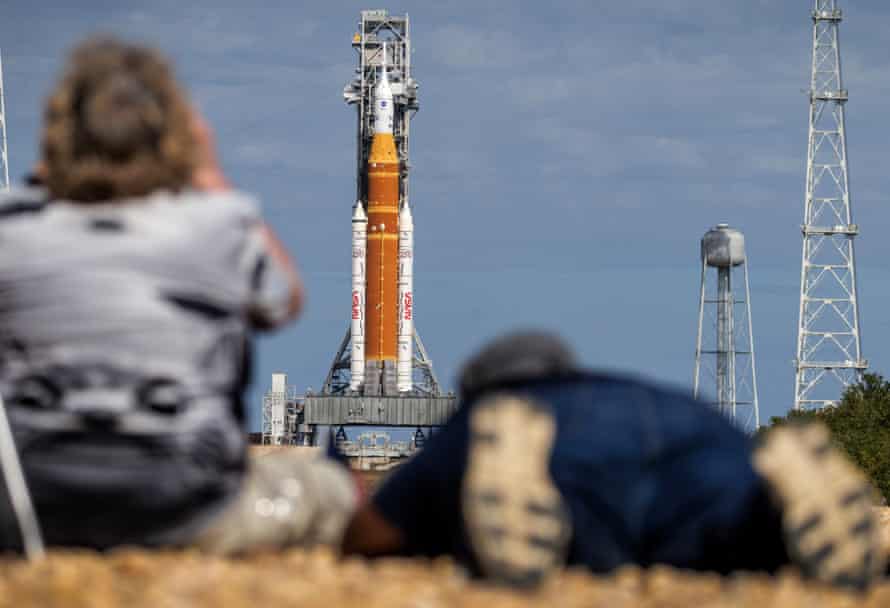
NASA has postponed its landmark mission to send astronauts around the Moon and back after technical problems emerged during a key test of its most powerful rocket to date.
The US space agency had planned to launch Artemis II from the Kennedy Space Center in Florida as early as next week. However, Nasa said overnight that the mission would be delayed until March, without confirming a specific launch date.
The decision followed a “wet dress rehearsal”, an extensive launch-day simulation in which engineers detected a hydrogen leak in the Space Launch System (SLS). A separate issue was also found with a valve linked to the Orion capsule, where the four astronauts will live and work during the 10-day mission.
Nasa said engineers had “pushed through several challenges” during the two-day test and that teams would now conduct a full review of the data from the 98-metre-tall rocket.
The delay is a setback for the crew, who have already spent nearly two weeks in quarantine to reduce the risk of illness before launch.
The mission would mark humanity’s first return to the vicinity of the Moon in more than 50 years. It will also see Christina Koch become the first woman and Victor Glover the first person of colour to travel beyond low Earth orbit.
Artemis II will be the second flight of the SLS rocket, following the uncrewed Artemis I mission in 2022, which was also affected by hydrogen leaks during testing.
The astronauts will not enter lunar orbit but will complete a 685,000-mile round trip around the Moon, the first such journey since Apollo 17 in 1972. The mission is intended to pave the way for Artemis III, which aims to land astronauts near the Moon’s south pole.
Nasa ultimately plans to establish a sustained human presence on the lunar surface under the Artemis programme, named after the Greek goddess of the Moon and twin sister of Apollo.
The Artemis II crew is led by Reid Wiseman, a US astronaut who previously spent months aboard the International Space Station. He is joined by Victor Glover and Christina Koch, along with Jeremy Hansen, a Canadian physicist and former fighter pilot.
If the mission is successful, Hansen will become the first non-American astronaut to travel beyond low Earth orbit.
During the overnight test on Tuesday, engineers pumped more than 2.6m litres of super-cooled liquid hydrogen and liquid oxygen into the rocket’s tanks, simulating the final stages of a live countdown.
Nasa said the crew would return to quarantine around two weeks before the next launch attempt. The agency has previously indicated there are several possible launch windows between February and the end of April.

