


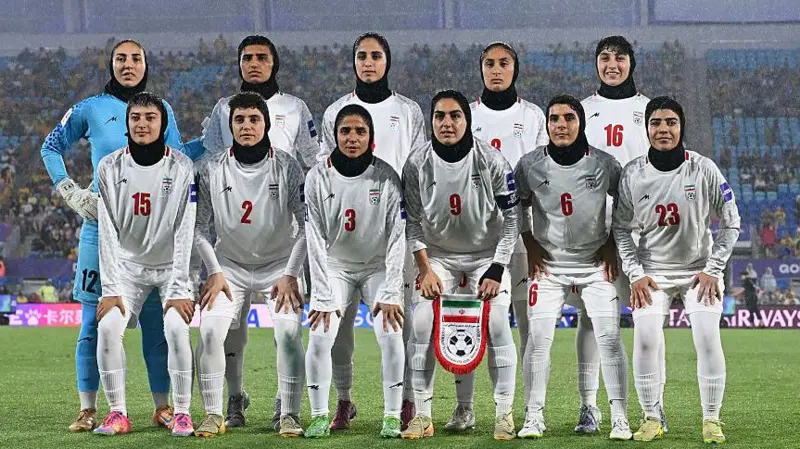
Two members of Iran’s women’s football delegation have chosen to return home despite offers of asylum and safety assurances from the Australian government, a decision that has drawn global attention to the risks facing athletes who challenge authority in Iran.
The pair — a player and a member of the team’s support staff — had earlier indicated they wanted to remain in Australia following concerns about their safety after the team refused to sing Iran’s national anthem before a match at the AFC Women’s Asian Cup.
But Australian Immigration Minister Tony Burke told parliament on Wednesday that one of the two later reversed her decision after speaking with teammates who had already chosen to leave the country.
“One of the two who had made the decision to stay last night had spoken to some of the teammates who had left and had changed her mind,” Burke said.
Read related news:
Pursue peace, Oluwo urges Iran’s new leader
Putin backs Iran’s new leader as China warns against foreign interference
Linc Edochie warns northern youths over Iran protest
The two had previously joined five teammates who were granted humanitarian visas by Australia. The government said those players would be fast-tracked for permanent residency amid fears they could face repercussions in Iran.
However, Burke said the individual who reconsidered her decision had been advised by teammates and a coach to contact the Iranian embassy.
“Unfortunately, in making that decision, she’d been advised by her teammates and coach to contact the Iranian embassy and to get collected,” he said.
The development raised concerns because it revealed the location of the other players who had chosen to stay in Australia.
Burke said he immediately ordered authorities to move them to another secure location.
“I immediately gave the instruction for people to be moved, and that’s been dealt with immediately,” he told lawmakers.
The situation unfolded as the Iranian team prepared to leave Australia after being knocked out of the Asian Cup. The remaining players departed on Tuesday night local time.
Before their departure, Australian officials made repeated offers of protection to the delegation. At Sydney Airport, players were separated from their minders and spoken to individually through translators, with a strong police presence ensuring they could make their decisions privately.
Officials also allowed players to contact family members before deciding whether to stay.
Despite the opportunity, none of the remaining team members accepted the offer.
Burke said the decision was entirely theirs.
“That individual made their own decision,” he said, stressing that there had been no pressure to board the flight.
The controversy surrounding the team began last week when players declined to sing Iran’s national anthem before their opening match against South Korea. The move was widely seen as a silent protest against Iran’s leadership.
Iranian state media commentators later accused the players of betrayal, with one conservative analyst describing them as “wartime traitors” and calling for punishment.
The team sang the anthem in their following matches, prompting speculation that they had come under pressure from officials accompanying the delegation.
Meanwhile, activists from Australia’s Iranian community gathered at Sydney Airport to support the players and protest against their return to Iran. Some campaigners claimed members of the team had quietly signalled for help.
Five players who accepted humanitarian visas — Fatemeh Pasandideh, Zahra Ghanbari, Zahra Sarbali, Atefeh Ramazanzadeh and Mona Hamoudi — have since been moved to a secure location.
Australian Prime Minister Anthony Albanese said the situation had resonated deeply with the public.
“Australians have been moved by the plight of these brave women,” he said. “They’re safe here, and they should feel at home here.”
The case also drew international attention from former U.S. President Donald Trump, who urged Australia to grant asylum to the players and offered to accept them in the United States if Canberra declined.
For now, however, most members of the Iranian delegation have returned home, leaving unanswered questions about what consequences they or their families might face after the tournament.

