


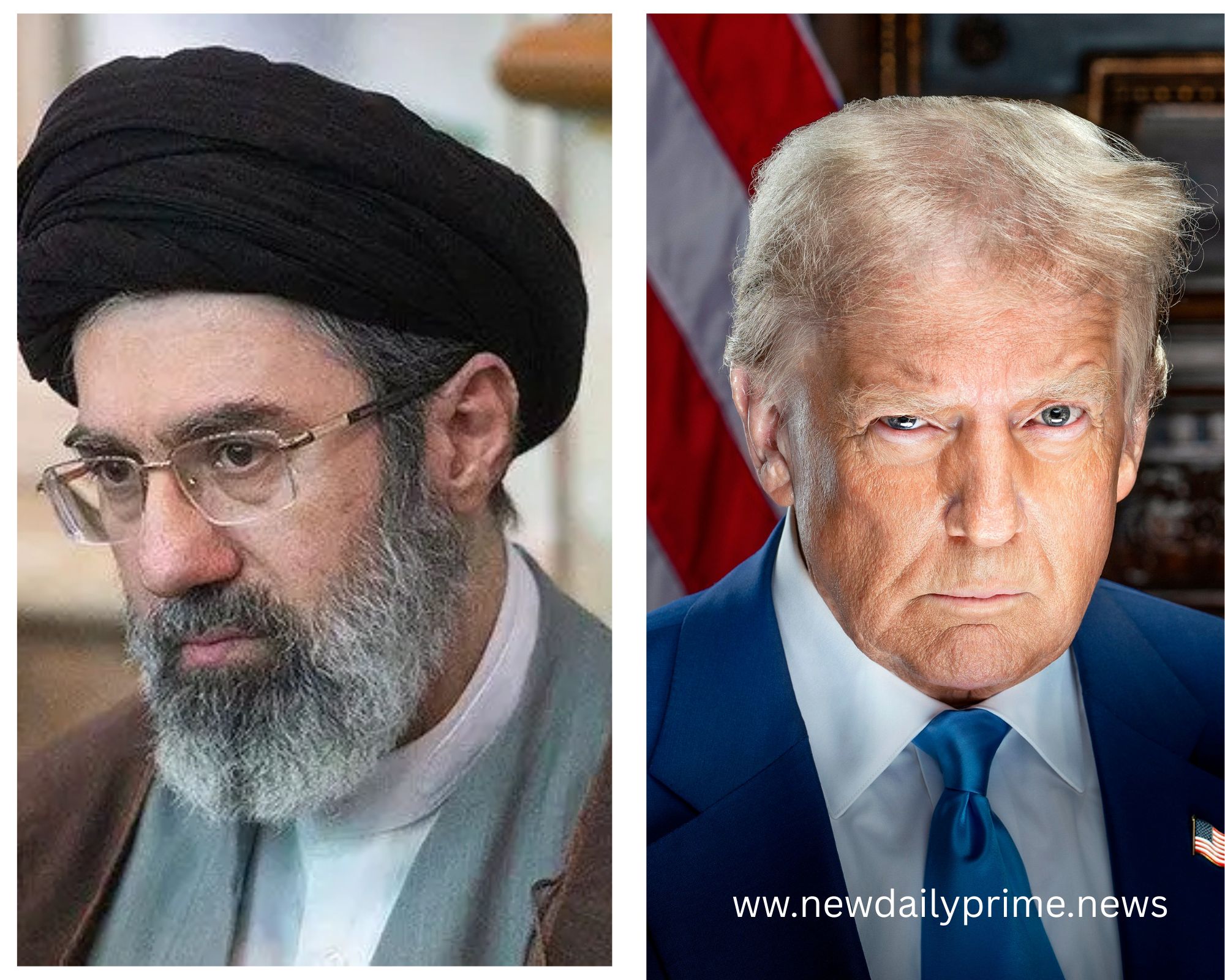
Iran’s political future has been thrown into uncertainty after the appointment of Mojtaba Khamenei as the country’s new supreme leader, a move that has already drawn sharp criticism from United States President Donald Trump.
The 56-year-old cleric has taken over the powerful position following the death of his father, Ayatollah Ali Khamenei, who was killed in his Tehran compound on the first day of the ongoing war. Ayatollah Khamenei had ruled as Iran’s supreme leader for more than 37 years, making him one of the most influential figures in the country’s modern history.
Mojtaba Khamenei survived the attack because he was not present at the compound when it was struck. However, the strike reportedly killed several members of his immediate family, including his mother, wife and daughter.
Read related news from New Daily Prime:
Russian intelligence ‘helped Iran target US military bases’
Iran’s next supreme leader must win US approval to survive — Trump
Under Iran’s political system, the supreme leader is selected by the Assembly of Experts, a body of 88 Islamic scholars responsible for choosing and supervising the country’s highest authority. The assembly members are chosen largely for their loyalty to the ruling system.
The building where the assembly usually meets was destroyed in an airstrike during the early stages of the conflict. However, officials believe none of the members were inside at the time.
Despite his powerful family background, little is publicly known about Mojtaba Khamenei. The second-eldest son of the former leader has kept a low public profile for most of his life. Unlike many senior clerics, he has rarely appeared in public speeches and has not led Friday prayers.
However, he is widely considered a hardlines conservative within Iran’s political system. During the 1980s Iran-Iraq war, he served in the Habib battalion of the Islamic Revolutionary Guard Corps (IRGC), the powerful military organisation that plays a major role in Iran’s politics and security.
That experience helped him build strong relationships within the IRGC. Many of the men he served with later rose to senior positions in the country’s military and political establishment.
His close ties with the Revolutionary Guard are believed to have played a key role in securing his appointment as supreme leader. US President Donald Trump strongly criticised the decision, describing Mojtaba Khamenei as a “lightweight” and saying his leadership was unacceptable to Washington.
“Khamenei’s son is unacceptable to me,” Mr Trump said.
“We want someone that will bring harmony and peace to Iran.”
Political analysts say the new leader holds significant influence behind the scenes. Tara Kangarlou, author of The Heartbeat of Iran, said Mojtaba Khamenei has deep connections within the IRGC and across many sectors of Iran’s power structure.
“He holds a lot of power in the IRGC apparatus,” she told Sky News. “He has his hands in pretty much every infrastructure you can imagine in Iran — money, power and influence.”
Mojtaba Khamenei is currently under US sanctions and has reportedly built a large network of wealth and property around the world, including assets linked to London.
Unlike his father, who was known as an intellectual with a strong following among clerics and supporters in Iran, the new leader does not have the same reputation among the public.
The role of supreme leader is the most powerful position in Iran. The leader controls the armed forces, influences the judiciary and government, and acts as the ultimate guardian of the Islamic Republic.
Although Mojtaba Khamenei studied in the holy city of Qom, he is considered only a mid-ranking cleric rather than a senior ayatollah.
His appointment also raises questions about the direction of Iran’s political system. By choosing the son of the previous leader, the Assembly of Experts has effectively created a dynastic transfer of power.
That move may prove controversial. Iran’s modern history includes two revolutions that removed ruling dynasties — the fall of the Qajar dynasty in 1925 and the overthrow of the Pahlavi monarchy in 1979.
Despite his influence behind the scenes, Mojtaba Khamenei has never held elected office or served in any formal government role.
When his father became supreme leader in 1989, Mojtaba began working in his office and gradually became a powerful figure behind the scenes. US diplomatic cables released by WikiLeaks described him as the former leader’s “principal gatekeeper” and “the power behind the robes”.
His close alliance with the Revolutionary Guard also signals that hardline factions may still dominate Iran’s leadership, a development that could complicate efforts to negotiate an end to the current conflict.

