


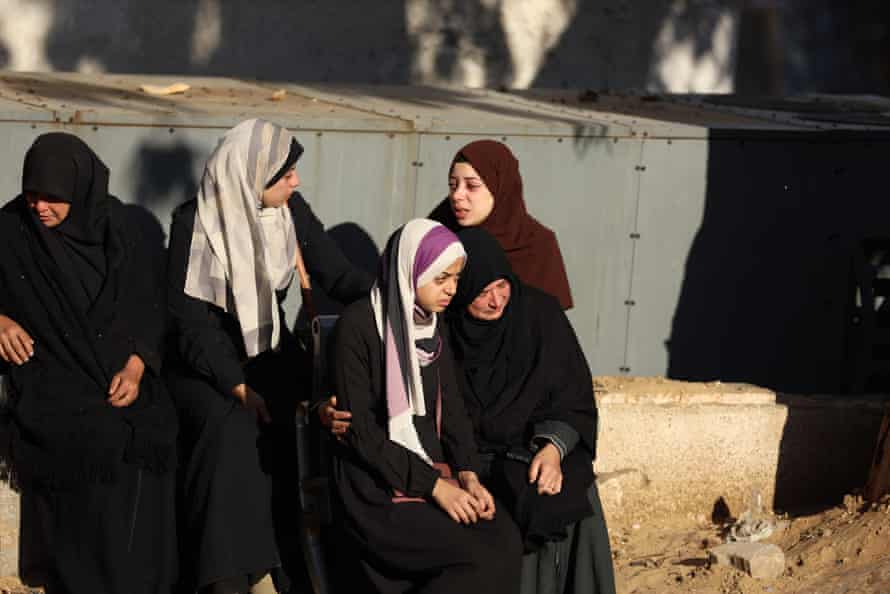
Israeli forces killed six Palestinians, including a baby, in an attack on a school sheltering displaced people in Gaza City, according to hospital officials. The deaths bring the number of Palestinians killed by Israel to 401 since the October ceasefire came into effect.
The Palestinian civil defence said Israeli troops fired across the ceasefire line, striking the school and wounding several others. It said rescue teams were only able to recover the bodies after coordinating with the United Nations, to avoid further fire.
At Gaza City hospital, dozens gathered to mourn the dead. Five body bags were placed outside the building, while a man was seen holding an infant wrapped in a white shroud.
“This is not a truce, it is a bloodbath,” said Nafiz al-Nader, a witness to the attack, speaking to Agence France-Presse. Another witness said shelling began without warning on Friday night and hit the school directly.
Under the terms of the October ceasefire, Israeli troops withdrew to a designated “yellow line”, marked on maps and on the ground by yellow concrete barriers. Despite the pullback, Israeli forces still control about 53% of Gaza and continue to carry out airstrikes in areas they do not occupy.
Friday’s killings add to growing strain on the ceasefire, now in its third month, as mediators attempt to move talks towards a second phase. The first phase called for a halt to hostilities, the withdrawal of Israeli forces to the ceasefire line, and an increase in humanitarian aid to Gaza, which earlier this year slipped into famine following Israeli aid restrictions.
The proposed second phase is intended to pave the way for a permanent end to the war. However, major disagreements remain. Israel has said Hamas must disarm and relinquish power to a civilian transitional authority, alongside the deployment of an international stabilisation force, before Israel fully withdraws from Gaza.
No clear agreement has been reached on how to resolve these issues. On Friday, the US secretary of state, Marco Rubio, said the mandate of the proposed international force would need to be clarified before countries commit troops.
“At a minimum, countries want to know what the mandate is and how it will be funded,” Rubio said, adding that several states acceptable to all sides had expressed willingness to take part.
The ceasefire has so far prevented a return to full-scale fighting, but its future looks increasingly uncertain as progress towards a permanent settlement stalls. Qatar’s prime minister, Sheikh Mohammed bin Abdulrahman bin Jassim al-Thani, warned on Thursday that delays in advancing to the second phase “endanger the entire process”.
The war in Gaza began after Hamas-led militants killed about 1,200 people and took 251 hostages during attacks on Israel on 7 October 2023. Under the ceasefire deal, all but one of the hostages, or their remains, have been returned in exchange for Palestinian detainees and prisoners.
According to Gaza’s health ministry, more than 70,925 Palestinians have been killed during Israel’s military campaign, around half of them women and children. The figure is expected to rise as bodies continue to be recovered from beneath the rubble.
Large parts of Gaza’s civilian infrastructure and housing have been destroyed by Israeli bombardment. A UN commission, Amnesty International and Human Rights Watch have accused Israel of committing genocide in Gaza, a claim the Israeli government strongly denies.

