


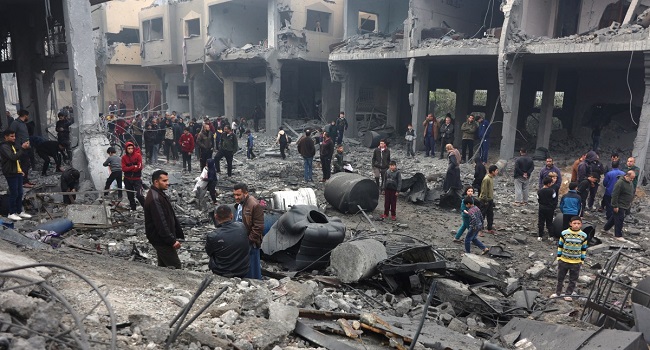
A diplomatic row has erupted between Israel and the BBC after the Israeli embassy in London accused Britain’s national broadcaster of giving disproportionate attention to the war in Gaza while largely ignoring mass protests currently unfolding in Iran.
The criticism was voiced by Alex Gandler, the Israeli embassy’s official spokesman, who took to social media platform X to question the BBC’s editorial priorities and impartiality. Gandler claimed there had been “near-total silence” on BBC news bulletins regarding widespread demonstrations against Iran’s Islamic theocratic leadership.
According to rights groups, at least seven people have been killed in clashes between protesters and Iranian security forces since the demonstrations began in Tehran on December 28, before spreading to other parts of the country.
Gandler argued that while the BBC continues to devote extensive resources to covering developments in Gaza, it has failed to adequately report on unrest in Iran, which he described as a regime that “destabilises the entire region.”
“A broadcaster that claims global impartiality cannot obsess over one theatre of conflict while largely ignoring the regime that destabilises the entire region,” he said.
BBC Rejects Claims as ‘Factually Incorrect’
The BBC strongly rejected the accusations, describing them as “factually incorrect.” In a public response, the broadcaster said it had provided daily coverage of the protests in Iran across its television channels, radio programmes, and digital platforms.
The BBC News press team shared links to recent bulletins and online articles reporting on the unrest, as well as screenshots of correspondents covering events in Iran on-air. A BBC spokesman said the protests had been reported in English and through BBC News Persian, the corporation’s Farsi-language service.
“These criticisms are factually incorrect,” the spokesman said. “We have been covering the protests in Iran daily across all of our platforms, including our main news bulletins.”
The BBC added that on one day alone, the story had featured on Radio 4’s Today programme, the BBC News channel, and multiple television and radio bulletins.
Exchange With Veteran Correspondent
Gandler’s comments came in response to remarks by John Simpson, the BBC’s veteran world affairs editor, who had noted the difficulty of deploying reporters inside Iran due to restrictions imposed by the authorities.
The Israeli embassy spokesman dismissed that explanation, insisting that the scale of BBC coverage devoted to Gaza “vastly exceeds” that given to conflicts and humanitarian crises elsewhere, including Iran.
Read related report from New Daily Prime: Israel accuses Mamdani of fuelling antisemitism
The dispute highlights a broader deterioration in relations between the Israeli government and the BBC following the October 7 attacks and the subsequent war in Gaza. Since then, Israeli officials have repeatedly questioned the broadcaster’s neutrality in its Middle East reporting.
In November, The Telegraph reported that an internal BBC memo had warned of perceived anti-Israel bias within the corporation. The memo, written by Michael Prescott, an independent editorial adviser, said there was “a desire always to believe the worst about Israel” among some BBC staff.
The BBC also faces criticism from Iranian hardliners and dissidents alike. Some critics in Iran have derisively referred to the broadcaster as “Ayatollah BBC,” accusing it of echoing narratives promoted by the office of Ayatollah Ali Khamenei. The corporation has previously said its journalists and their families have been harassed and persecuted by Iranian authorities for reporting independently.
As protests continue in Iran and the war in Gaza dominates international headlines, the latest dispute underscores the increasingly fraught environment in which global media organisations operate—caught between competing political pressures while striving to maintain claims of impartiality.
For the BBC, the row serves as another test of its editorial judgment at a time when scrutiny of its Middle East coverage remains intense, both at home and abroad.
For more details, visit www.newdailyprime.news

