


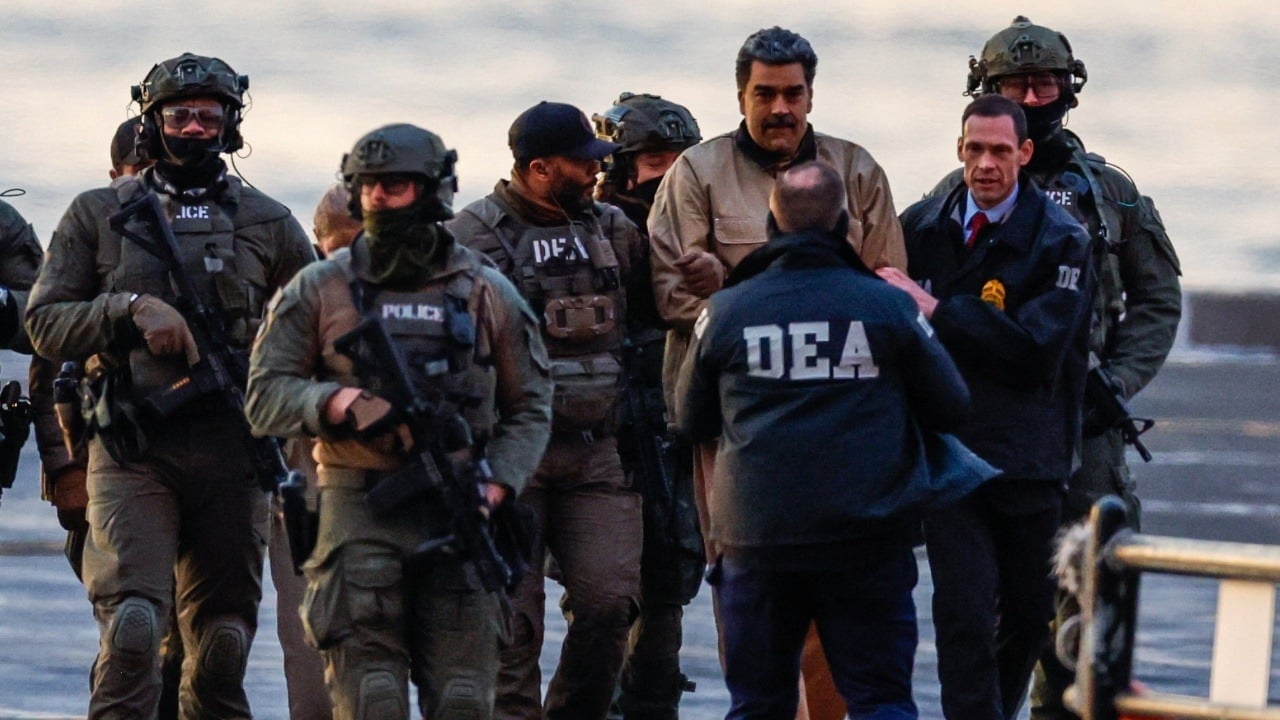
On January 3, US President Donald Trump announced that American forces had arrested Venezuelan President Nicolás Maduro and his wife, Cilia Flores, at the Miraflores Palace in Caracas.
Trump later shared an image showing Maduro blindfolded and handcuffed aboard the amphibious warship USS Iwo Jima, presenting it as evidence of the operation’s success.
Maduro was subsequently flown to the US naval base at Guantanamo Bay in Cuba before being transferred to Stewart Air National Guard Base in New York.
The New Daily Prime reported Maduro was brought before a New York court on Monday, just two days after he was taken out of Caracas by United States special forces during a military operation.
Photographs circulating online showed an armoured vehicle transporting Maduro as it arrived at the courthouse earlier in the day.
Maduro is facing four criminal charges linked to alleged drug trafficking and weapons-related offences.
Also listed as co-defendants in the case are his wife, Cilia Flores; his son, Ernesto Guerra; the minister of interior, justice and peace, Diosdado Rondón; former interior minister Ramón Chachín; and Héctor Flores, identified as the leader of the Venezuelan transnational criminal gang, Tren de Aragua.
Court documents accuse Maduro of being at the “forefront of corruption,” alleging that he used his unlawfully acquired power, alongside his alleged accomplices, to move “thousands of tons of cocaine” into the United States.
US prosecutors further claimed that Maduro had “tarnished” every public office he occupied and permitted “cocaine-fueled corruption to flourish for his own benefit, for the benefit of members of his ruling regime, and for the benefit of his family members.”
The dramatic operation marked a sharp escalation in decades of strained relations between Washington and Caracas.
The rift dates back to 1999, when Hugo Chávez — Maduro’s predecessor — won the presidency on a fiercely anti-US platform, drawing support from public anger over inequality, corruption and what many Venezuelans saw as American dominance in Latin America.
Chávez’s close alliance with former Cuban leader Fidel Castro boosted his popularity at home but deepened tensions with Washington. His decision to rewrite Venezuela’s constitution and nationalise the oil industry further set the two countries on a collision course.
Relations deteriorated further as Chávez strengthened ties with Russia, China and Iran — all rivals of the US — while expelling American-backed NGOs and diplomats, accusing the US of plotting to destabilise his government.
A failed 48-hour coup attempt against Chávez intensified distrust after Caracas accused Washington of backing the plot, an allegation the US denied.
When Chávez died in 2013, Maduro narrowly won the presidency. His administration soon became synonymous with economic collapse, corruption allegations and worsening diplomatic ties with the US.
The recent “large-scale strike” in Venezuela followed months of rising tension, including repeated threats by Trump of missile attacks and a series of deadly US operations against boats in the Caribbean, which Washington accused of smuggling narcotics.
Maduro insisted at the time that the US actions were a disguised attempt to remove him from power.
After his arrest, Venezuela’s government described the operation as an “imperialist attack” and called on citizens to protest in the streets.
Below is a timeline of key moments that defined the breakdown in relations between the two countries since Trump’s second term began:
January 2025:
On January 10, Maduro was sworn in for a third six-year term after elections widely disputed by the opposition. The US rejected the result, repeating claims of electoral fraud. On the same day, Washington announced a reward of up to $25 million for information leading to Maduro’s arrest — a figure that was later doubled.
The US State Department also imposed visa restrictions on officials aligned with Maduro, accusing them of “undermining the electoral process in Venezuela and being responsible for acts of repression.”
Ten days later, Trump was inaugurated for a second term. During his first presidency, the US justice department had indicted Maduro on narco-terrorism and cocaine trafficking charges, accusations Maduro strongly denied.
February 2025:
The Department of Homeland Security ended the temporary protected status (TPS) that had shielded about 600,000 Venezuelans in the US from deportation, citing “gang membership” and “adverse effects on US workers” without providing evidence.
Around the same time, a plane carrying 177 Venezuelan migrants deported from the US and previously held at Guantanamo Bay arrived back in Venezuela.
March 2025:
Trump imposed a 25 percent tariff on countries buying Venezuelan oil and gas. China — Washington’s main economic rival — was Venezuela’s biggest energy customer at the time, and the move came amid an escalating US–China trade dispute.
August 2025:
The US doubled the reward for Maduro’s arrest to $50 million, branding him the “global terrorist leader” of the Cartel de los Soles.
September–November 2025:
Tensions reached a peak as Washington launched an “anti-narcotics” maritime campaign across the Caribbean and Pacific. About 35 strikes were reportedly carried out against suspected drug-smuggling vessels, leaving at least 115 people dead.
The operations prompted the United Kingdom to suspend intelligence sharing with the US, while France accused Washington of violating international law.
During the same period, the US deployed its largest regional naval force in decades. Trump later confirmed he had authorised the CIA to carry out covert operations inside Venezuela and considered ground operations.
In response, Venezuela launched nationwide military drills. Shortly after, the USS Ford, America’s most advanced aircraft carrier, entered the Caribbean as part of “Operation Southern Spear”.
December 2025:
US authorities seized an oil tanker off Venezuela’s coast over alleged crude theft, piracy and other transnational crimes. The vessel was reportedly operated by Nigeria-based Thomarose Global Ventures Ltd and registered to Marshall Islands–based Triton Navigation Corp.
Caracas condemned the seizure as “a blatant theft and an act of international piracy”.
January 2026:
Maduro said Venezuela was willing to negotiate with Washington on combating drug trafficking but accused the US of seeking regime change and access to the country’s vast oil reserves.
Days later, he was captured. Trump declared that the US would “run the country until such time as we can do a safe, proper and judicious transition”.
Maduro is currently being held at a detention facility in New York, where he is being questioned over alleged “drug-trafficking” offences.
UN reacts
Following Maduro’s arrest, Stéphane Dujarric, spokesperson for the United Nations, said Secretary-General António Guterres was “deeply alarmed” by the latest developments in Venezuela.
The statement warned that the military action could have “worrying implications” for stability across the wider region.

