


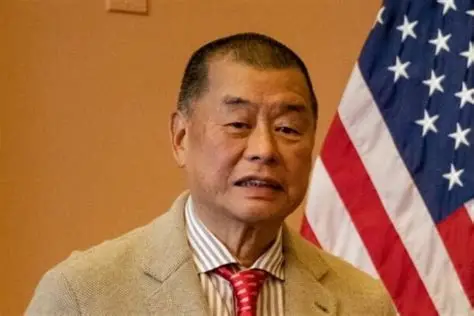
Jimmy Lai, the Hong Kong media tycoon and prominent pro-democracy activist, has been sentenced to 20 years in prison on national security charges, prompting widespread international condemnation and renewed concerns over the city’s declining civil liberties.
Lai’s daughter, Claire Lai, said the sentence was “heartbreakingly cruel” given her father’s age and deteriorating health, warning that it could mean he would “die a martyr behind bars”. His son, Sebastien Lai, described the punishment as “draconian” and “devastating”.
The 78-year-old founder of the now-defunct Apple Daily was convicted in December of sedition and conspiracy to collude with foreign forces. He pleaded not guilty to all charges. The collusion offences carry a maximum sentence of life imprisonment.
The case marks the end of a years-long legal battle that critics say symbolises Hong Kong’s transformation from a largely free society into one where dissent is harshly punished under Beijing’s control.
Taiwan, along with press freedom and human rights organisations, swiftly condemned the sentence. Reporters Without Borders said the ruling marked the effective end of press freedom in Hong Kong, accusing the authorities of showing “profound contempt for independent journalism”.
Human Rights Watch described the sentence as “effectively a death sentence”, saying it demonstrated the Chinese government’s determination to crush independent media and silence critics of the Communist party.
Amnesty International called the case “another grim milestone” in Hong Kong’s shift from rule of law to rule by fear.
Hong Kong’s chief executive, John Lee, welcomed the outcome, calling the sentence “deeply gratifying”. He said Lai’s actions were “heinous and evil in the extreme” and that the punishment upheld justice and the rule of law.
The city’s police national security chief, Steve Li, also defended the sentence, describing it as appropriate and dismissing claims about Lai’s failing health as exaggerated.
Human rights groups and the British government have repeatedly described Lai’s prosecution as politically motivated and have called for his release. Chinese state media, however, labelled him an “anti-government instigator and traitor”.
Lai, a British citizen, fled mainland China as a child refugee and later built a media empire in Hong Kong. His newspaper, Apple Daily, became a leading voice in support of the city’s pro-democracy movement, which gained momentum in the 2010s.
That movement was effectively crushed in June 2020 with the introduction of a sweeping national security law that criminalised most forms of political dissent. Lai was arrested two months later, and Apple Daily was forced to close in 2021.
UK prime minister Keir Starmer said he raised Lai’s case during a meeting with China’s president, Xi Jinping, in Beijing in January. It remains unclear whether any progress has been made. Sebastien Lai has accused the UK government of failing to act decisively, saying “time is running out”.
US president Donald Trump has also claimed he would secure Lai’s release.
Lai has been in custody since December 2020 and has spent much of that time in solitary confinement. His family say he has lost a significant amount of weight and that his teeth have deteriorated. Hong Kong authorities insist he has received appropriate medical care and say he requested separation from other inmates.
The trial was heard by three judges selected by the government to preside over national security cases. In their 855-page judgment, they described Lai as a “savvy businessman” whose “resentment and hatred” of the Chinese Communist party led him down a “thorny path”.
Prosecutors accused Lai of using Apple Daily and his international connections, particularly in the United States, to lobby for sanctions against China and Hong Kong following the 2019 and 2020 protests. Lai denied doing so after the national security law came into force, saying it would have been “suicidal”.
Lai was sentenced alongside eight co-defendants, including activists and former executives from his media company, all of whom pleaded guilty in what is seen as a landmark national security case.

