


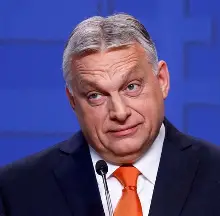
Rightwing leaders from across Europe and beyond have publicly endorsed Hungary’s prime minister, Viktor Orbán, underlining the symbolic importance of the country’s upcoming election for global far-right movements, even as the populist leader trails in opinion polls.
A campaign video released online this week by Orbán features endorsements from nearly a dozen political figures, including Italy’s prime minister Giorgia Meloni and her deputy Matteo Salvini, France’s Marine Le Pen, and Alice Weidel, a co-leader of Germany’s far-right Alternative für Deutschland (AfD).
“Europe needs Viktor Orbán,” Weidel says in the video.
Le Pen, the former leader of France’s National Rally, praises Orbán’s leadership, describing him as a key figure in what she called the growing success of “patriots and defenders of nations and sovereign peoples” across Europe.
Meloni, meanwhile, highlights shared values, saying they stand for a Europe that respects national sovereignty and is proud of its cultural and religious roots.
The show of international support comes ahead of Hungary’s election on 12 April, following a turbulent year in which Orbán’s government sought to ban Pride events and tightened restrictions on independent media and non-governmental organisations.
Orbán, the European Union’s longest-serving leader, has long been criticised for weakening democratic institutions, curbing press freedom and undermining the rule of law. He now faces an unprecedented challenge from Péter Magyar, a former senior member of his own Fidesz party.
With Hungary facing economic stagnation, rising living costs and strained public services, recent polls suggest Fidesz is trailing Magyar’s opposition Tisza party.
In response, Fidesz has emphasised Orbán’s international ties, presenting them as a strength in an increasingly unstable global environment. Márton Bene, a political analyst at the TK Institute for Political Science in Budapest, said this was something Orbán’s challenger lacked as a political newcomer.
Magyar’s campaign has instead focused on domestic issues, promising to tackle corruption, revive the economy and secure billions of euros in frozen EU funds.
Bene said the outcome could depend on whether voters prioritise international challenges or judge the government on its domestic record.
The campaign video also touches on Russia’s invasion of Ukraine. Orbán, the EU leader closest to Vladimir Putin, has repeatedly blocked attempts by Brussels to present a unified stance in support of Kyiv, prompting critics to label him Moscow’s Trojan horse within the bloc.
In the video, these positions are framed positively. Weidel says Orbán is “fighting for peace in Ukraine”, while Salvini tells voters: “If you want peace, vote for Fidesz.”
Other figures appearing include Herbert Kickl, leader of Austria’s Freedom party; the Czech prime minister, Andrej Babiš; Serbia’s president, Aleksandar Vučić; and Argentina’s president, Javier Milei.
Israel’s prime minister, Benjamin Netanyahu, also features, praising Orbán’s approach to security and leadership. His appearance has drawn attention because Israel officially boycotts Germany’s AfD and Austria’s Freedom party over their antisemitic roots, as reported by the Israeli newspaper Haaretz.
No US officials appear in the video, but Orbán recently published a letter from Donald Trump, written in December, wishing him success in the election. Trump praised Orbán for defending what he described as Hungary’s core principles of faith, family and sovereignty.
Bene said the video highlighted the broader stakes of the election. A defeat for Orbán, he said, would carry major symbolic weight for the international far right.
“Orbán’s Hungary has long been seen as a prototype and early model of illiberal populism,” he said. “If that model collapses, the idea of a uniform and unstoppable global trend would be much harder to sustain.”

