


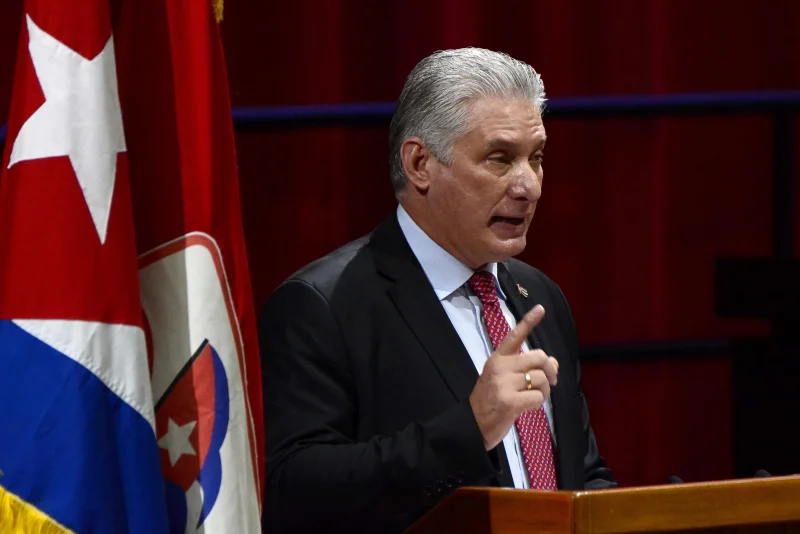
President of Cuba, Miguel Díaz-Canel, has sharply condemned recent U.S. military strikes on Venezuela, describing them as an act of “state terrorism” and calling for an urgent international response.
In a statement posted on social media, Díaz-Canel denounced what he called a “criminal attack” by the United States against Venezuela, warning that the escalation threatens regional peace and stability across Latin America and the Caribbean. “Our #ZonaDePaz is being brutally assaulted,” he wrote, referencing the 2014 proclamation signed in Havana that declared Latin America and the Caribbean a “Zone of Peace.”
He added that the strikes amounted to “state terrorism against the brave Venezuelan people and against Our America,” a phrase often used by left-wing governments in the region to emphasise shared political and historical identity.
Venezuela Declares State of Emergency
The condemnation from Havana came as the Venezuelan government announced a state of emergency early Saturday, following the U.S. strikes. Authorities urged citizens to take to the streets in protest, framing the attacks as an imperialist assault on national sovereignty.
“People to the streets!” the government said in a statement. “The Bolivarian Government calls on all social and political forces in the country to activate mobilisation plans and repudiate this imperialist attack.”
Officials said security forces had been placed on high alert nationwide, while defence plans were activated in response to what they described as a direct foreign aggression.
Helicopters Spotted Over Caracas
As tensions escalated, new footage circulating on Saturday morning showed dual-rotor helicopters flying through smoke-filled skies above Caracas. Residents of the capital had earlier reported seeing aircraft overhead and hearing loud explosions, with some witnesses saying objects resembling bombs appeared to be falling.
According to FlightGlobal, the Venezuelan military does not operate any dual-rotor helicopters, raising fresh questions about the origin of the aircraft seen over the city. The footage has fuelled speculation about direct foreign military involvement, though U.S. officials have not publicly commented on the specific aircraft observed.
Growing International Concern
The developments have heightened alarm across the region, with several governments and political groups expressing concern over the risk of wider conflict. Cuba has long been one of Venezuela’s closest allies, and Díaz-Canel’s remarks reflect broader fears among left-leaning governments that the strikes represent a dangerous precedent.
The United States has so far declined to issue a detailed public response to the accusations. The White House and the Pentagon have not confirmed the scope of the operations or addressed claims regarding helicopters seen over Caracas.
Region on Edge
The strikes and subsequent reactions mark a significant escalation in the long-running standoff between Washington and Caracas. Analysts warn that the combination of military action, mass mobilisation calls, and sharp rhetoric from regional leaders increases the risk of instability across Latin America and the Caribbean.
As protests gather momentum in Venezuela and international condemnation grows, attention is now focused on whether diplomatic efforts can contain the crisis—or whether the confrontation will deepen in the days ahead.
For more details, visit www.newdailyprime.news

