


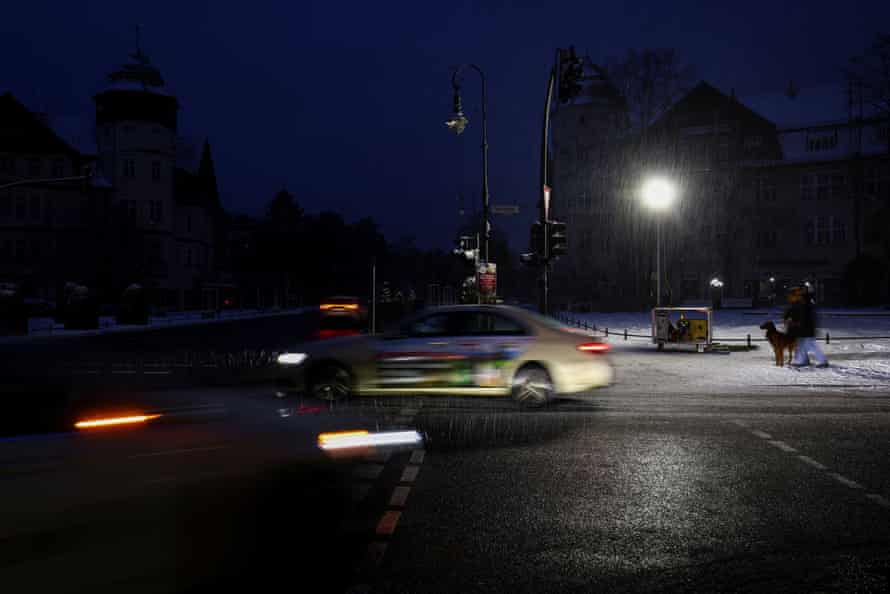
German leftwing militants have claimed responsibility for an arson attack that caused a major power cut in Berlin, leaving tens of thousands of homes without electricity and heating during freezing weather.
The fire broke out early on Saturday on a bridge over the Teltow canal in the south-west of the city. Stromnetz Berlin, the grid operator, said up to 35,000 households and 1,900 businesses could remain without power until 8 January.
Several high-voltage cables were damaged near the Lichterfelde heat and power station. State security authorities have opened an investigation into the blaze.
A group calling itself Vulkangruppe (Volcano Group) said it was behind the attack. In a 2,500-word pamphlet seen by the Guardian and described by police as “credible”, the group said it had deliberately targeted some of Berlin’s wealthiest districts.
The group said the aim was to “cut the juice to the ruling class”. It described the attack as an act of “self-defence” against what it called a fossil-fuel-driven “greed for energy”.
Vulkangruppe also accused data centres used for artificial intelligence of worsening climate change and expanding surveillance. It warned of a future in which people would sit “before bright screens or dead machines” while suffering hunger and thirst.
The group apologised to poorer residents affected by the blackout but said it had little sympathy for “villa owners” left without power.
The outage has affected elderly care homes, hospitals and high-rise buildings, where residents reliant on lifts have been left stranded. Snow fell across Berlin over the weekend, with night-time temperatures dropping well below freezing.
Berlin’s mayor, Kai Wegner, said the blackout was clearly politically motivated. He condemned the attack as a danger to human life.
“It is unacceptable that leftwing extremists are once again attacking our electricity grid,” Wegner said during a visit to an emergency shelter for residents without heating or hot water.
With mobile phone networks down in some areas, police used loudspeakers to pass on information as they assisted vulnerable residents. Several commuter rail lines were disrupted, and schools due to reopen on Monday may remain closed.
A similar arson attack in September caused a 60-hour blackout in south-east Berlin, reportedly the longest power cut in the city since the second world war.
Initial speculation about the weekend outage had included the possibility of Russian sabotage, as Germany remains on high alert for foreign attacks on critical infrastructure.
In March 2024, Vulkangruppe claimed responsibility for an arson attack on a pylon supplying power to Tesla’s gigafactory outside Berlin, temporarily halting production.
Germany’s domestic intelligence agency classifies Vulkangruppe as a leftwing extremist organisation. In its 2024 annual report, it cited repeated attacks on regional power infrastructure by the group.
The agency said the group, believed to have existed for around 14 years, chose targets designed to have a direct impact on the public, with little concern for collateral damage.
Stromnetz Berlin said about 45,000 households and 2,200 businesses in Nikolassee, Zehlendorf, Wannsee and Lichterfelde were initially affected when the power cut began at around 6am on Saturday.
By Sunday afternoon, electricity had been restored to around 10,000 households and 300 businesses in Lichterfelde. Repair work has been slowed by the cold, which is making it difficult to lay new underground cables.
The company said remaining customers may have to wait until Thursday afternoon for full restoration of power.
Energy experts said such attacks require little technical expertise. Detailed maps of power networks are widely available online, while contingency plans for sabotage remain limited.

