


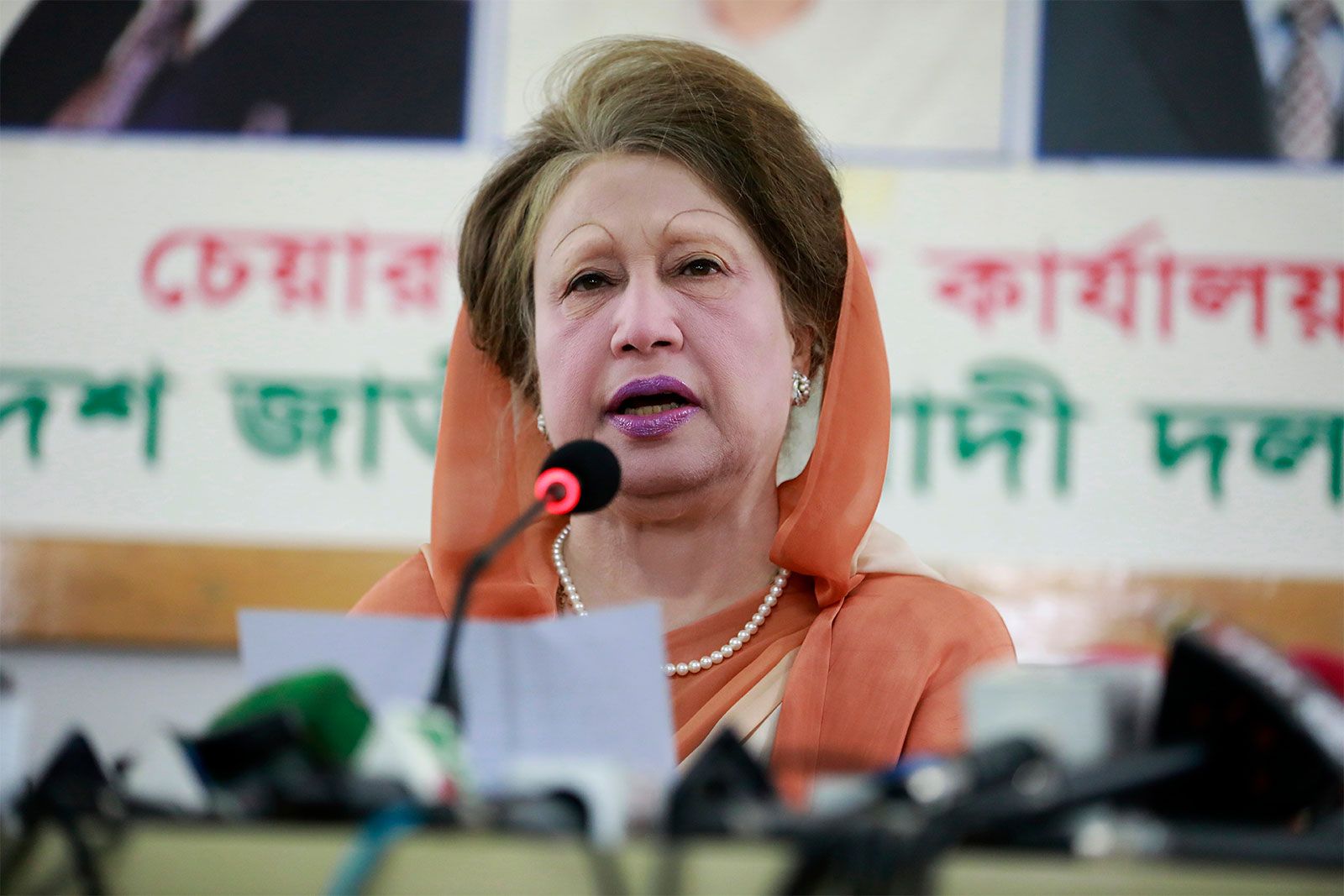
Bangladesh’s first female prime minister and a central figure in the country’s politics for more than three decades, Khaleda Zia, has died aged 80.
Her death was announced on Tuesday morning by the Bangladesh Nationalist Party (BNP), which she led for many years.
Zia was one of the most influential and polarising figures in Bangladesh since independence, with her long-running rivalry with Sheikh Hasina shaping the country’s political life for a generation.
She was the widow of Ziaur Rahman, a former president and military leader who played a key role in Bangladesh’s struggle for democracy before being assassinated in a military coup in 1981.
After his death, Khaleda Zia entered politics and quickly built a strong following, known for her firm opposition to military rule. She became prime minister in 1991, holding office until 1996, and returned briefly for a second term.
Her government was later challenged by Sheikh Hasina, who defeated her and went on to become her principal political rival for the next 30 years. The two women alternated in power as prime minister over three decades, rarely easing their bitter feud.
Zia’s government in 2001 faced accusations of corruption. After Hasina returned to power in 2009, Zia was charged in several cases.
In 2018, she was convicted on corruption charges and sentenced to 10 years in prison. The BNP said the charges were politically motivated, a claim denied by Hasina’s government.
Under Hasina’s rule, the BNP faced sustained pressure, with many senior figures jailed or forced into exile. Zia herself spent years under house arrest as her health steadily declined.
Following the collapse of Hasina’s government during mass protests in 2024, Zia was released from house arrest. In January, she was allowed to travel abroad for medical treatment after repeated earlier requests had been rejected.
Despite poor health, Zia said in November that she intended to campaign ahead of elections scheduled for February 2026, the first national vote since Hasina’s fall. Later that month, she was admitted to hospital, where her condition worsened.
After her death, interim prime minister Muhammad Yunus described her as a “symbol of the democratic movement”.
Zia’s son, Tarique Rahman, returned to Bangladesh this month after 18 years in exile in the UK. He is expected to contest the upcoming elections, with the BNP regarded as a leading contender.
Khaleda Zia is expected to be buried on Wednesday in Dhaka, alongside her husband.

