


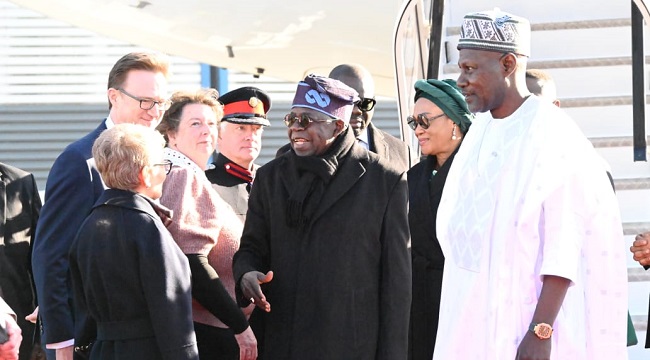
President Bola Ahmed Tinubu arrived in the United Kingdom today, 17 March 2026 , the first official visit by a Nigerian leader in nearly 40 years, as both countries seek to deepen economic ties and strategic cooperation.
King Charles III and Queen Camilla will host Tinubu and First Lady Oluremi Tinubu at Windsor Castle from Wednesday to Thursday in what is regarded as Britain’s highest level of diplomatic engagement. The last such visit by a Nigerian leader took place in 1989, when then-military ruler General Ibrahim Babangida met Queen Elizabeth II.
Analysts say the visit carries both symbolic and practical significance, marking the first time a democratically elected Nigerian president has been accorded a state visit since Nigeria’s return to civilian rule in 1999.
“It underscores the importance of Nigeria as a key partner to the UK,” said Ikenna Okonkwo of SBM Intelligence. “But beyond the symbolism, the real focus will be on economic cooperation.”
Read related news:
Tinubu departs for historic UK state visit, first in 37 years
Tinubu swears in 50-year-old economist Taiwo Oyedele as minister
NEMA warns Nigerians of rising fire risks, health dangers amid heatwave
Trade between the two countries exceeded £8 billion in the year to October, with both sides signing an Enhanced Trade and Investment Partnership in 2024 aimed at expanding opportunities in sectors such as energy, infrastructure and services.
Officials in Abuja are framing the visit as a turning point in bilateral relations, with Tinubu expected to promote his administration’s economic reform agenda and attract foreign investment into critical sectors, including mining, energy and the creative industries.
However, the visit comes against a backdrop of mounting domestic challenges in Nigeria, where sweeping economic reforms, including the removal of fuel subsidies and currency devaluation, have pushed up inflation and increased the cost of living for millions.
“The country is under pressure from multiple fronts,” Okonkwo said. “Economic reforms have stabilised some indicators but have also created hardship for many Nigerians.”
Security concerns remain acute, with armed groups and banditry affecting several regions, while instability across the Sahel continues to spill over into West Africa.
Among Nigeria’s diaspora in the UK, reactions to the visit are mixed. Some have welcomed the potential for stronger economic ties, while others question whether the trip will deliver tangible benefits.
“What is he coming here for? He needs to fix things at home,” said Monica, a London-based Nigerian business owner who declined to give her surname. “The economy is still very difficult.”
Policy experts say discussions during the visit are likely to cover trade expansion, security cooperation, migration policy and climate financing, as both countries look to strengthen their strategic partnership in a post-Brexit context.
“The UK is seeking deeper commercial access to Africa’s largest market, while Nigeria needs investment and security support to stabilise its economy,” said Kabir Adamu, head of Beacon Security and Intelligence in Abuja.
However, analysts caution that while foreign investment could provide short-term relief, it is unlikely to address deeper structural issues within Nigeria’s economy, including unreliable power supply, weak infrastructure and limited diversification beyond oil.
Despite recent improvements, including a stabilising currency and renewed investor interest, poverty levels remain high, food insecurity is rising and small businesses continue to face high borrowing costs.
Tinubu’s foreign policy, characterised by frequent international engagements and high-profile diplomacy, has drawn both praise and criticism. While it has elevated Nigeria’s global profile, questions remain about whether it has translated into meaningful improvements in living standards at home.
Security cooperation is also expected to feature prominently in talks, with Nigeria grappling with insurgency in the northeast and widespread criminality in other regions. The country ranks among the most affected by terrorism globally.
For Britain, the visit offers an opportunity to reinforce ties with a key Commonwealth partner and one of Africa’s largest economies. For Tinubu, it is a chance to secure investment and reaffirm Nigeria’s position on the global stage.
Whether the visit delivers concrete outcomes , or remains largely symbolic — will be closely watched both in Abuja and among Nigerians at home and abroad.

