


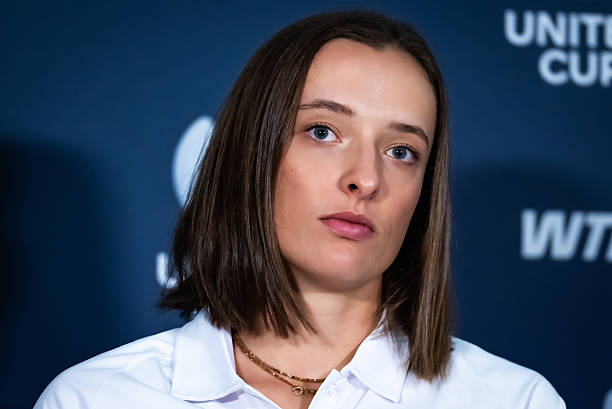
Wimbledon champion Iga Swiatek has said women’s tennis no longer needs events like the so-called “Battle of the Sexes” to prove its value, insisting the women’s game now “stands on its own”.
Her comments follow a highly publicised exhibition match in Dubai last week, where men’s player Nick Kyrgios defeated women’s world number one Aryna Sabalenka in straight sets on a modified court designed to level the contest. While the event drew global attention, Swiatek was unconvinced of its significance beyond entertainment.
“I think for sure it attracted a lot of attention,” Swiatek said. “It was entertainment, but I wouldn’t say that had anything to do with social change or any important topics.”
The world number two deliberately distanced the exhibition from the historic 1973 “Battle of the Sexes” between Billie Jean King and Bobby Riggs — a match that played a major role in advancing gender equality and prize money in tennis.
“I think the name was just the same as the one from the Billie Jean King match in ’73. That’s it,” Swiatek said. “There were no more similarities because I feel like women’s tennis stands on its own right now.”
Swiatek added that she did not even watch the Dubai match, saying such exhibitions hold little interest for her. Instead, she believes the women’s game is now strong enough to command attention on its own merits, without comparison to men’s tennis.
“We have so many great athletes and great stories to present,” she said. “We don’t necessarily need to compare to men’s tennis. Honestly, there doesn’t need to be any competition.”
Her comments reflect a broader shift in the sport. In the decades since King’s victory over Riggs, women’s tennis has achieved equal prize money at Grand Slams, built global stars and established the WTA Tour as a powerful entity in its own right. Players such as Serena Williams, Naomi Osaka, Coco Gauff and Sabalenka have helped push women’s tennis into mainstream global popularity.
While exhibitions like the Dubai match are often defended as harmless fun, critics argue they risk reviving outdated narratives about gender comparison rather than celebrating excellence. Swiatek’s stance suggests many leading players feel the women’s game has outgrown that need.
Rather than headline-grabbing gimmicks, Swiatek pointed to the United Cup as a better model for showcasing tennis as a unified sport. The mixed-team tournament, which got under way in Australia on Friday, features nations competing across men’s singles, women’s singles and mixed doubles.
“Events like this one, United Cup, bring tennis together,” Swiatek said. “WTA fans and ATP fans can watch this event with so much excitement.”
She also highlighted the appeal of mixed doubles, a format rarely seen at the highest level outside Grand Slams.
“Seeing singles players that usually don’t have space to play mixed doubles together playing these kind of matches — this is actually what makes our sport much more interesting and better,” she said.

