


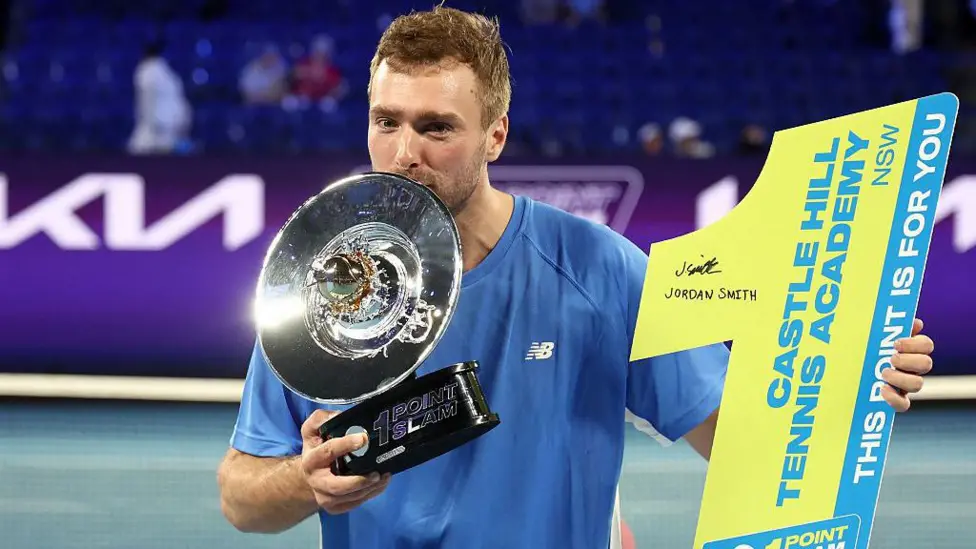
Melbourne witnessed one of the most extraordinary nights in tennis history as amateur player Jordan Smith stunned the sport’s elite to win the Australian Open’s Million Dollar One Point Slam, pocketing A$1m and instant global attention.
Smith, a 29-year-old New South Wales state champion, arrived at Rod Laver Arena with modest expectations. By the end of the night, he had defeated some of the biggest names in world tennis, including two-time defending Australian Open champion Jannik Sinner, to claim bragging rights and a life-changing prize.
The innovative exhibition event, staged four days before the Australian Open begins, featured a unique and ruthless format: one point, winner takes all. Each match was decided by a single rally, with players first contesting rock, paper, scissors to decide who served. For professionals, the pressure was magnified — one serve, one chance.
Smith’s headline victory came against world number two Sinner, who failed to land his serve, instantly ending the contest. The packed arena erupted as the amateur advanced without even striking the ball, a moment that perfectly captured the drama and unpredictability of the format.
He followed that up by beating women’s world number four Amanda Anisimova, then Spain’s Pedro Martinez, before sealing the title in a final showdown against Joanna Garland. Garland, ranked 117th in the world, had enjoyed a fairytale run of her own, knocking out Alexander Zverev, Nick Kyrgios and Maria Sakkari along the way.
“I would have been happy winning just one point,” Smith admitted afterwards, still visibly stunned. “I was so nervous, but I enjoyed being out here. It was an amazing experience.”
Smith was not the only amateur to shine. Queensland state champion Alec Reverente defeated world number seven Felix Auger-Aliassime and later beat Smith in a head-to-head contest to win a brand-new car, awarded to the best-performing amateur outside the main prize.
The event was played in a light-hearted but fiercely competitive spirit. Kyrgios jokingly smashed his racquet after defeat, while many of the world’s top players, including Carlos Alcaraz, stayed courtside to watch the unlikely conclusion unfold. Even Alcaraz himself was eliminated earlier, netting a drop shot against Maria Sakkari in a moment that summed up the fine margins of the night.
The Million Dollar One Point Slam featured 48 competitors: 24 top professionals, eight amateur state champions, eight qualifiers and eight wildcards, including celebrities. It was a significant expansion from the inaugural 2025 edition, which offered A$60,000 and featured only one top-10 player.
Tournament director Craig Tiley described the concept as a leveller between grassroots tennis and the elite game, and the scenes in Melbourne suggested the experiment succeeded. The arena was full, the crowd vocal, and the underdogs embraced with enthusiasm.
BBC Sport analyst Jonathan Jurejko called the event a “roaring success,” noting Smith’s calmness amid the chaos. “He was unruffled by the stature of his opponents or the enormous prize at stake,” Jurejko wrote. “The unknown underdog delivered exactly what the tournament hoped for.”
In addition to his personal winnings, Smith also secured a A$50,000 grant for the Australian tennis club he represented, reinforcing the event’s grassroots focus. He hinted that his first major purchase would likely be a house — a symbol of how one point can change a life.
For tennis, the night offered more than entertainment. It showcased innovation, accessibility and the enduring romance of sport, where, for one point in Melbourne, an amateur stood tallest among giants.

