


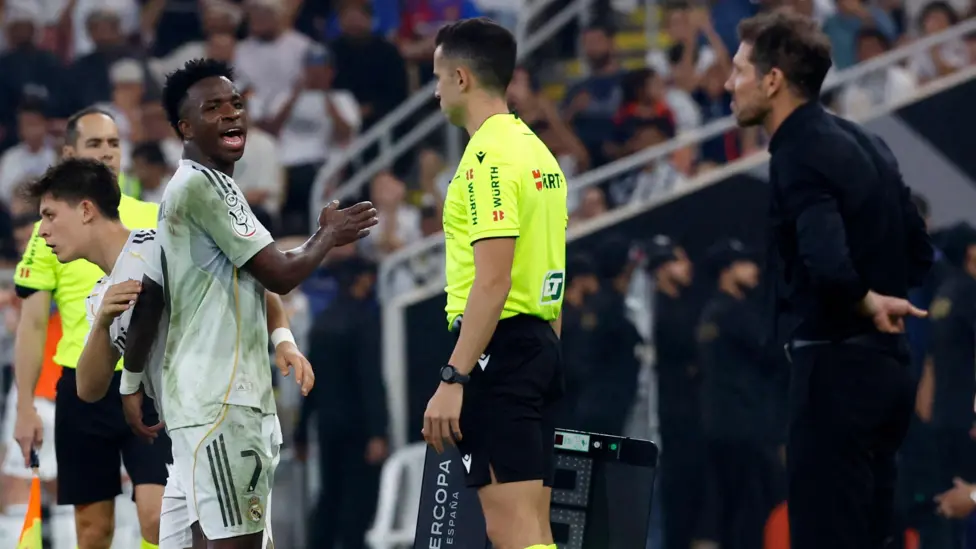
Atletico Madrid manager Diego Simeone has apologised to Real Madrid winger Vinicius Jr following a heated touchline exchange during the Spanish Super Cup semi-final, an incident that briefly overshadowed an otherwise intense Madrid derby in Saudi Arabia.
The Argentine coach admitted his behaviour towards the Brazilian forward was wrong after reports emerged that he made comments suggesting Real Madrid president Florentino Perez would look to sell Vinicius. The exchange occurred as emotions ran high during last Thursday’s semi-final, which Real won 2-1 to book their place in the final against Barcelona.
Vinicius, 25, was once again a central figure in a high-profile clash, combining his trademark flair with an edge that often provokes strong reactions from opponents and rival supporters. While he helped Real overcome Atletico, his side ultimately fell short in the final, losing 3-2 to Barcelona despite Vinicius scoring.
Speaking after the match, Simeone struck a contrite tone. “I would like to apologise to Mr Florentino and Mr Vinicius for the incident they witnessed,” he said. “It was wrong of me to put myself in that position, and I accept that it was wrong. The team that wins deserves to go through; they deserved to go through.”
The apology came amid widespread discussion in Spanish media about the responsibilities of senior figures in the game, particularly in matches already charged with rivalry and tension. Simeone, long admired for his passion and intensity, has also faced criticism in the past for allowing emotion to spill over the technical area.
Footage from the semi-final appeared to show Simeone directing comments at Vinicius from the touchline, with further words exchanged when the winger was substituted after 81 minutes. While neither party revealed the full content of the exchange, the incident added another chapter to Vinicius’ often fractious relationship with rival players and coaching staffs.
Vinicius remains one of Real Madrid’s most important players, with a contract running until the summer of 2027. Despite persistent speculation linking him with a future move, particularly amid interest from Saudi clubs, Real have consistently maintained that the Brazilian is central to their long-term plans. Simeone’s reported remarks about a potential sale were therefore seen by many as both provocative and unnecessary.
Asked directly whether his conduct had crossed a line, Simeone was unapologetic in tone but firm in acknowledging fault. “I apologise, but I do not ask for forgiveness,” he said. “I have nothing more to add.” The response reflected Simeone’s familiar defiance, even as he conceded that his actions were inappropriate.
The incident also reignited debate about Vinicius’ treatment in Spanish football. The winger has previously been subjected to racist abuse from fans and has often found himself at the centre of confrontations on the pitch. While this latest episode did not involve supporters, it raised questions about how opponents and officials handle one of the league’s most high-profile and expressive talents.
From Atletico’s perspective, the focus quickly returned to football. Their defeat by Real meant another missed opportunity for silverware, while Real’s subsequent loss to Barcelona in the final left all three giants reflecting on what might have been. For Simeone, the semi-final exit was made more frustrating by the controversy that followed.
For Real Madrid, Vinicius’ performance once again underlined his importance, even in defeat. His goal in the final against Barcelona showcased his ability to deliver on the biggest stage, reinforcing why the club sees him as a cornerstone of their future.
Ultimately, Simeone’s apology may draw a line under the incident, but it also serves as a reminder of the scrutiny placed on managers in modern football. In an era of constant cameras and instant reaction, even a brief lapse in judgement can dominate headlines.
As the Spanish season resumes, attention will return to league form and results. Yet the episode stands as another example of how passion, rivalry and personality continue to shape the narratives of Spanish football’s fiercest contests.

