


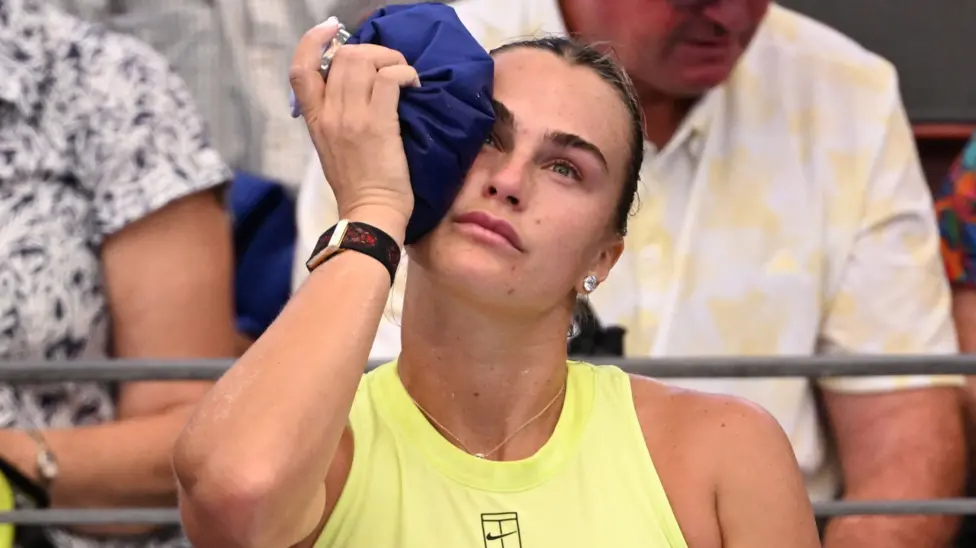
World number one Aryna Sabalenka has issued a stark warning to tennis authorities, accusing them of failing to protect players as concerns grow over an increasingly punishing global schedule.
Speaking after her straight-sets win over Sorana Cirstea at the Brisbane International, the Belarusian said governing bodies were “following their interests” rather than prioritising player welfare. Her comments add weight to a debate that has been simmering across the sport, with leading stars warning that the calendar is stretching athletes to breaking point.
Sabalenka, the defending champion in Brisbane and a four-time Grand Slam singles winner, highlighted the relentless demands placed on top players, particularly on the women’s tour. Elite WTA players are required to compete in at least 20 mandatory tournaments each season, including four Grand Slams, 10 WTA 1000 events and six WTA 500s. The schedule leaves little room for recovery, even for those managing injuries or illness.
“The season is definitely insane, and you see so many players getting injured,” Sabalenka said. “The balls are quite heavy, so it’s a lot of struggle for all of us.” Her comments reflect a wider frustration among players who believe the physical toll of the modern game is being underestimated.
Despite finishing last season with consistently strong results, Sabalenka admitted she often competed while unwell or exhausted. As a result, she has decided to skip several tournaments this year in an effort to preserve her health, even though doing so could lead to fines or ranking penalties.
“I’m skipping a couple of events in order to protect my body because I struggled a lot last season,” the 27-year-old said. “Even though the results were really consistent, some of the tournaments I had been playing completely sick or I’ve been really exhausted from overplaying.”
Sabalenka and world number two Iga Swiatek were both docked ranking points last year for failing to meet the required number of WTA 500 appearances, a rule critics say discourages sensible workload management. Sabalenka acknowledged that further penalties may follow this season but insisted her long-term health must come first.
“This season we will try to manage it a little bit better, even though they are going to fine me by the end,” she added.
The WTA has maintained that player welfare “will always remain a top priority”, but skepticism remains among players and fans. With matches becoming more physically demanding and seasons stretching across nearly 11 months, calls for reform are growing louder.
Sabalenka also admitted she is not yet at her best as she builds towards the Australian Open, where she is aiming to claim a third title in four years. “I’m definitely not at my peak,” she said. “Of course I prefer to win every match 6-0 6-0, like everyone, but you only get better when someone pushes you.”
The Melbourne tournament promises to be fiercely competitive. Elena Rybakina, one of Sabalenka’s chief rivals, continued her strong form in Brisbane with a commanding win over Spain’s Paula Badosa. The 2022 Wimbledon champion beat Sabalenka at the season-ending WTA Finals and is widely viewed as a major title contender in Australia. Rybakina will next face Karolina Muchova for a place in the Brisbane semi-finals.
There was less positive news elsewhere, as China’s Zheng Qinwen withdrew from the Australian Open while recovering from elbow surgery. The Olympic gold medallist said she had not yet reached the “extreme competitive condition” required for a Grand Slam, highlighting again the physical demands of the modern game.
Away from the women’s draw, Britain’s Cameron Norrie suffered a second-round defeat in the men’s event in Brisbane, while Katie Boulter was beaten in Auckland. Sonay Kartal provided the sole British singles victory on Thursday.
As the new season gathers momentum, Sabalenka’s comments underline a central question facing tennis: how to balance commercial growth with the health of its players before the sport reaches breaking point.

