


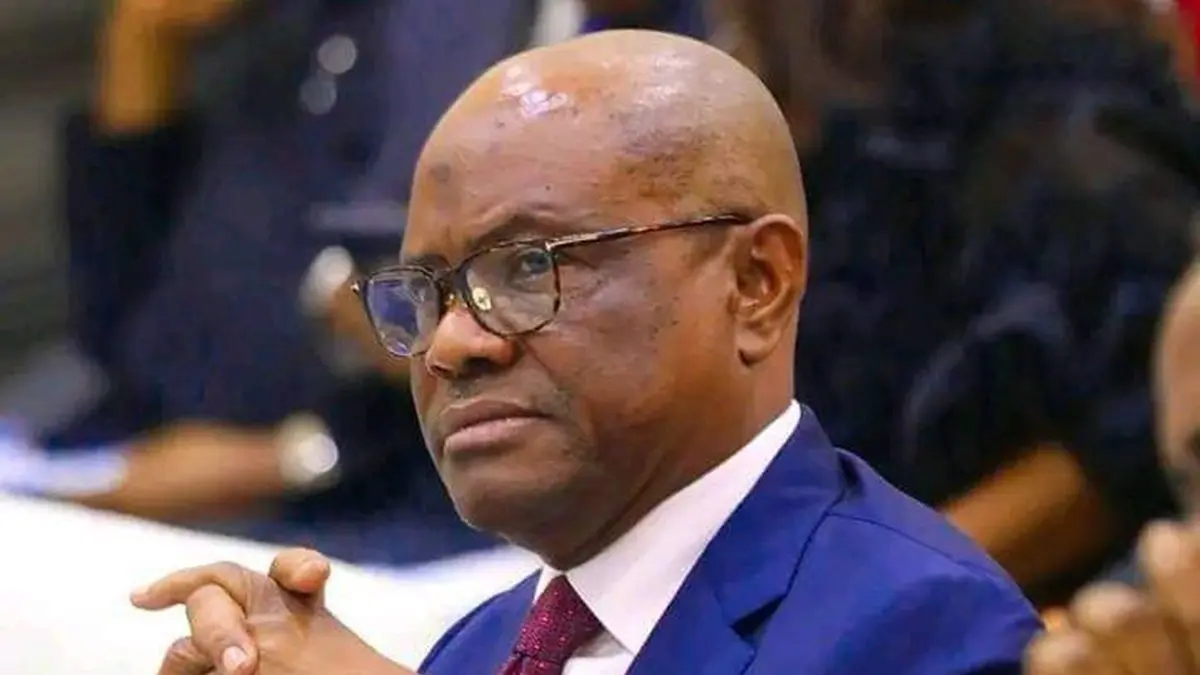
By Clement Abayomi
Nyesom Wike, former Rivers State Governor, is one of the most controversial political personalities in Nigeria. As a prominent Nigerian politician and current Minister of the Federal Capital Territory (FCT), he has long been a subject of national discourse.
This is not only because of his leadership but also for the persistent controversies surrounding his wealth.
Argument over Wike’s actual net worth is at its peak in 2025 as a result of claims, accusations, and counterclaims pushing his finances into the limelight.
This article builds on the established facts, accusations and denials that have made Wike’s finances a subject of public scrutiny. Drawing exclusively from the most recent and relevant sources, this report presents an account of Wike’s net worth in 2025.
Wike was born on 13 December, 1967 in Rumuepirikom, Rivers State. As the son of Reverend Nlemanya Wike, he grew up in a religious and disciplined household, which have been said to provide the moral and foundational grounding for his later pursuits.
Speaking on his finances, Wike has claimed that his wealth comes from his family background and not from politics.
“As a student, I was using a Mercedes Benz. My father was the manager of so many companies. I come from a rich background . . .I have a Rolls Royce. Nobody gave it to me. I bought it for myself,” he said in an interview on Channels Television.
His early studies at Government Secondary School, Eneka, and later academic success (an LL.B from Rivers State University of Science and Technology and a Master’s in Political and Administrative Studies) prepared him not only for a career in law and politics but also for his own goals.
Wike has been said to have credited these early years of hard work and ambition as instrumental in determining his approach to public service and resource management.
Reports have claimed that Wike’s academic and career paths are avenues through which he could have amassed wealth. Wike dabbled in private legal practice after graduating from law school and passing the Nigerian Law School examinations.
This phase has been said to give him a basic grasp of contract management, negotiation, and the operation of Nigeria’s legal and corporate settings.
As explained by Novaline, his move from law to politics started with his election as Obio-Akpor Local Government Area’s (LGA) Executive Chairman (1999–2007), a position that gave him more political visibility and leadership in the Association of Local Governments of Nigeria (ALGON).
Wike’s ascendance to federal and state-level positions enhanced his political profile as well as the attention paid to his finances.
Wike served as Chief of Staff to Governor Rotimi Amaechi (2007–2011) and later as Minister of State for Education under President Goodluck Jonathan.
He was at the middle of public resource management and governance. During his term as Governor of Rivers State (2015–2023), he reached a career peak as his government was praised for progressive laws like the law increasing women’s inheritance rights, free education reforms, and transformational infrastructure projects.
However, it was also during this time that financial irregularities started to come to light more often, and people questioned where Wike’s money came from and how much he had in comparison to what he earned officially.
What then is Wike’s net worth? Estimates of Nyesom Wike’s net worth in 2025 actually vary, and these estimates are highly controversial because, usually, financial disclosures among Nigeria’s public officials are not clear.
With a $200 million estimate given by Port Harcourt Socials and BsgistNews, Wike is among the richest politicians in Nigeria. Novaline, on the other hand, indicates that Wike may be worth as much as $550 million.
Official asset declarations or outside audits, however, do not totally support these numbers. The lack of confirmed financial records has prompted suspicions and made the truth hard to come by.
But the only thing that is certain is that the numbers going around are the result of a mix of investigative reporting, rumoured leaks, and sometimes politically driven speculation.
The story of Wike’s wealth has, in recent years, been shaped by claims of unexplained assets and financial misconduct. Jaiyeola Ajasa on his Facebook page reported that among these claims is Wike’s U.S. property purchases, especially in Florida.
In his report, activist Omoyele Sowore is said to have petitioned the Florida Attorney General in September 2025 for an inquiry of quit-claim deeds and other methods meant to conceal ownership of properties reportedly purchased by Wike’s family valued at over $6 million.
These properties were said to be gained both during and following Wike’s governorship, and family proxies and shell businesses apparently masked their ownership.
Furthermore, several July and August 2025 reports charged Wike with giving family members thousands of hectares of valuable FCT land through shell companies. Should they prove true, these deeds would point to a trend of asset diversion and money laundering far exceeding legal compensation.
The difference between Wike’s official income and his apparent way of living seems to be a major bone of contention. Wike’s annual pay as a minister has been reported to be around $5,000, which falls much below the size of his claimed possessions.
This contrast has caused repeated charges of unaccounted wealth and, by extension, corruption. For instance, as reported by Jaiyeola Ajasa in a Facebook post, former Ekiti State Governor Ayodele Fayose’s brother publicly charged Wike in September 2025 with using illegal funds to buy luxury properties including a Rolls-Royce, land in Abuja, and several residences in Rivers State.
Although such allegations are challenging to prove due to lack of public asset records, they reflect the general public mistrust of Nigerian public officials whose way of life far surpasses their recorded earnings.
Apart from the opulent lifestyle and real estate extravagances, Wike’s government has been plagued by particular claims of theft and corruption.
The most extreme of these occurred in May 2025, when allegations of N1.3 trillion going missing from the Rivers State treasury in less than 15 hours caused the State House of Assembly to declare a financial emergency. Major players in the claimed theft, legislators said, are authorities in Wike’s inner circle.
Also, earlier, in December 2023, a widely shared video claimed that Wike stole N9 billion when he was governor. Sources report that he has not responded to this claim directly.
Other claims date back to his tenure as Minister of State for Education, when civil society organisations petitioned the Economic and Financial Crimes Commission (EFCC) over suspected misadministration of N3.3 billion in Millennium Development Goals grants and claimed kickbacks totalling N6.68 billion from federal school resources.
Former Governor Rotimi Amaechi charged Wike with stealing N3.5 billion in contract funds in 2014 but Wike rejected the claim and challenged Amaechi to produce proof.
Wike has maintained his innocence despite the seriousness of the claims against him, blaming political vengeance and media exaggeration for the accusations.
He has often challenged accusers to offer reliable proof to law enforcement and has insisted that his wealth is not political. Regardless, his financial life is often left in limbo; it is neither unequivocally vindicated nor definitely condemned.
In sum, the question of Wike’s net worth in 2025 is emblematic of the challenges associated with assessing the finances of high-ranking Nigerian officials.
The available estimates (ranging from $200 million to $550 million) are just as much an indication of public suspicion and scrutiny as they are of concrete financial proof. It is important to state that the lack of transparency and the failure of official systems to produce definitive answers mean that Wike’s true net worth remains, for now, an open question.
For More Details, Visit New Daily Prime at www.newdailyprime.news

