


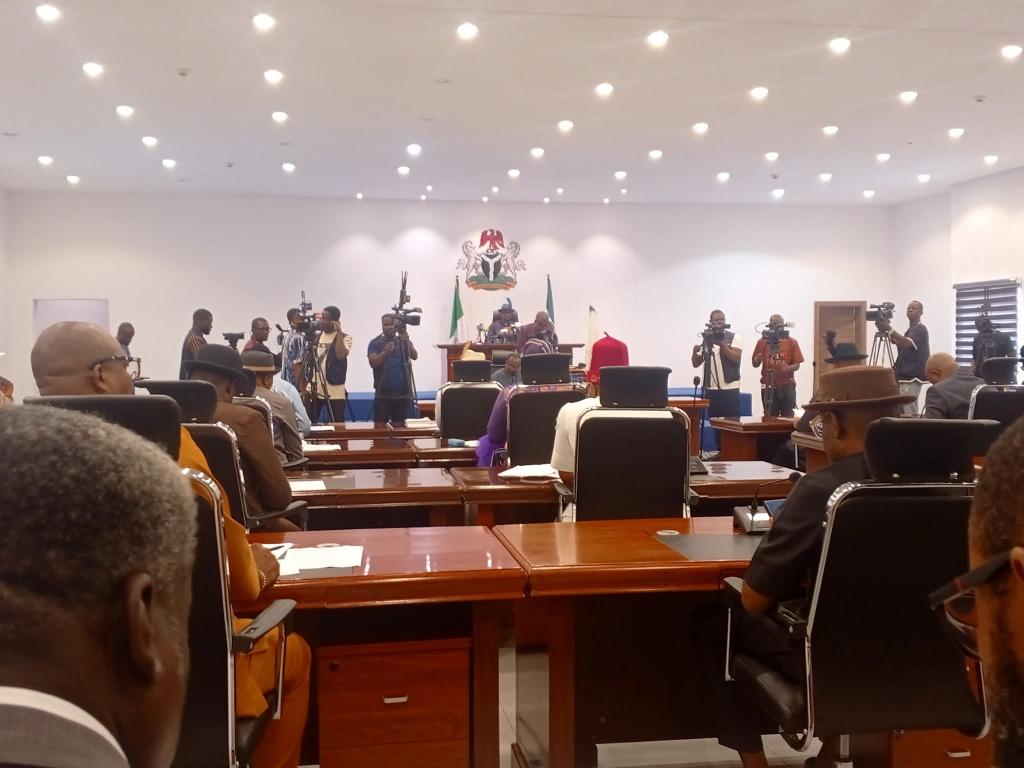
The Rivers State House of Assembly has raised the alarm over what it described as “secret plots” to unlawfully secure court orders aimed at stopping the legislature from performing its constitutional duties.
In a statement released on Sunday by Chairman of the House Committee on Information, Petitions and Complaints, Enemi George, the Assembly had received intelligence indicating that “certain persons” were planning to procure restraining orders from some high courts within the state but outside the Port Harcourt judicial division.
According to the lawmakers, those allegedly behind the moves are fully aware of the constitutional provisions governing legislative affairs and the limits of judicial intervention in such matters.
The statement cited section 272(3) of the constitution, which, according to the assembly, provides that “subject to the provisions of section 251 and other provisions of the constitution, the Federal High Court shall have jurisdiction to hear and determine the question as to whether the term of office of a member of the house of assembly of a state, governor or deputy governor has ceased or become vacant”.
The lawmakers also referred to section 188(10) of the constitution, which states that “no proceedings or determination of the panel or of the House of Assembly or any matter relating to such proceedings or determination shall be entertained or questioned in any court”.
“These persons are also fully aware of judicial pronouncements on this matter, especially recently at the court of appeal on a matter involving similar ex parte order by a Rivers State High Court contrary to section 272(3) of the constitution. A word is enough for the wise,” the statement added.
George said the Assembly, with the approval of the speaker, was calling on those involved to exercise restraint and desist from actions he described as contrary to the constitution and the rule of law.
“Therefore, with the leave of the speaker of the Rivers state house of assembly, I call on those concerned to exercise restraint and refrain from acts inimical to the Constitution and the rule of law,” he said.
He added that rather than resorting to what he termed “subterranean moves,” the affected public office holders should simply respond to the notices of allegations of gross misconduct already served on them.
“All that is required is for the office holders who have already been duly served with the Notice of Allegations of Gross Misconduct to respond to them item by item rather than deploy subterranean moves to subvert the law or use proxies to malign members and the Rivers State House of Assembly in the media,” George said.
The Assembly reaffirmed its commitment to constitutionalism and the rule of law.
The renewed tensions are linked to the long-running political crisis in Rivers state, rooted in a power struggle between Siminalayi Fubara, the current governor, and Nyesom Wike, his predecessor and now minister of the Federal Capital Territory.
The dispute, largely over control of the state’s political structure and key appointments, has repeatedly disrupted governance. Impeachment threats from a legislature widely viewed as loyal to Wike first surfaced in 2023 and re-emerged in 2025, leading President Bola Tinubu to declare a six-month state of emergency that temporarily suspended both the executive and legislative arms.
Although the emergency rule ended in September 2025 and Fubara was reinstated, the breakdown of a subsequent peace deal has sparked fresh impeachment moves against the governor and his deputy, with the house accusing them of gross misconduct.

