


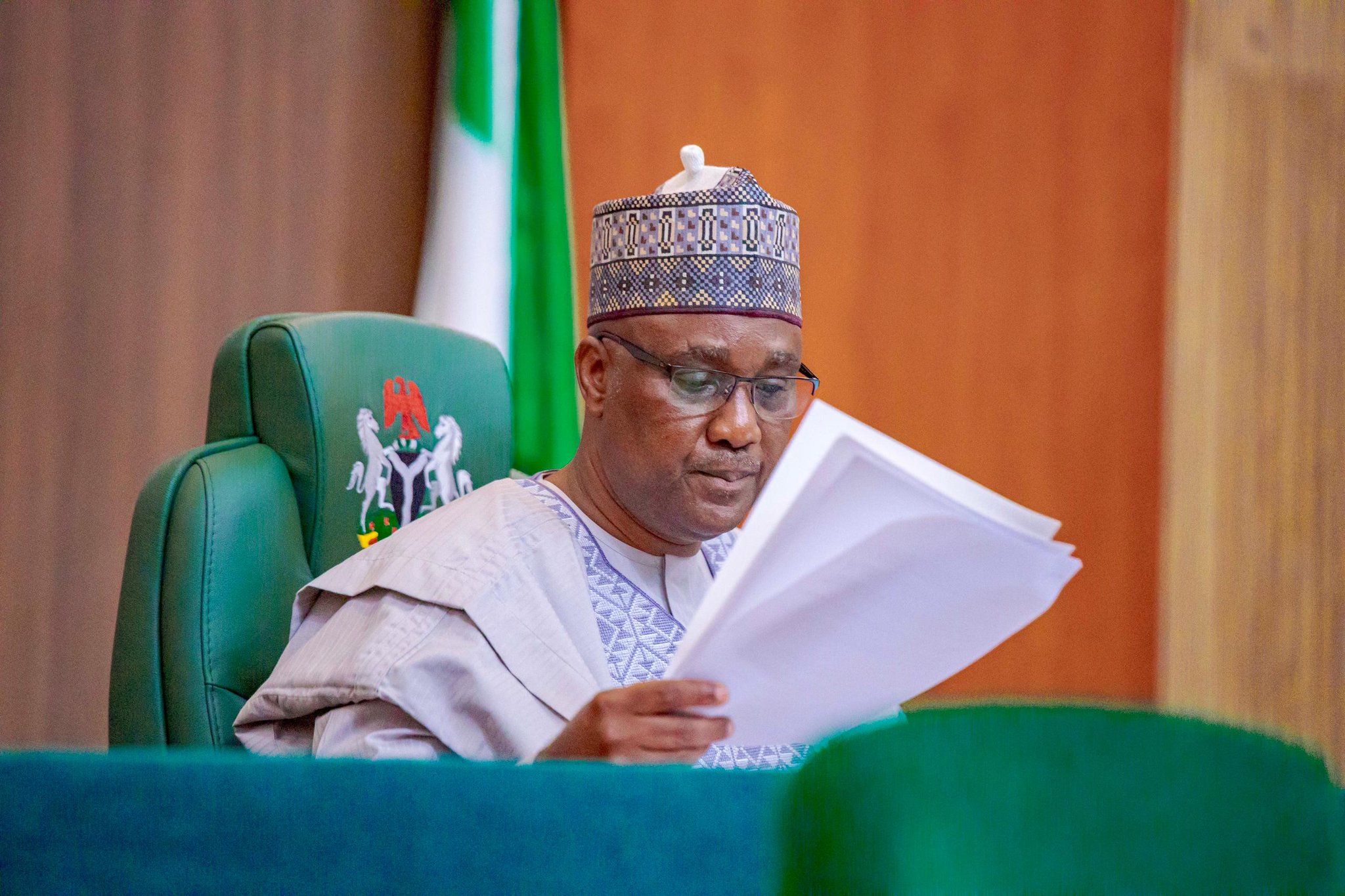
Speaker of the House of Representatives, Tajudeen Abbas, has explained that the National Assembly approved a hybrid system combining electronic and manual transmission of election results in the amended Electoral Act to enhance participation and prevent voter exclusion ahead of the 2027 general elections.
Abbas said relying solely on electronic transmission was unrealistic due to Nigeria’s inadequate internet coverage and persistent electricity challenges.
The Speaker made the remarks on Sunday while receiving Spain’s Ambassador to Nigeria, Felix Costales, during a courtesy visit at the National Assembly complex in Abuja.
According to a statement issued by his Special Adviser on Media and Publicity, Musa Krishi, the meeting was attended by key lawmakers, including Chairman of the House Committee on Appropriations, Abubakar Bichi; Chairman of the House Committee on Foreign Affairs, Wole Oke; and Chairman of the Nigeria-China Parliamentary Friendship Group, Jafaru Yakubu.
Abbas noted that the decision to adopt a hybrid system followed practical considerations about Nigeria’s infrastructure limitations.
“Sometimes, people scream far beyond the exact level of the issue. A lot of people think that we need to embrace electronic transmission in real-time in Nigeria, but within the very little period that you’ve been in Nigeria, you should be able to speak on the quality of our internet network. You should know that even in advanced cities like Abuja, you are not guaranteed stable internet services all the time,” he said.
Citing data from the Nigerian Communications Commission, Abbas added that large parts of the country still lack internet access.
“Based on the NCC report, they said Nigeria is still underserved by almost 40 per cent, which means 40 per cent of territories at large in Nigeria are not covered by the internet.”
He warned that adopting only electronic transmission could worsen voter turnout, which he said already remains low.
“It is sad to say that even with the manual arrangement we are using, we are only able to capture about 12–15 per cent of registered voters who, after every four years, come to vote. That’s voter apathy.”
According to him, exclusive dependence on technology could disenfranchise millions of voters.
“Now, if we are to introduce only the electronic system, it will further reduce the number because 40 per cent of the country will probably not be able to vote as they don’t have adequate internet services… we will also record, perhaps, the lowest number of voters in the next elections.”
He explained that the amended law allows flexibility based on local realities.
“That is why we said, in our wisdom, the Electoral Act should be hybrid—a combination of both the manual and electronic systems. Where it is feasible to use the electronic transmission, use the electronic transmission; where it is not possible, use the manual.”
Abbas also pointed to power supply challenges, stressing that internet services depend heavily on stable electricity.
“The internet is always backed by energy. How do you power the entire country on the day of the election to have phones that are working and internet that is working, backed by adequate electricity?”
Describing democratic development as gradual, the Speaker said Nigeria would continue improving its electoral processes over time.
“In our entire democracy, we will continue to improve year after year, election after election. I believe Nigeria, with the support of countries like Spain, will do better.”
Earlier, Ambassador Costales said his visit aimed to strengthen parliamentary cooperation and deepen diplomatic relations between Spain and Nigeria.
“You can count on us—whatever we can do to deepen Nigerian democracy. Yes, there may be challenges, but you can count on us in any way possible,” he said.
He added that political disagreements and polarisation were common across democracies worldwide.
“At the end of the day, if you want to move forward in democracy, you have to reach some level of compromise. We have to try to rule and govern on the level of consensus.”
President Bola Tinubu recently assented to the amended Electoral Act passed by the National Assembly, which formally authorises both electronic and manual transmission of election results depending on infrastructure availability.
While supporters describe the hybrid model as a practical solution suited to Nigeria’s realities, critics argue that its implementation must be carefully monitored to safeguard transparency in future elections.

