


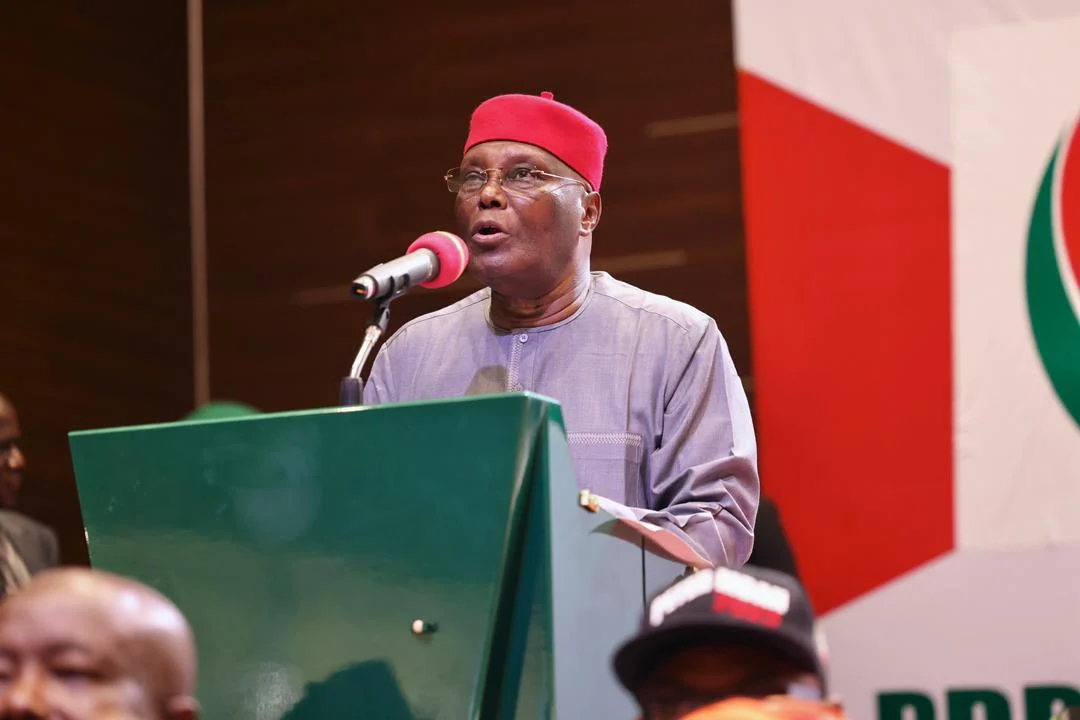
Former Vice-President Atiku Abubakar has launched a strong criticism of President Bola Tinubu’s administration, accusing it of economic mismanagement, worsening insecurity and what he described as an erosion of democratic governance.
In a New Year message released on Thursday, Atiku said 2025 ranked among the most “punishing” years in Nigeria’s recent history. The former vice-president and 2023 presidential candidate of the Peoples Democratic Party (PDP) blamed the hardship experienced by Nigerians on what he termed incompetent leadership and governance lacking empathy under the All Progressives Congress (APC)-led Federal Government.
According to Atiku, the country endured what he described as “economic suffocation, political recklessness and policy bankruptcy”. He alleged that the Tinubu administration operated for several months without a functional budget, relying instead on propaganda and excessive borrowing to sustain government activities.
He pointed to the controversy surrounding a disputed tax law as emblematic of what he called the decay within the current administration. “A government that begins reform with forgery cannot end with prosperity,” Atiku stated, without elaborating further on the allegation.
The former vice-president also accused the ruling party of deliberately weakening Nigeria’s democratic institutions. He claimed there were ongoing attempts to intimidate opposition figures and consolidate power in a way that could turn Nigeria into a de facto one-party state.
On security, Atiku said the situation deteriorated significantly in 2025, with kidnappings, abductions and violent crimes spreading across various parts of the country. He added that rising unemployment, labour unrest and the collapse of small businesses further deepened the hardship faced by ordinary Nigerians.
“Despite these failures, compounded by the appointment of undistinguished and unfit individuals to represent Nigeria abroad, the country survived not because of government competence, but because of the resilience of its people,” he said.
Describing calls for citizens to make sacrifices as “cruel”, Atiku argued that leaders who continue to live in comfort while the masses suffer lack the moral authority to demand patience. “Leadership without shared pain is not leadership; it is exploitation,” he added.
He also criticised what he described as selective enforcement of anti-corruption laws, accusing the government of weaponising institutions such as the Economic and Financial Crimes Commission against political opponents while shielding allies. According to him, such practices undermine justice and public trust in state institutions.
Atiku warned that any government capable of manipulating laws could not be trusted to conduct free and fair elections in 2027. He therefore urged Nigerians to begin organising, mobilising and preparing to vote and defend their votes.
“Let us vote out hunger, insecurity, unemployment, dishonesty, corruption and propaganda,” he said, adding that Nigeria and its citizens deserve dignity and better leadership.
He concluded by describing 2026 as a year for preparation and 2027 as a year of reckoning, calling on Nigerians to unite and reclaim the country’s future.

