


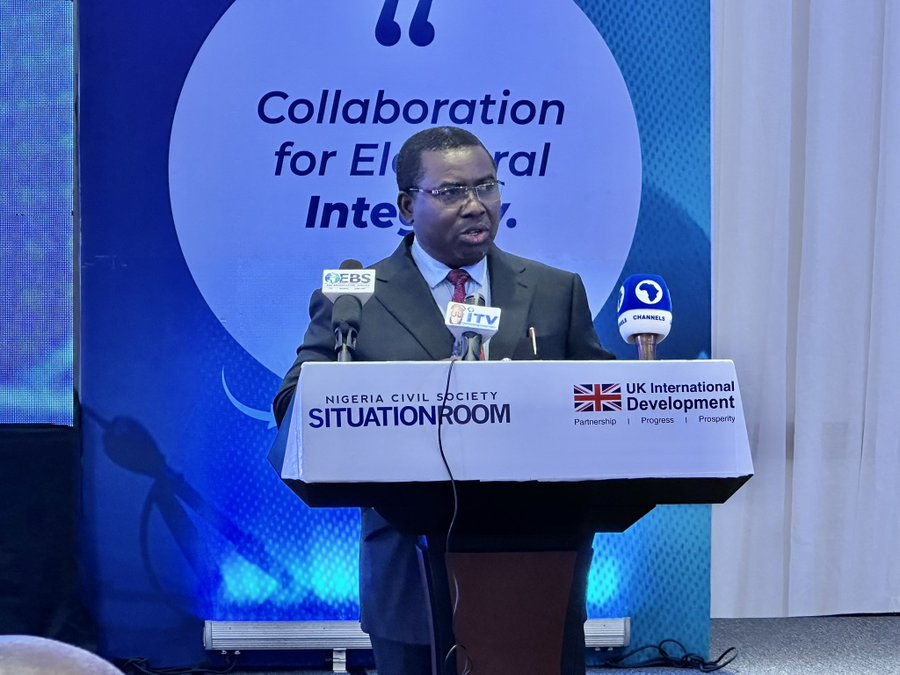
The Chairman of the Independent National Electoral Commission (INEC), Joash Amupitan, has called for deeper national consensus, enhanced collaboration, and sustained civic engagement among all stakeholders to protect Nigeria’s democracy.
Amupitan made the remarks today at the Nigeria Civil Society Situation Room’s 9th annual National Stakeholders’ Forum on Elections, held at the Sheraton Hotel, Abuja, under the theme: “Securing Nigeria’s Democracy: Building Consensus for Credible Elections and Accountable Governance.”
Describing the forum as a vital platform for meaningful dialogue, he warned that Nigeria’s democracy remains under constant threat from misinformation, electoral malpractice, and violence.
READ ALSO: INEC Chairman Joash Amupitan pledges credible, transparent elections
He stressed that securing the democratic system requires a multi-sectoral approach.
According to Amupitan, credible elections are the foundation of democracy and can only be achieved when political parties, the media, security agencies, civil society, and INEC collectively uphold electoral rules and principles.
Accountable governance, he added, naturally follows credible elections, enabling citizens to hold leaders to higher standards.
Highlighting INEC’s ongoing use of technology under the Electoral Act 2022, he cited the Bimodal Voter Accreditation System (BVAS) as a key innovation redefining voter accreditation, while the INEC Result Viewing (IReV) portal sets a new benchmark for public trust.
However, he acknowledged persistent challenges with telecommunications infrastructure, noting that real-time result uploads across 176,000 polling units remain difficult.
READ ALSO: Tinubu asks Senate to confirm Amupitan as INEC Chairman
INEC is working closely with the Nigerian Communications Commission (NCC) and exploring alternative technologies to address these gaps.
Amupitan also expressed concern over declining voter participation, citing the 27% turnout in the 2023 general elections as a warning sign.
He highlighted the success of targeted mobilisation in Anambra State—where Permanent Voter Card (PVC) collection rose from 63.9% to 98.8%—as proof that improved voter engagement is possible through effective partnerships.
He revealed new national data from the ongoing Continuous Voter Registration (CVR) exercise, noting that INEC had recorded 2,685,725 completed registrations, including 1,576,137 online pre-registrations and 1,109,588 physical captures.
Osun led the states with 208,357 completed registrations, followed by Kano (159,669), Sokoto (152,650), and Imo (145,561), while Lagos and Borno each recorded over 123,000 registrations.
With the first quarter of the CVR concluding on 10 December, Amupitan urged stakeholders to sustain public awareness campaigns until the exercise’s completion.
He announced preparations for the 2026 Area Council Elections in the Federal Capital Territory, scheduled for Saturday, 21 February 2026.
“These elections will mark the end of the current four-year tenure of the six Area Council Chairmen and 62 Councillors elected in February 2022,” he said.
He reaffirmed INEC’s collaboration with security agencies through the Inter-Agency Consultative Committee on Election Security (ICCES) to combat vote-buying and voter intimidation.
Amupitan also emphasised civil society’s critical role in monitoring compliance, promoting voter education, and holding political actors accountable.
Amupitan stressed that building credible elections is an ongoing commitment requiring innovation, transparency, and resilience.
READ ALSO: Tinubu swears in Amupitan as INEC chairman
He outlined the Commission’s plans to mitigate connectivity issues, simplify user interfaces, and strengthen digital and security infrastructure, urging that democratic leadership must prioritise the long-term national interest.
Quoting leadership expert Simon Sinek, he said: “Leadership is not about the next election; it’s about the next generation.”

