


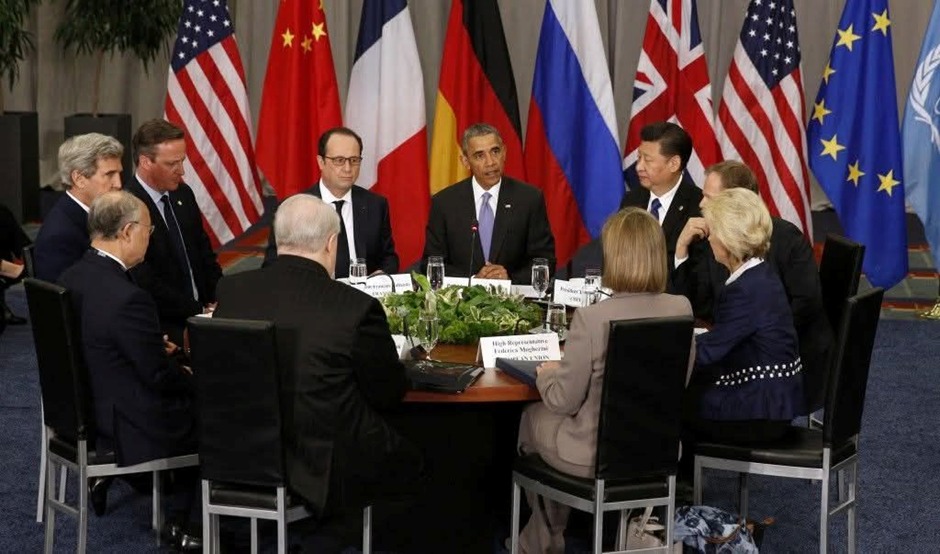
When Donald Trump insists that Iran must “come to the table” and strike a deal, there is an inconvenient historical detail that often gets ignored: Iran already did exactly that. In 2015, Tehran reached an agreement with the United States under Barack Obama. That agreement was broadly supported by the international community but later abandoned by Washington.
The accord, formally known as the Joint Comprehensive Plan of Action (JCPOA), was negotiated between Iran and a coalition of global powers, including the United States, the United Kingdom, France, Germany, Russia, and China. Its purpose was clear: to prevent Iran from developing a nuclear weapon while opening a pathway for the country to re-enter the global diplomatic and economic system.
Rather than relying on vague assurances, the JCPOA imposed detailed technical restrictions on Iran’s nuclear activities. These measures were designed to extend Iran’s “breakout time”—the period required to produce enough fissile material for a nuclear weapon—to at least twelve months.
Read related news from New Daily Prime:
America’s secret plan to invade Canada
America furious as UK refuses to ban first-cousin marriage
American rapper DDG says streaming pays more than music
To enforce compliance, the agreement granted the International Atomic Energy Agency extensive inspection powers. Inspectors were permitted to continuously monitor declared nuclear facilities. Through a formal dispute resolution process, they could also gain access to suspected undeclared sites when concerns arose.
In exchange, Iran was offered significant sanctions relief. This included the release of billions of dollars in Iranian assets that had been frozen overseas, along with renewed access to international trade and financial systems.
The deal was not without flaws. It depended heavily on verification mechanisms and a degree of mutual trust. Still, the prevailing view among nuclear experts was that, even if the agreement strengthened Iran economically, it would make any covert attempt to build a nuclear weapon extremely difficult and highly likely to be detected early.
Above all, the JCPOA was an exercise in serious diplomacy. It was a carefully constructed effort by a U.S. president willing to engage longstanding adversaries, driven by the belief that negotiation and compromise could reduce the risk of war and promote global stability.
So why did it collapse?
From the outset, conservative media outlets in the United States—most notably Fox News—attacked the agreement relentlessly. They promoted the false narrative that Obama had handed Iran billions of dollars, when in reality the funds released belonged to Iran and had been frozen under previous sanctions.
Israeli Prime Minister Benjamin Netanyahu was among the deal’s most vocal critics. He publicly denounced it as a “historic mistake” and took the extraordinary step of addressing the U.S. Congress, without the approval of the sitting president, to urge Republican lawmakers to oppose the agreement.
In 2018, President Trump formally withdrew the United States from the JCPOA, dismissing it as “the worst deal ever made.”
The remaining signatories, particularly European nations along with China and Russia, attempted to preserve the agreement without U.S. participation. Trump, however, went beyond withdrawal. He reinstated sweeping sanctions on Iran and imposed additional penalties, undermining any chance the deal had of functioning as intended.
For a time, Iran continued to comply with its commitments. After roughly a year with no meaningful economic relief, Tehran began gradually stepping away from the agreement and resumed nuclear activities that had been suspended under the JCPOA.
The domestic political consequences in Iran were profound. President Hassan Rouhani, a relative moderate, had tied his political credibility to engagement with the West. He presented the agreement as an alternative to permanent hostility and appeared to genuinely believe that a new relationship with the United States was possible.
Trump’s decision sent a starkly different message. To many Iranians, it demonstrated that agreements with the United States could be discarded by the next administration. In the following election, voters turned to Ebrahim Raisi, a hardline cleric with a strongly anti-Western stance, fuelled by anger and disillusionment over what was widely viewed as American bad faith.
Under Raisi, Iran adopted a far more confrontational posture. Support for regional proxy groups expanded, hostility toward the West intensified, and Iran’s nuclear programme accelerated.
Some of the instability now gripping the Middle East, including conflicts involving Israel, Yemen, Lebanon, and even Sudan, can be traced in part to the decision to abandon the JCPOA. What could have been a path toward gradual de-escalation instead gave way to renewed volatility, driven by a unilateral U.S. withdrawal that appeared motivated more by politics than long-term strategy.
There was a moment when Iran might have been brought in from isolation and encouraged to act as a stabilising regional force. Instead, it now supplies drones used in attacks on Ukrainian cities, wages proxy conflicts through Hezbollah, Hamas, and the Houthis, and is directly engaged in war with Israel.
This leaves an unavoidable question: after watching a painstakingly negotiated agreement dismantled by a change of presidents, why would Iran, or any other nation, trust that a future deal with the United States would be honoured?

