


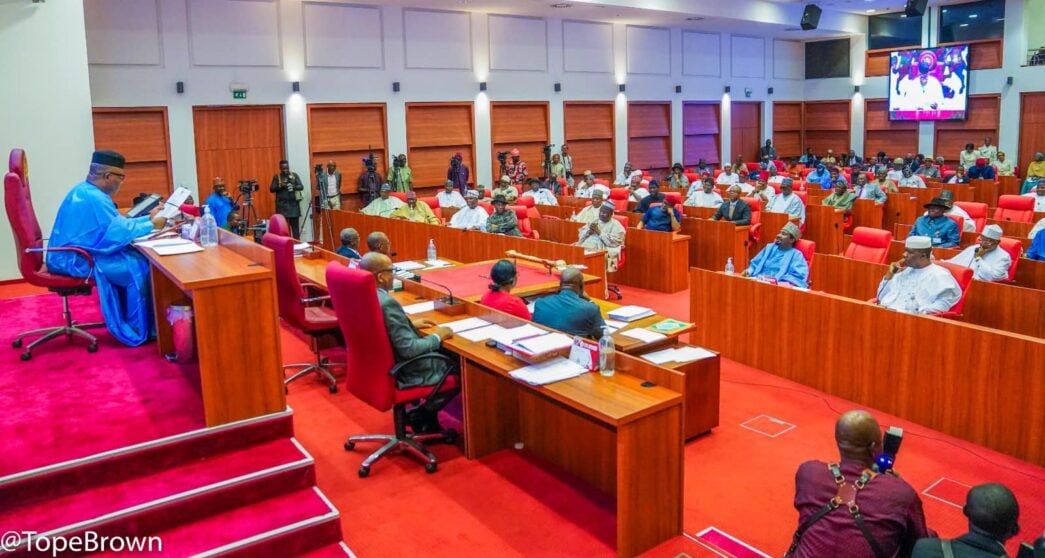
Nigeria’s National Assembly has approved President Bola Ahmed Tinubu’s request to secure fresh external loans totalling $6 billion, in a move aimed at addressing fiscal shortfalls and financing critical infrastructure projects.
The approval was granted by both chambers—the Senate and the House of Representatives—following the consideration of reports presented by Aliyu Wamakko, Chairman of the Senate Committee on Local and Foreign Debts, and Abubakar Nalaraba, his counterpart in the House.
The decision came shortly after the President formally wrote to the Senate, seeking legislative backing for the borrowing plan. The request was read during plenary by Senate President Godswill Akpabio.
In his correspondence, Tinubu requested approval to obtain a $5 billion facility from First Abu Dhabi Bank. The loan, structured as a total return swap derivative financing programme, is expected to be disbursed in tranches.
According to the President, the funds will be used to support budget implementation, finance priority infrastructure projects and refinance more expensive domestic and external debt. He added that the facility would also provide liquidity to meet urgent financial obligations.
Tinubu disclosed that Nigeria’s total public debt stood at approximately $110.3 billion, equivalent to N159.2 trillion, as of December 31, 2025.
In a separate request, the President sought approval for an additional $1 billion loan arranged by Citibank through its London branch, backed by UK export finance. The facility is intended to fund the rehabilitation of key port infrastructure, including the Lagos Port Complex and Tin Can Island Port.
The government described the port rehabilitation as a strategic modernisation effort aimed at addressing long-standing operational challenges and restoring critical infrastructure that has suffered significant engineering deterioration.
Following the presentation of the requests, Akpabio referred the proposals to the relevant Senate committee for expedited review, a process that culminated in their swift approval. Similarly, the House of Representatives referred the requests to its Committee on Aids, Loans and Debt Management before adopting the recommendations.
Lawmakers endorsed provisions allowing the loans to be drawn in phases, with safeguards such as collateralisation through naira-denominated Federal Government securities. The arrangement also includes provisions for margin payments in the event of fluctuations in market value or exchange rates.
The approval underscores the Federal Government’s continued reliance on a mix of domestic and external borrowing to finance budget deficits and drive economic development. Analysts note that while the loans may ease short-term fiscal pressures, they also add to Nigeria’s growing debt burden.

